This review page is supported in part by the sponsors whose ad banners are displayed below |
 |
 |
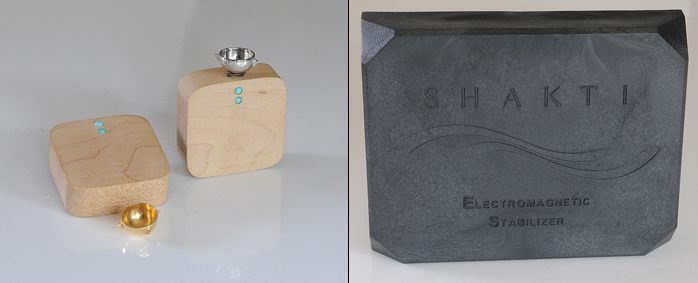
All three of its circuits are stacked together and held in place with tape before the assembly is cast air and watertight into polyurethane. Voilà, a Stone ready for use. Shakti recommends that the Stone be placed as close as possible on top of or beneath the device you suspect of being an EM polluter. In practice this means that a Stone will end up on a CD player or DAC to dissipate HF radiation; or an amplifier to address the power transformer’s radiating field. In case of a class D amplifier a Stone covers all EM sources.
Mr. Piazza also sent us a double pair of On-Lines. On-Lines are miniature Stones designed to affix to cable via Velcro or bluetack. On-Lines can also slip inside a DAC or other device and attach directly to a chip or other offending part as long as thermal precautions are taken. Coincidence or not, Shakti too paid for professional lab tests in the automotive arena where a performance car was equipped with On-Lines to shield the cars’ electronics from EMI. The results was a gain of horsepower – admittedly a mere 1 percent but with race cars that can be the difference between winning and losing.
|
|
|
We couldn’t measure the effects of the Stones and On-Lines in our hifi but certainly we could hear them. With its broadband coverage, the Shakti effect was very easy to notice. Just put a Stone on top of the DAC and the whole musical landscape gets cleared from residual mist. The sun breaks through as it were and details previously masked emerge. This was with the ASI resonators still in place but the Blackbodies removed. Removing the Stone always telegraphed by subtraction to an even larger extent but returning the Blackbody near the DAC also returned the sun. The difference in sound, clarity and grain with Stone or Blackbody on the DAC was not big. A rather bigger difference is how to operate both devices. Putting the Stone to work is as simple as putting one on the DAC. Getting the most out of the Blackbody needs more experimenting. According to LessLoss the Blackbody is effective like a focused beam of light or a cone that must be properly aimed at the EM emitter. In practice this involves some trial and error. Placing a Blackbody flat on top of a component does create results too but the substantial addition of weight of course also alters the enclosure’s resonant behavior.
Placed freestanding behind the DAC at an angle pointing towards the location of its internal chips proved to be the best solution.
|
 |
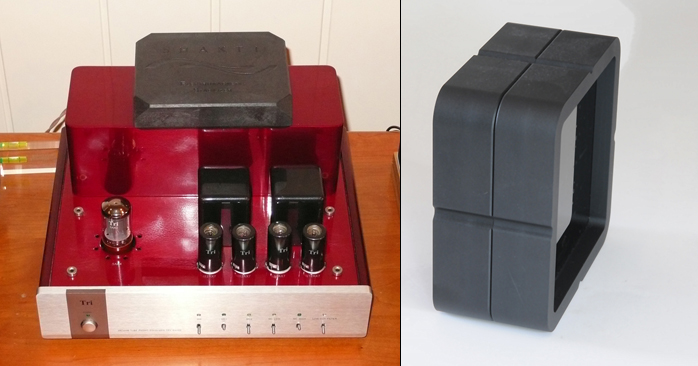
As with many things in audio, more can be more and the Stones were no exception. Ben Piazza sent us four Stones and four On-Lines. One Stone each ended up on our transport, DAC and phono stage. Number four was happiest on the Meishu tube integrated over the bank of its transformers and carefully out of harm’s way of the hot power tubes. The On-Lines performed well in our television corner where two were blue-tacked to the flat screen’s bottom and two to the digital decoder. Do we even need to mention that the image cleared up just as did the sound?
|
|
|
At this point we had to add things up. Even though they attenuate EMI very well when used at close range to a radiating source, the acoustic resonators’ main feature is as acoustic influences where the other two contenders don’t operate at all. Between Shakti Stone and Blackbody, the former wins hands down on ease of use, versatility and price. When distance vs. proximity is taken into consideration, the Blackbody pulls ahead. In our setup ultimate effectiveness came by way of four Stones placed as mentioned above with one Blackbody sitting on each subwoofer cabinet of the Avantgarde Duo speakers facing the other. Recall that the effective coverage area of the Blackbody is like a light cone emerging from its center so two opposing cones form a sort of cloud or field above the audio gear between them. The combination of Shakti Stones focusing on the components they sat on and the LessLoss Blackbody covering a more general area from a greater distance rendered the most benefits in audible clarity without getting sterile or hyper detail. Most significant to us was that the volume could be turned down quite a bit more. Less innate system noise requires less power to overcome it.
|
|
In hindsight it is quite shocking to fully appreciate how most if not all of our audio gear can be enhanced by addressing (minimizing or eliminating) its EMI radiation. We wonder if designers ever think about the pollution their creations cause and what the effects thereof will be on the component itself, the other components it will interact with and the customer. All three passive devices in today’s survey demonstrated to us that absorption or attenuation of electromagnetic interference is achievable by aftermarket products and very efficacious and desirable. So the real question is, why isn’t this addressed by the primary makers of our audio gear?
|
|
|
 |
|
 |
 |
