|
"Every loudspeaker is a compromise. The ideal loudspeaker exists only as a myth. Usually, people overestimate the importance of the loudspeaker. As a loudspeaker maker, it would be more advantageous to claim that the speaker was the most important part of the audio reproduction chain. However, I think of it as the least important - garbage in, garbage out as Ivor Tiefenbrun so cleverly stated many decades ago.
Crossovers -- although one of the biggest offenders against accurate and natural music reproduction -- are not the only reason why I think full range speakers offer the most acceptable compromise. I don't see proper driver integration, and not only at the roll-off frequencies. The various sonic characters of dissimilar drivers contribute to artificial impressions and a loss of the whole spectrum's cohesiveness. It's as though you took a guitar and fitted strings from different manufacturers, or mixed nylon and metal.
Without a doubt, one could properly tune this guitar. Even so, you'd easily notice something amiss. The fact that most people don't know or simply don't care enough about the actual timbre of particular instruments creates nonchalance in these design aspects. Most audiophiles tend to concentrate on how they want things to sound rather than how they should sound.

Full-range drivers have advantages over multi-driver designs because they don't suffer crossover-induced time domain smears. Their distortion figures are lower and their impedance stability better. They are closest to the idealized single point source with its coherence over the entire frequency range. However, this coherence should not come at the cost of linear frequency response.
You might now conclude that everything about full-range drivers was peaches and crème. (Actually, Sead said milk and honey.) Not so. Full-range transducers suffer their own severe problems. However, most of these can be overcome by clever cabinet design.
The biggest problems of course are the frequency extremes. Having lived for 20 years with speakers that had flat 20Hz-20kHz response, I've realized that in an average European living environment, the bottom octave actually causes more problems with standing waves than it benefits the musical experience. (Due to building material and room size specifics, this statement points at the European kind of construction Sead is most familiar with.)
The bottom octave does add the foundation to the presentation. Still, integration problems in average rooms do more harm than good. Hence, extension to a healthy 50Hz seemed fairly sufficient.
When I began my design work on the Essence, the goal was to reach 60Hz. The actual 35Hz I eventually arrived at caught me as much by surprise as those people who now search for the subwoofers. They can't understand how such a tiny enclosure and small driver could play this low.
Get high or be high
On the other end of the frequency spectrum, we're faced with the proposed problem of early high frequency roll-off. This issue is much more complex but -- to go against the common knowledge that equates high frequency extension with accuracy, the recreation of fast transient response and good spatial and presence characteristics -- it is far more important to achieve a fast and clean HF waterfall response than to reach for a few more hundred Hertz.
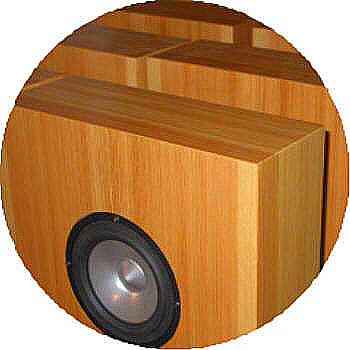
I know this is an unpopular stance, but to borrow one of Junji's favourite replies, I simply don't care. The Essence has very good HF extension. I have never felt the need for a super tweeter. In fact, using a super tweeter would do more harm than good.
To loathe that Lowther or love it
I spent a long time selecting the right driver. Many options were considered, each having its own advantages and failings.
The Lowther is a beautiful driver and almost synonymous with the concept of the full-range driver. Still, it has severe extension limitations and is also rather tricky to implement. In front-loaded horns, it creates an immense, bigger-than-life presentation, not to mention a very narrow sweet spot.
I listen to and enjoy music even as I'm typing these words. With a narrow sweet-spot speaker, that's simply impossible. And back-loaded horns with Lowthers cause very bulky cabinets. I've heard only a few that sounded good.
The Jordan driver has better overall extension, better speed, and much higher temperature and humidity stability. The Lowther does have an obvious efficiency advantage, which is usually overrated and accompanied by impedance dips in certain frequencies. Not only do I prefer the lower efficiency and more stable impedance of the Jordan, I designed my speaker to work with 47Labs electronics, not 2-3wpc micro-power amps that ultimately would call for 100+ dB efficient speakers.
Of course, there are many other competent full-range drivers but my heart and soul fixated on the Jordan. I was disenchanted with the temperature and humidity instability of common materials used in other HighEnd units. I wanted to ensure consistent performance over a wide temperature and humidity range. Also, I needed a small driver for better accuracy and speed and to compensate for the lack of a tweeter. Ultimate bass extension was never a big decisive factor. This could be compensated for with good cabinet design.
But the final design of the Essence is strictly a product of real world requirements. It had to work within our environment. While you could say that the Essence was designed with a pre-calculated high WAF, that's true only to the extent of finding acceptance with my wife."
|