 |
|||||||||||||||
| Talon Audio got so jazzed by the lessons learned during the Firebird development phase that they've spun off two new products, the stand-mounted Hawk ($8,000/pr, $9,000/pr w. stands) and the statement subwoofer Thunderbolt ($10,000 ea.). Like Kharma, Lumenwhite and Marten Design, Talon has embraced the ceramic Accuton driver technology which, in 1" and 7" versions, appears in the 18.5" high by 13.75" wide by 11" deep reference monitor. Incorporating the Talon Prescriptive Loading Technique (TPLT) pioneered in the Firebird's labyrinth bass system, 2nd and 3rd-order THD levels are claimed to have been reduced by over 20% while power handling has improved significantly. With published frequency response of 35Hz-40kHz, 8/6.5-ohm nominal/minimum impedance, 89dB efficiency and max power handling of 400 watts, the floor-coupled Hawk atop its custom stand is said to be bass-adequate for rooms <16' x 18'. |
|||||||||||||||
 |
|||||||||||||||
 |
|||||||||||||||
The new Thunderbolt employs a 13-inch version of the Firebird's 11" Audiom woofer inside an inert cabinet whose side panels hide 1/2-inch dove-tailed aluminum panels for increased rigidity and energy dissipation. An outboard 3000-watt Crown CTS3000 amplifier with sophisticated DSP provisions allows control over crossover point and slope, parametric EQ and polarity. Contemplating both units side-by-side, I couldn't help notice that, essentially, they're both halves of the Firebird sold separately. It makes them the perfect multi-channel compliment or a viable, more room-adaptive sat/sub music combination whose performance should equal or exceed that of the Firebird. For smaller rooms, the Hawk by itself will actually outperform the Firebird whose bass prowess would overwhelm such spaces. |
|||||||||||||||
 |
 |
||||||||||||||
| Canadian Tetra Speakers displayed both their Live ($6,800/pr limited Edition) and Kid ($2,450/pr) models, the latter a particularly impressive price/performance buster proudly sporting the wildly popular while usually MIA in affordable designs Seas Excel Tweeter and 4.5" Excel magnesium woofer. With the grooviest business card I'd seen in a while (it sez it all, don't it?), designer Adrian Butts' last name might have been the cruel target of kiddie jokes in school but his Kid speaker was anything but a joke and would have shut up any and all such juvenile offenders in a heart beat. Sparklingly clear, perfectly full-range into the lower 40s even without the optional display sub, this was a perfect less-is-more example where room, speaker size and expense were optimally matched to demonstrate real-world HiFi at its best. Yo Adrian - bravo! |
|||||||||||||||
 |
|||||||||||||||
| Once again, Grand Prix Audio Monaco stands were in evidence, reminding us that resonance control properly engineered is far more important than previously believed. It's something personal experience and ownership has since validated to an extent that surprised even this relative veteran of the audiophile hype jungle. |
|||||||||||||||
 |
 |
||||||||||||||
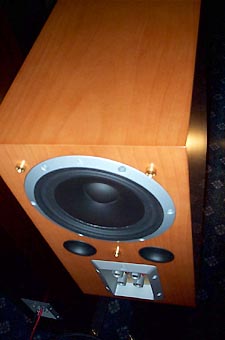 |
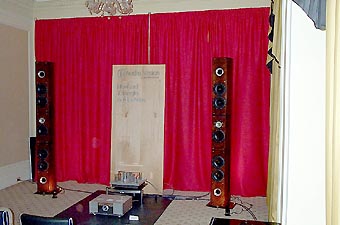
Sam Tellig has become ev'ryone's favorite whipping boy for bestowing an inordinate amount of attention on Musical Fidelity and Triangle products. I'm with you thinking that things seemingly have gotten out of whack in that department. But you know what? Where Triangle is concerned (never had MF in-house to form an opinion), the man's right. Triangle is my favorite affordable speaker range, too. There, now you can throw stones on me as well and hone your target practice. That said, I was thrilled to see that Triangle's mighty Magellan -- already covered extensively in our CES 2003 report -- caused downscaled waves in the engineering department to spawn the new Stratos range. It incorporates a Magellan-derivative horn-loaded tweeter, new midranges and the S-surround woofer architecture of the $35,000 flagship, as well as rear-firing tweeter or tweeter/mid arrays again borrowed from the Magellan. Here's a quick breakdown: Solis ($2,395/pr 3-way bookshelf, pictured upper and lower left); Naia ($2,995/pr 4-driver 3-way tower); Luna ($3,995/pr 5-driver 3-way tower, pictured upper left); Australe ($4,995 6-driver 3-way tower); Volante ($6,595/ pr 7-driver 3-way floorstander); Barea ($1,295/pr 2-way rears); Leo Minor ($1095 3-driver 2-way center); and Leo Major ($1695 4-driver 3-way center). All Stratos models are available in Amber Beech and Mahogany real-wood veneers, sport the Magellan floor-coupling scheme and incorporate a new, much nicer terminal plate assembly than the older 222 Series. |
||||||||||||||
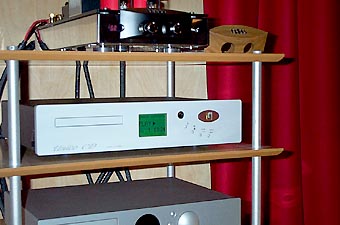
| US/Canadian distributor VMax-Services showed with his other brands Cairn, Pathos and Unison Research but was quick to confess that these new display Triangles had been rush-shipped from France and weren't quite hatched yet - neither broken in nor 100% final. Rather than listening, I thus took notes on the new entries and asked about the Unison CDP whose release had been delayed due to software rewrites to speed up slow TOC access of the CD/ROM transport. At $1,995, this triode-powered CD player is now in full production with 24/192 upsampler card and one player I'm excessively curious about, given the massive home-run the Italian team scored with the Unico Integrated that became our Component of the Year 2002. |
 |
||||||||||||||
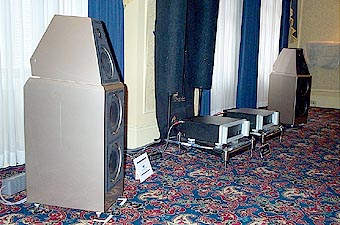
BayArea dealer Music Lovers held court on the 12th floor with Wilson Audio Specialties and Spectral gear. Spaced 20-feet apart and thus optimized for a narrow sweet spot, the Watt/Puppy Sevens locked into focus like a high-power laser beam to create some of the best center fill money can buy. While I personally crave the kind of spaciousness and silk as epitomized by Jonathan Tinn's big Kharma/Tenor exhibit, I can also admit that if focus and precision were your poison, this was a system that had your name written all over it. Once again -- dare I say it without collecting sponsorship dollars? -- Grand Prix Audio supplied equipment supports. Which brings us to our last entry and award: XHifi. |
|||||||||||||||
 |
|||||||||||||||
 |
|||||||||||||||
 |
|||||||||||||||
| It took all of 30 seconds for ye olde Jones to rise and lust after this miniature rig with ridiculous cravings utterly out of proportion to its actual dwarf size. | |||||||||||||||
 |
|||||||||||||||
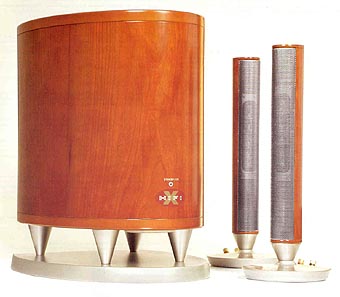
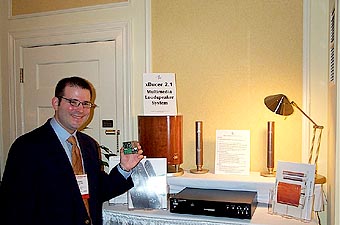
| I'm all radio-active with desire. Why? Grab a copy of the Take 6 album So Cool and listen to the lyrics of the title song. That says it all. Based on JVC's Direct Drive Stick design, the xDucer 2.1 Multimedia Loudspeaker System ($695 direct) benefits from Howard Schilling's Camelot Technologies design work, in the form of the Model 50 digital amplifier module (shown upper right by the man himself). It powers the track dome drivers of the broad-dispersion satellites from 230Hz on up to 50kHz. Below that, the 6.6" high-excursion paper dome woofer in the gloss-Cherry finished subwoofer takes over with 50 watts of on-board, custom Class B high-current juice. | |||||||||||||||
 |
|||||||||||||||
Hooked up to an Apple IPod in one of the table-top display, this system rocked and wasn't at all betrayed by splashy highs, one-note boom-boom, hand-over drop-out or cupped-hands vocal colorations. The high xover point of the sticks certainly mandates placing the woofer on the same plane rather than outa sight/outa mind. But - the resultant cloud of sound hovered like a torrid mirage over these combatants whose detail work, fit'n'finish and audiophile accoutrements (real gold-plated 5-way binding posts, tip-toe woofer footers) whispered CEO board room rather than Circuit City one-day-only special. I want this micro rig - badly. End of story. Well, of this but not the report's. Flip one last virtual page for our swan song and fat-lady concluding solo. |
|||||||||||||||
 |
 |
||||||||||||||
 |
|||||||||||||||