 |
||||||||||
|
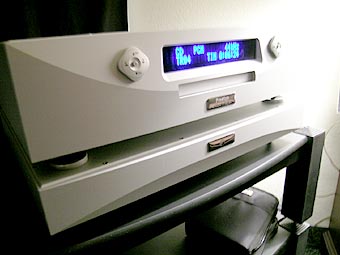
Audio Aero showed the Prestige SACD player/preamp [$13,360, right] driving the Capitole amplifiers at $8,695 ea. into the Wilson Benesch Curve [$8,200/pr] speakers which our own Phil Gold, proud owner of this firm's older model, eyed most keenly. Canadian customs willing, he should get his hands on a pair during 2004 to report on how they compare to his own. Alas, your scribe got distracted by John Barker and his father from Southern Cali's Sonic Culture, an excellent establishment for those into sophisticated audio, and hence forgot to take pictures of the remainder of this system. Hey, equipment is all nice and dandy, but it's the people behind it that make the real difference. Las Vegas is the one time a year when you're bound to run into old friends and make new ones. Which, to be frank, makes it hard at times to concentrate on the gear-driven task at hand. How's that for a lame excuse? |
||||||||||
 |
||||||||||
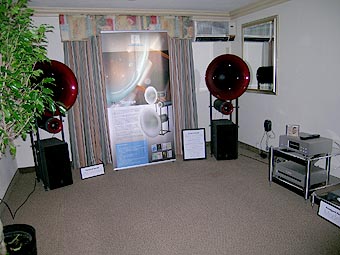
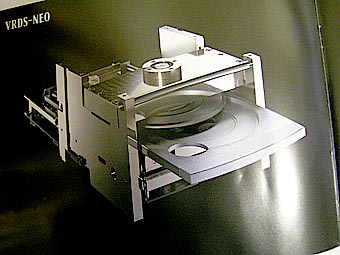
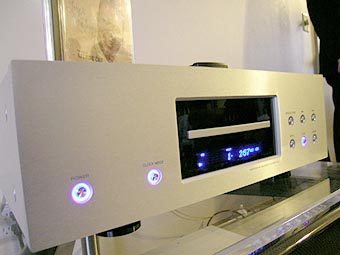
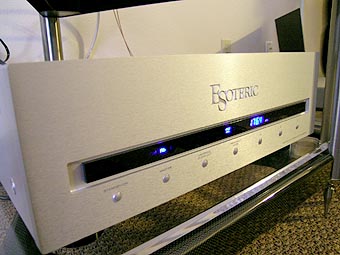
| Avantgarde Acoustic meanwhile made no excuses and offered showgoers two distinct flavors on their Duo hornspeakers, one Germanic, one Americain. Holger Fromme and Matthias Ruff spent the long green on their source component, TEAC/Esoteric's massive 2-box player that's exclusive to Japan at the moment but expected to appear in Germany shortly and implements the firm's latest VRDS Neo transport [Keanu's penetrating HighEnd] while dedicating an entire chassis to reclocking functionality. The Avantgarde integrated amplifier [$3,970] and some generic cable completed the setup. |
||||||||||
 |
 |
|||||||||
 |
||||||||||
 |
||||||||||
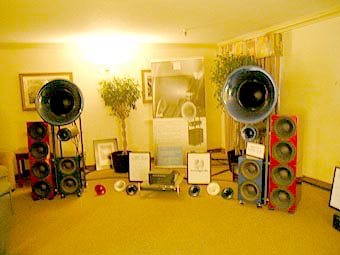
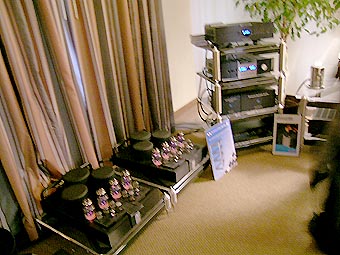
Next door, Avantgarde-USA's Jim Smith added two active woofer modules per channel to transform his speakers into Super Duos but then ran his rig with a more modest front-end and massive amplification instead, all electronics compliments of Balanced Audio Technology, power line conditioning by Running Springs Audio, component support by Grand Prix Audio and crafty dj'ing by RSA's Lenny Mayeux whose world music proclivities mirror my own. Expect an exploration of the Blues by history, musician and album from Lenny on 6moons later this year, to introduce those less familiar with this genre [yours truly raising both of his hands] to the important personages, their contributions and albums, and how the diverse inventors morphed and developed the overall style and musical syntax of the Blues. |
||||||||||
 |
 |
|||||||||
 |
 |
|||||||||
The German Avantgarde room had significantly more resolution, speed and dynamics, the American variant more warmth, spatiality and density - all this by way of demonstrating, by design or consequence, that these hornspeakers are unusually responsive to personality tweaking. Which, naturally, also includes the very real possibility of screwing things up, mandating more so than with other products that a prospective buyer interface with a bona fide dealer who doubles as setup expert and psychoanalyst - er, personality calibrator. I forgot to confirm this with the folks from Avantgarde, but the German room's lively yet sophisticated presentation suggested that some work had been done to their affordable integrated. It didn't sound remotely as suave last year. This has me suspect that the restless Matthias has given it the silent once-over since. Make no mistake, as out-of-place as this affordable preamp/amp might have appeared flanked by $15K of digital SOTA wizardry on one end and $18,970 of speakers on the other, it didn't once telegraph being the weak link. That of course won't prevent deep-pocket folks from overlooking it as unsuitable, but not having turned quite that snobbish yet -- though I'm working on it -- I would really love to review this 'un to hear for myself just how it will deliver on its Las Vegas promise. Perhaps it's just personal wishful thinking, but more and more folks seem to go on record that they've never "gotten" these spherical horns before but finally see the light loud and clear. HE2003 saw such commentary in its wake, and I predict more in the months to come. Hey, I could care less - I've long since been sold. Still, it's nice to see one's personal fancy garner momentum with others. There's nothing quite as thrilling as spreading the audiophile virus, and though how anyone gets their jollies matters far less than that they do, it's still fun to see others groove to the same components as oneself - especially when they're as outrageously different as the Avantgardes. Who says there's nothing in a name? Which brings me to one of three-or-so solid-state exhibits that made perfect sound and merely trailed my report's opening rooms in that ephemeral but very real and tangible "perfect feeling" dimension as our own Jules Coleman so aptly put it. The Ayre/Avalon exhibit gets my nod for coming bloody close though, and needless to say, will never suffer from tube deterioration or outright valve failure while being suitable for far larger venues than low-power SET amps could ever fill without straining - and driving a far larger number of speakers without impedance interface quibbles. |
||||||||||
 |
 |
|||||||||
Put differently, should I tire of tubes one of these days, the Ayre brand would be one I'd take a long and hard look at which, though it might seem an underhanded compliment, is high praise from one as hopelessly befuddled by valves as yours truly. |
||||||||||
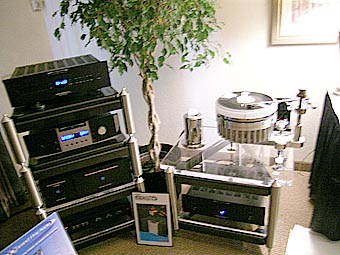
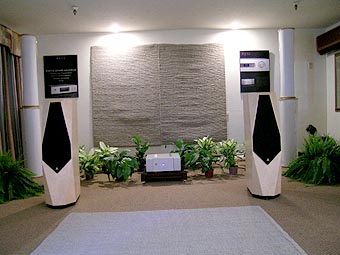
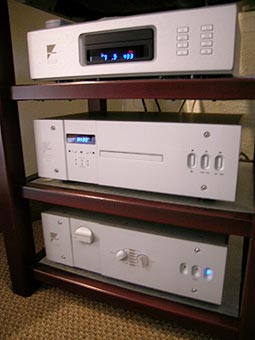
| I also found it telling that more than one room without any expressed Avalon affiliation opted to show with their speakers over any others - Wadia springs to mind, as does Muse and BAT. Call me antiquated, rebellious or just contrary, but I just don't get the Wilson/JMlab fascination. Perhaps I've just never been exposed properly to overcome my diehard hesitation where these brands are concerned. Jules rebutted a young and not very service-oriented waiter at P.F Chang's while we were patiently waiting our turn. "Do you have any reservations?" "No, but if you continue in that vein, I'll soon do." Well, I had no reservations whatsoever in this room which indicates there might be hope for this thermionic fossil after all. The system in this room used the Ayre CX-7 CD player, the K-1x preamplifier, V-1x power amplifier and Eidolon Diamonds. Transistors for tube lovers - that's how I'll remember this exhibit. |
||||||||||
 |
 |
|||||||||
 |
||||||||||
 |
||||||||||
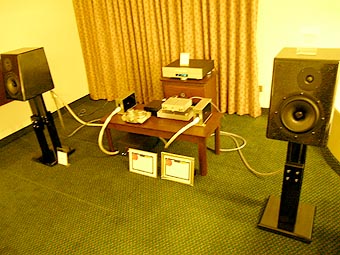
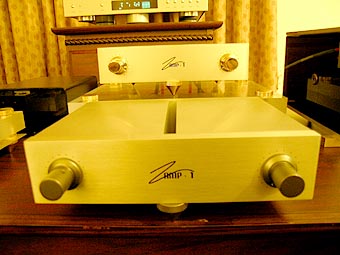
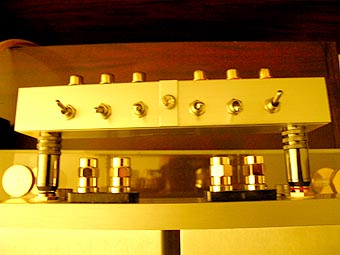
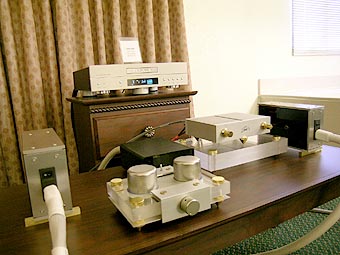
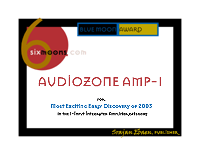
| Canada's Audio Zone wisely picked the Reference 3A Da Capo to show off their miniature op-amp based sand designs which garnered two Blue Moon Awards for, respectively, their AMP-1 [lower right above with new Input Xpander] and the new PRE-T1 and AMP-2 transformer-attenuated passive preamp and monoblocks. Though I should have known better, I was still shocked to see these monos -- which Paul Candy reviewed -- in the flesh and thus realize just how puny they really are. The AMP-1's slightly adjusted cosmetics over my review sample now sport a silk-screened rather than brass-engraved decal, a silk-screened ring of dots around the dual-mono stepped attenuators for visual setting confirmation and a choice of natural aluminum or gold-plated knobs. A new friend from Marseilles [Patrice and his lovely wife Soraya who are the French distributors for the excellent German HMS cables] happened upon this room and told me afterwards that he now understood my enthusiasm for this brand although he laughingly wished that I would use music in my reviews anyone outside the world music fringe brigade has actually heard of before. Hey, that's exactly why I do it - to sneak implied music recommendations into otherwise boring hardware reviews. Which brings up another point someone else posed who heard this room and questioned our awards. |
||||||||||
 |
||||||||||
 |
||||||||||
There's clearly an operational hierarchy in HighEnd audio that, it could be argued, necessitates different classes of awards, something Stereophile as well as The Absolute Sound have addressed with their respective rating/ranking systems. I dislike classes or categories for one reason - by suggestion or implication, they tend to overlook that perfection exists on numerous levels. My favorite visual for that is a scale in balance. Once balance is attained, endless amounts of equal weight may be added which doesn't upset this equilibrium (perfection) but indicates endless states of perfection (higher dimensions or manifestations). That's why 6moons only bestows one kind of award but qualifies the recipients with the attached credits which might read "best affordable xyz"; "top performer in SOTA class" or any variation on this theme to quantify the specific league or level of excellence said component embodies. Is Chris Sommovigo's $100 Stereovox HDXV the best digital interconnect on the planet? I certainly hope not - or everybody charging more than that belongs under investigation. But the HDXV is so good for so little money that not bestowing an award on it would be equally reprehensible as charging $35,000 for a speaker cable. I hope this example clarifies the intention behind our awards, and how we wish them understood. They are not blanket "best there is" endorsements but "best qualified by the byline" examples which deserve special consideration from prospective buyers. |
||||||||||
 |
 |
|||||||||
 |
||||||||||