This review page is supported in part by the sponsors whose ad banners are displayed below |
 |
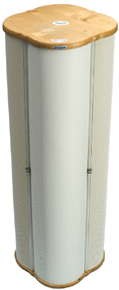
One product quickly emerged from amongst the crowd of classic bass traps and absorber:- the so-called DAAD 4 absorber developed by Italian firm Acustica Applicata. A DAAD is an acoustic correction device for both diffusion and absorption over a wide band extending beyond 20kHz and starting from 50Hz. Smaller models start a bit higher: 80Hz for the DAAD 3, 120Hz for the DAAD 2. The DAAD 4 adopts a shape composed of four embedded cylinders. It is designed to absorb reflections and resonances without loss of energy.
The design takes into account not only the amortization of reflections and resonances but the need to preserve the acoustic energy within a 25-60ms delay diffused over the listening room. A double internal chamber ensures a powerful deep bottom end. Below 50Hz there is no miracle solution and the sheer size required to treat sub bass is incompatible with any notion of aesthetics (and in that case where the correction curve is still manageable through a minimum of additional distortion, it is probably better to opt for active correction). |
|
|
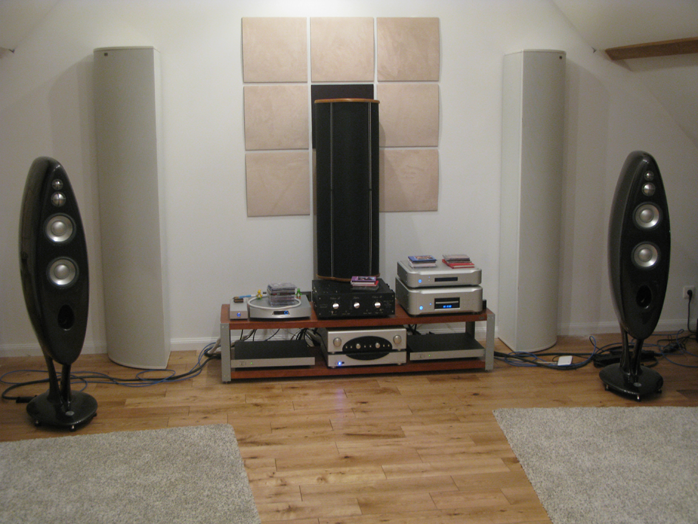 |
These acoustic traps are adjustable with easy placement in the room (they can also be stacked) and by orientation. The DAAD 4 has reversed characteristics front and back. On one side it absorbs, on the other sound waves spread as a diffusor. This is extremely convenient for the treatment of the wall behind the speakers where you may need to spread between the speakers and absorb in the corners or behind them. Through gradual rotation the DAAD allows very fine and precise adjustment between diffusion and absorption. Now you can manage the energy distribution of the soundstage. I consider it amazingly practical and easily detectable by ear, more so than any change in cables.
|
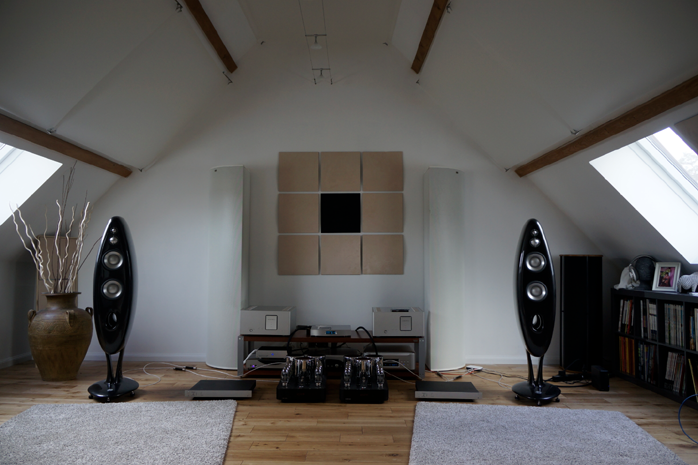 |
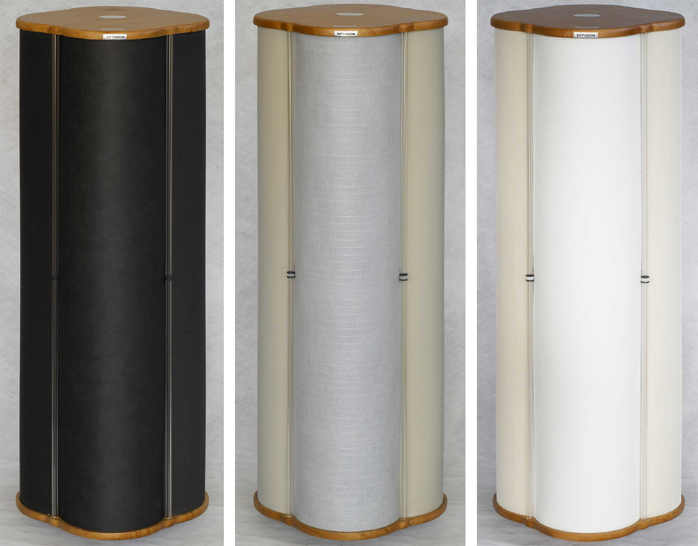
To return to the central topic of this article, a very strong point in favor of the DAAD traps is being available in white or gray. This transcends the traditional black monoliths as models of indiscretion and even less elegance. Another positive point is that they are mobile and can be hidden inside a closet when your stereo is off. During my tests other types of traps like Music Tools products came and went. I thought they offered less flexibility in use and positioning and were a little less discreet.
|
 |
|
|
|
The sonic results. First it is very nice now to be in a quiet room isolated from outside noise, with ga ood level of absorption but still slightly reverberant to preserve lifelike listening conditions. The quest for natural sound required both measurements and empirical methods. It was a rather long process of subjective imperfection because my understanding is that no listening condition can claim to be perfect. In this quest for sonic realism, aesthetics play a significant role. All intrusive treatments tend to limit our ability for abstraction and interfere with our mental process to recreate a virtual reality. If your eyes remain distracted by unusual prominent shapes, it is more difficult to rebuild this mental image into a concert hall or musical event. Unduly large speakers challenge me the same like my present Magnepan 20.7 loaners.
|
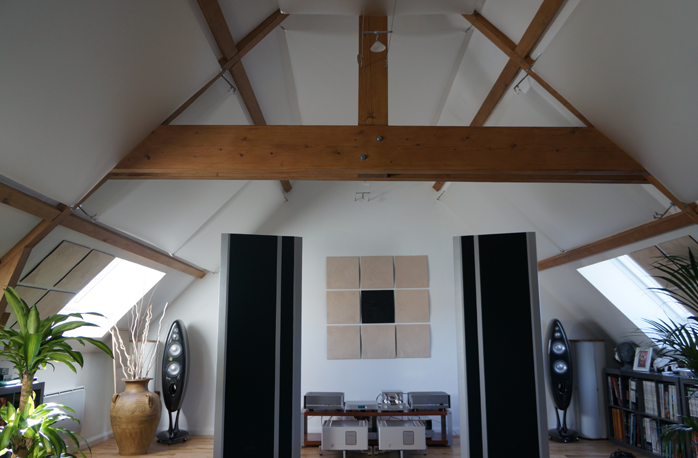 |
As this article mostly focused on the compromise between aesthetics and acoustics, it seemed useless to publish too much data and measurements which would require extrapolation and depend on the accuracy of the measurement protocol. Our last modifications also haven't been measured yet though they already give me great satisfaction. I'll just mention that the RT60 reverberation time was reduced by almost 50% and now stands at circa 0.3. Considering the geometry of my room, I consider the results fully satisfactory and am able to play loud without any particular fatigue or harshness. The room's signature in the midrange is very flat whilst the treble becomes absorptive above 18kHz which doesn't fully match my final subjective impressions. Bass response is stunningly good above 20Hz with no pronounced issues. I soon will be able to play with Trinnov's latest room optimizer to conduct a new slew of measurements (stay tuned).
|
|
|
|
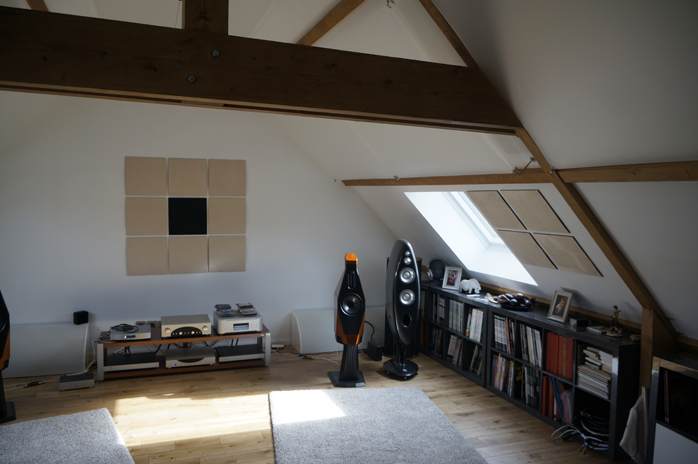
This personal project was my proof of concept that anyone who so desires can significantly improve their listening room acoustics with a minimum of aesthetic compromise. My solutions may not belong to the world of the usual recording studio but they might find a place in our audiophile living rooms. This is the end of my story. According to taste everyone must evaluate the aesthetic impact of my final choices. Beyond aesthetics this highlights that the usual acoustic treatments aren't the only avenue to passive room correction; and that cost needn't be excessive. The most expensive part remains bass correction. A single DAAD 4 costs about €640. The overall treatment for my 50m² room was ca. €6'000, i.e. more or less the cost of a good preamplifier or CD player. Summing up I think that all considered, there is no good excuse left to avoid acoustic corrections in your living room if you really want to get the best from your expensive hifi chain. Gents, do talk to your wives.
|
 |
Price examples:
PYT panels: €360 for a set of 8 Accès pieces, €310 for a set of 4 Reference pieces
Microsorber circa €90/m²
DAAD 4: €640
DAAD 3: €538
DAAD 2: €436
|
 |
|
 |
|
|
|
|
 |