 |
|
|
Directionality. The angled triple-pane window arrays of our living room come to a clear point. It marks the front wall's center where the Zu Submission sub lives. I've deliberately aligned our sisal throw rugs and Gabbeh wool carpet with it. That makes symmetrical speaker setup child's play. One simply uses the main mat's edges and seams as markers, no tape measure required. A laser guide then is the final tool to insure perfect path-length equality to the seat. Since we have two seats facing the speakers—after all, our space doubles as living room, not crude man-cave altar to hifi—either chair straddles the center line unless one moves smack in the middle. That makes it dead obvious whether speakers have broad or narrow dispersion. If the right seat only hears the right speaker in faux mono, the operative word is narrow aka very directional. Now one must either move said chair in the middle; or begin to toe in the speakers.
|
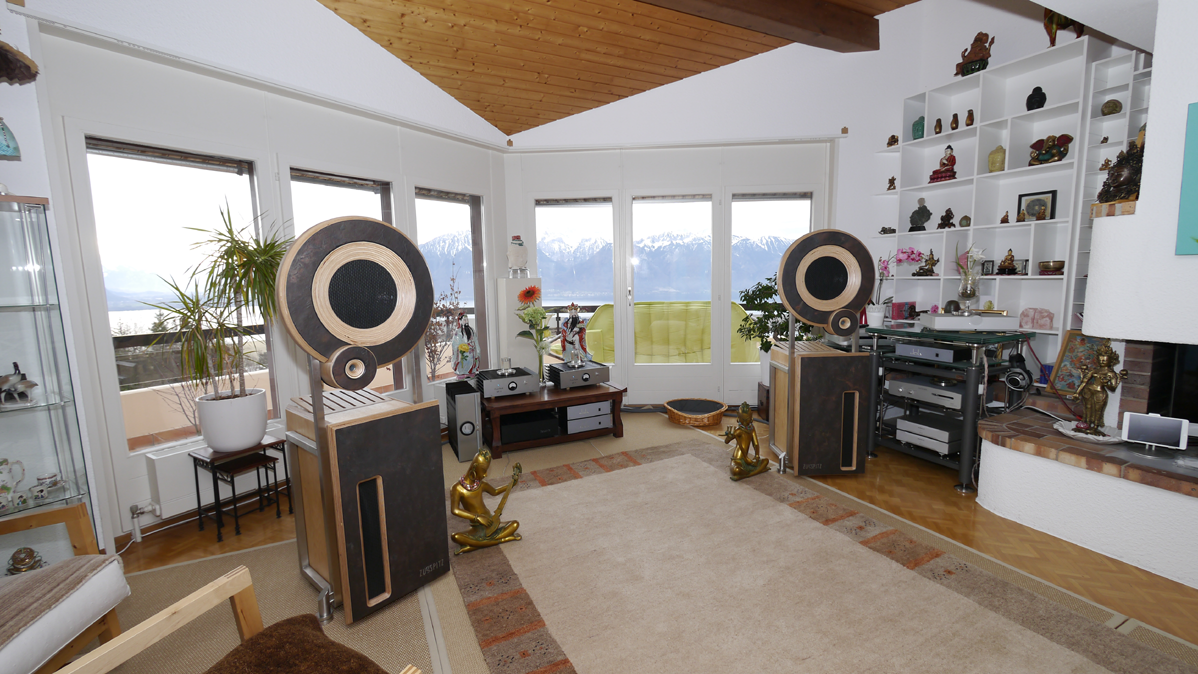 |
The straight-out positioning which Andreas insisted on whilst also creating proper width very obviously conspired with his unusually large widebander. Things became highly directional. Very predictably this meant that sitting in the left chair, the entire soundstage collapsed into the left speaker and vice versa. The obvious solution was to aim the speakers directly at the centre axis. Now two listeners could enjoy proper stereo whilst for really serious auditions, I'd still move one of the chairs dead centre. With his friendly neighbour, Andreas proceeded to move the speakers farther apart, farther away from the front wall and rotate them inward to heavier degrees. The final positioning is shown above. Besides fixing the originally very narrow sweet spot, it also opened up the stage, created more even sound coverage and made for more depth.
|
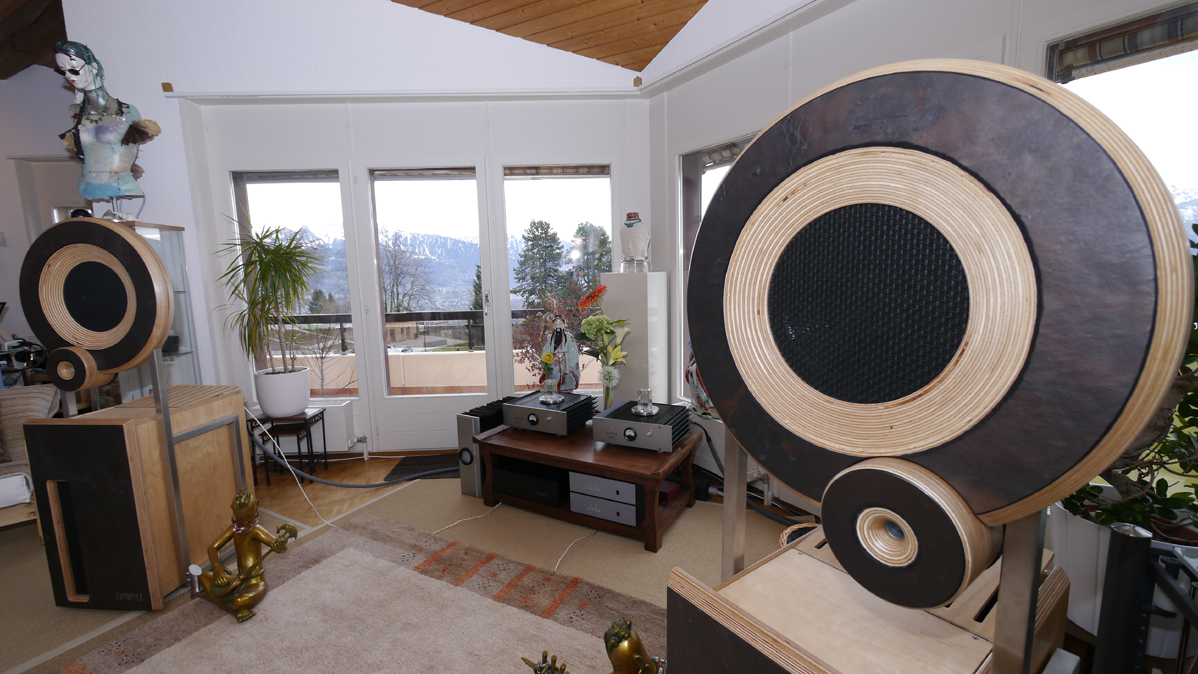 |
Wide-angle distortion of my 7-14 lens renders the nearer sun disc slightly oval but does show the beautifully mottled colors of its slate trim plus the full farther speaker.
|
|
|
|
|
Now first impressions were about a rather meatier than usual midband which nonetheless felt surprisingly transparent in the presence region to not obscure fine detail as one might fear with such a big driver asked to reach beyond 4kHz. The horn-loaded tweeter had proper power to augment the large radiating surface of the vocal range. Bass to 40Hz was very solid if less dry and damped than the usual loading schemes. Without yet experimenting with the two unmarked EQ settings, 1st-octave coverage below 40Hz was rather weaker than my sealed 12-inch downfiring Zu Submission creates at even very low SPL. This wouldn't matter with the majority of music but becomes relevant with synth-extended ambient fare where I already know what should be there.
|
 |
Specificity of soundstage layering as the clear demarcation of various performer distances from the listener particularly in the farther reaches of the virtual stage was less pronounced than that which my conventional direct radiators produce. What the Seligkeit seemed to be about—this still in the wake of making a pronounced change in the system and reacting to it based on strong contrast with the familiar—was a big and bold sound with saturated colours, high dynamic acceleration and more bass bloom than you'd get from overdamped sealed alignments.
|
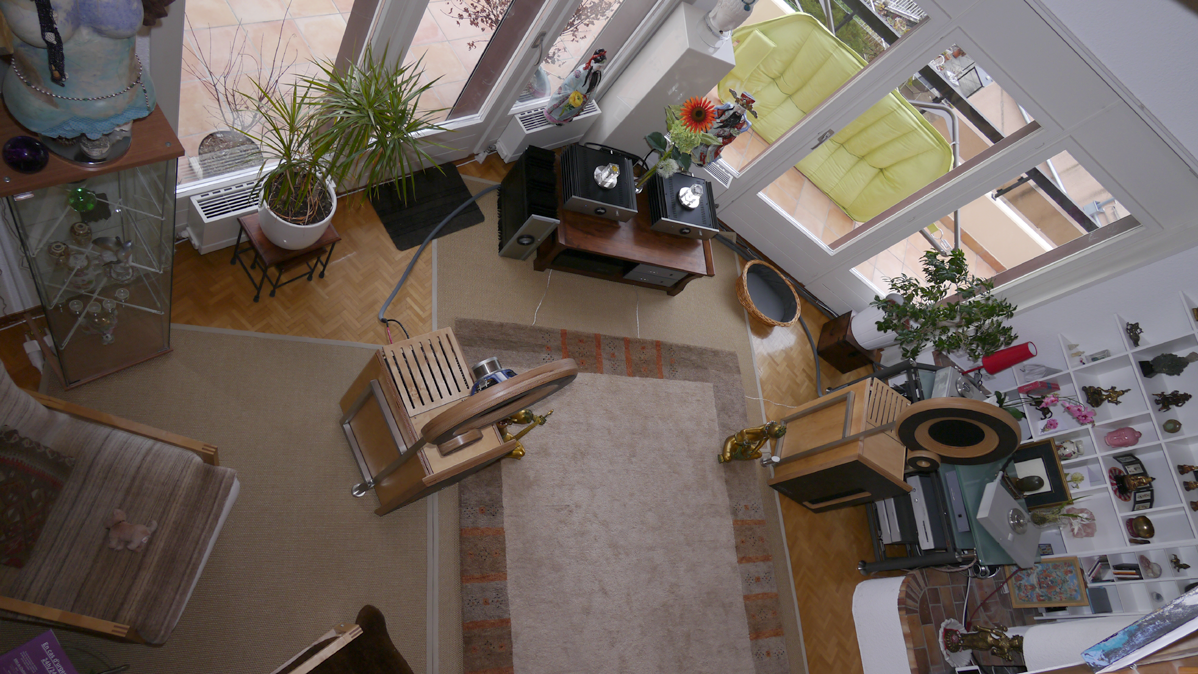 |
The relevant question now became this. How would my initial mental and psychological adjustments of expectations met or missed aka the new and the different settle in to perhaps end up with a different weighting of the various attributes one normally discusses in hifi commentary? I'd also get with Robert Bastani for specifics on the low-pass and EQ values. I wanted more data for strategic bass tweaks I still might want to make. Here I was told that the bass amp was the sole project contribution of Andreas' engineer who'd have to supply the answers. Hence Robert had forwarded the query on my behalf. On tone mass and color temperatures, I already had absolutely zero desire to reshuffle my COS Engineering D1 direct connection with the SIT1 monos. As it happened, Robert also had very specific preferences for setup: "I read the first part of your review, saw the photos and understand that you have toed-in the speakers a lot. I can follow the reasons you explained. If you prefer their sound that way, I'm fine. The Seligkeit were really designed for parallel placement to offer one listener the big size and imaging precision which only dipole speakers will produce. When more people want to listen, it is as you mention possible that those who sit off to the side won't get a true stereo image. If you prefer speakers which offer a very wide sweet spot, one can find a variety of designs which do this very well, for example the German Physiks which you'll review soon. I'm also a bit curious that the bass won't reach very low in your room. Normally, the woofers work down to below 30Hz without any EQ. They also offer a sonic bass signature where most other speakers which reach equally low produce only uniform bass. The Seligkeit isn't a mass-produced product but fully custom. All possible options are detailed out with the customer. In case that their floor should be uneven, Andreas can offer other footers which can be leveled."
|
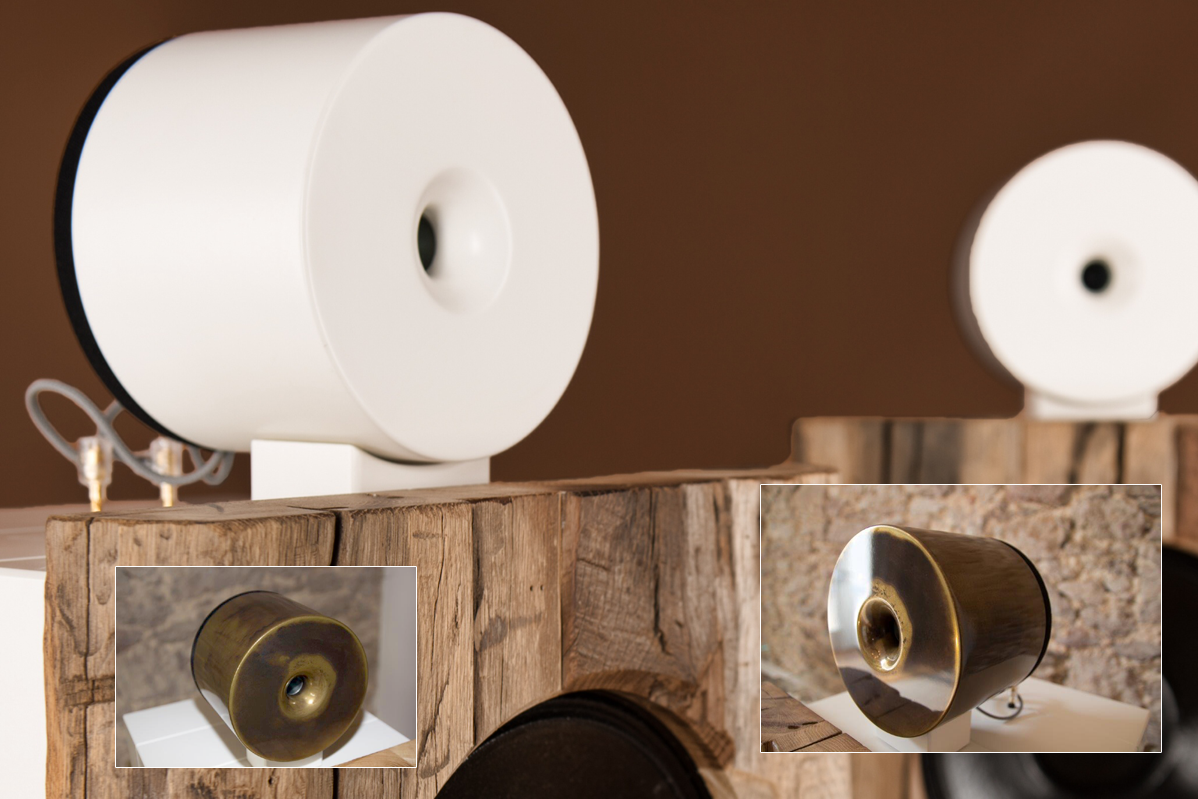 |
For just two finish options of the tweeter horn, here is white paint and clear-coated bronze.
|
| Andreas on the bass adjustments: "The open baffle geometry requires augmentation between 60-90Hz. This depends on a given room. Hence those adjustments must be made by ear. Bass boost with EQ1 is 6dB at 50Hz and 12dB at 25Hz with EQ2. Both use 24dB/octave slopes. The high-pass filter isn't in effect. The low-pass filter ranges from 40Hz to 160Hz."
|
|
 |
|
|

|

