 |
|
|
Keeping the selection process brief, the so-called static induction transistors did win the day as suspected. The triode-strapped zero NFB single-ended EL34 of the Polish G Lab Block exhibited mild self noise. They also had less treble elucidation and lower ambient recovery. Otherwise they were very similar. This confirmed that Nelson Pass had successful cloned triodes whilst still improving on them. Merging LIO's 25wpc ultracap-powered Mosfet amp into the left lane got a bit warmer and chunkier. This was less lucid, less ultimately teased out, less super-nova spacious than the FirstWatt; more 'tube' in fact. Just like the vertical power Jfets however, the Mosfets were wickedly noise free. I performed a painless Van Gogh by laying on of ear on widebander. Nothing. Noticing actual and faux valve contributions of these G Lab and Vinnie Rossi decks respectively, I ultimately preferred the SIT monos' greatest purity when LIO served as a passive preamp. I desired not even the most minute soft focus by way of Nagra's tube-based Jazz preamp. Hence the final review system just had a pair of 6922 bottles inside the Fore Audio DAISy 1's output buffer. The only valve amp I'd still have been curious about? Linear Tube Audio's Zotl 10. It leverages Berning's unique tech for pennies on the formal David Berning dollar.
|
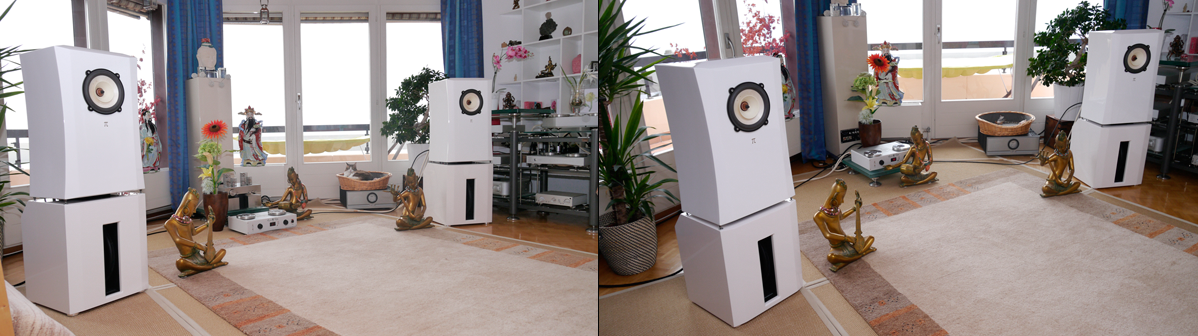 |
Which segues neatly into exhibit A of our hi-eff defense. (We won't take the prosecutor's position when majority opinion likes to belittle this speaker genre.) If traditional speakers in our private collection were various takes on conventional transformer-coupled valve amps, the Voxativ system would be a David Berning OTL (Output Transformer Less).
To whatever degrees and final remnants the trafo-coupled lot sounds slow, opaque, fuzzy and bloomy, a Berning Zotl performs a strip search. It throws out all the sticky cotton taffy, cob webs and related connective tissue, then steps on the accelerator. Bringing in an expert witness from the Swiss firm of Goldmund, Job & Partners, we'd shift the discussion to solid-state. That would call the Voxativ a wide-bandwidth direct-coupled circuit and how that sounds faster and more lit up across the audible range than most capacitor-coupled circuits of lesser bandwidth. For exhibit B, we present soundstage quantity and quality pinned to what plainly are point-source drivers. Their soundstaging is positively enormous. It extends well outside the speakers when so recorded. It layers like endless onions with fantastic depth of field. For exhibit C and the knock-out punch, we tie together A + B. The speed and pitch accuracy of the folded-baffle isobaric bass and its non-conventional radiation pattern subtracts usual overlay on the upper bands. This subtractive action further declutters and dusts off the soundstage whilst anchoring it at 30Hz in stereo. Such purist bass copies qualities from an open-baffle midrange driver. It's leaner and cleaner, less guttural, less box-backed shove than ubiquitous ported bass. As a result, the airy spaciousness netted from the widebander's strip search extends evenly down into the LF. Bass anchoring plus full-bandwidth air—more space between the performers—equals scale enormity. Things are big but perfectly sorted. That's like an executive's walk-in closet serviced by a maid. It dwarves the sloppy cubby holes which us commoners use and is organized to the 't'. The CEO's shoes are all polished, all his suits pressed and sorted by colour and style.
|
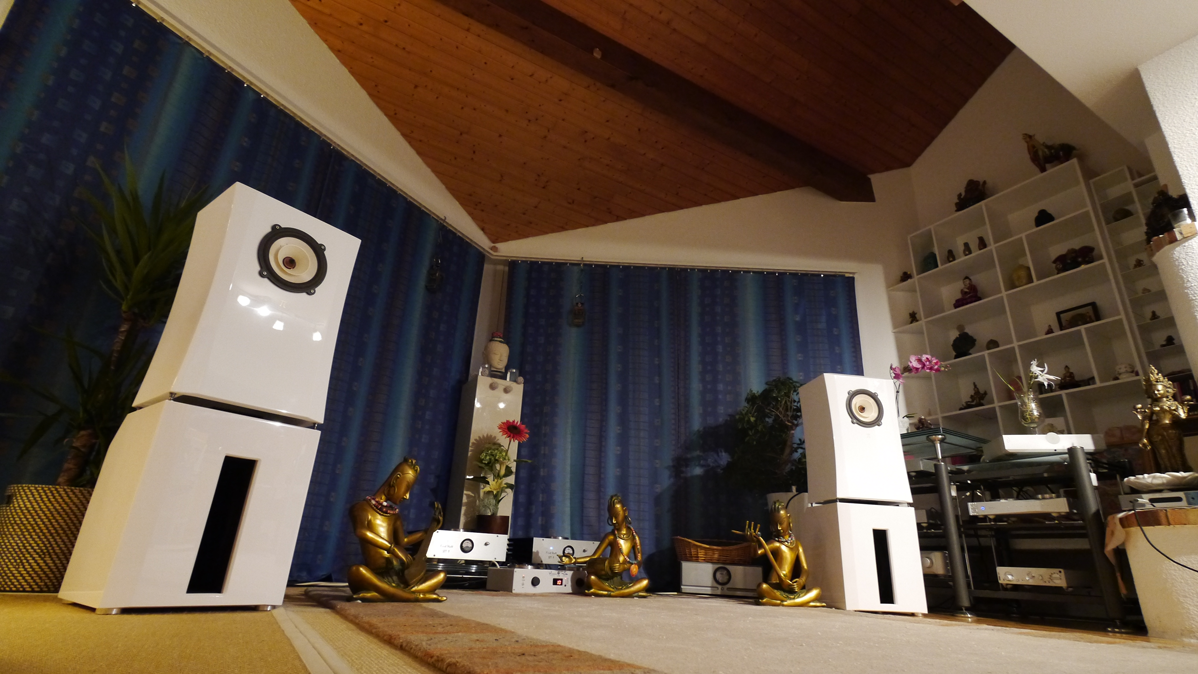 |
Leaving such goofy imagery behind—and admitting a priori that as one plays things louder and louder, any system will eventually unclutter at least relatively speaking—there's no denying that the 9.87 system shows up in full glory at rather lower than conventional levels. Greater clarity, superior focus, more efficient conversion of micro-volt flickers and less room-dependent bass all lower the barrier of entry. This barrier of entry is usually related to money. We've touched on that painful meaning already. In the sense of encountering one's music without veils, in the raw as it were, our second meaning applies to the playback levels required for the undressing. Here the twitchy finger on the remote's 'louder' button relaxes. There's no need to get noisy. It's all laid out in full at levels where conventional systems are still half groggy or asleep. In my book, getting satisfaction from lesser in-room decibels is a big benefit. It relates directly to when one can listen; and for how long. Lower volumes mean less fatigue; and more opportunities that don't disturb others. It's a new wrinkle on less is more. That covers the basics.
|
|
|
|
|
|
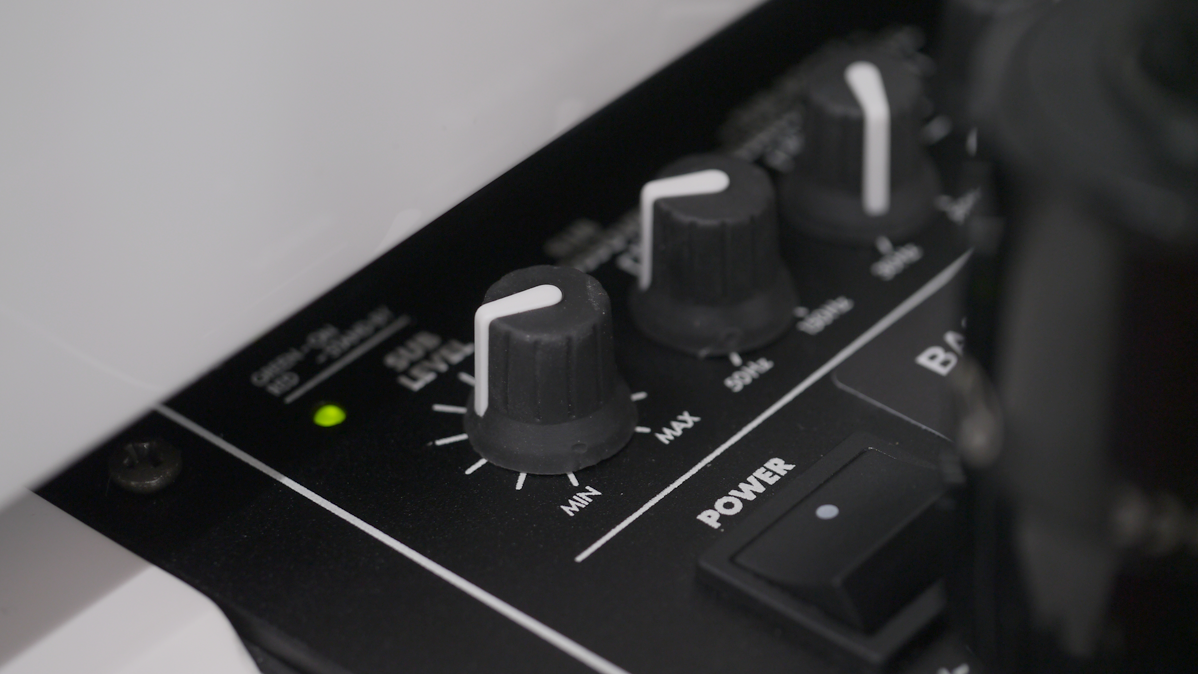
Puritanical conflicts? Set the sub attenuators to be just right in the seat. Walk up to one frontal slot. Kneel down. Put your ear against it. You'll be shocked by just how loud it gets in there*. Given its partial cancellation from the out-of-phase rear wave which freely wraps around—and makes for those very useful lateral nulls—the H-frame concept is plainly not the most efficient. A lot of energy generated inside never makes it to your ears. Add the optional +6dB boost at a selectable 30/40/50Hz. The rationale for 250 watts despite that shiny compound 99dB woofer rating becomes clear in a hurry. In fact, woofers of standard efficiency in this cab might easily require multiple kilowatts of power. And that would stipulate Class D by default. Given that the Pi launched before the eventual bass companion was ever conceived, the latter's need to match in width for cogent optics predetermined the loading geometry. Whilst domestically happy due to being more compact and less intrusive, it also makes for quite the brute-force approach with high acoustic losses and low power conversion. That principle is diametrically opposed to the top driver. But there's more to tweak your puritanical soul. Turn off the main amps to hear just the subs. At the recommended 100Hz low pass, you'll hear low vocal band. It's attenuated of course but still there. The filter slope is a standard 4th-order, not a brick wall after all. As a result, our tidy compact point-source ideal grows to a vertical meter in the overlap window. That this doesn't undermine the in-seat clarity I described above is surprising. One can obviously lower the filter hinge to whatever sounds personally best. That in fact is a big advantage of adjustable powered bass systems over fixed passive equivalents. Here 100Hz is simply the recommended default.
Whether I agreed with it would take some careful experimenting.
|
| ______________________________________________________________________________________________________________________________________________________ |
* Some of that is generic of course. The loudest part of the room is always inside the speaker where 50% of its total output are constrained by a far smaller cubic volume than the other 50% in the room. Most speakers simply don't allow one to 'lend an ear' to their innards like these subwoofers do.
|
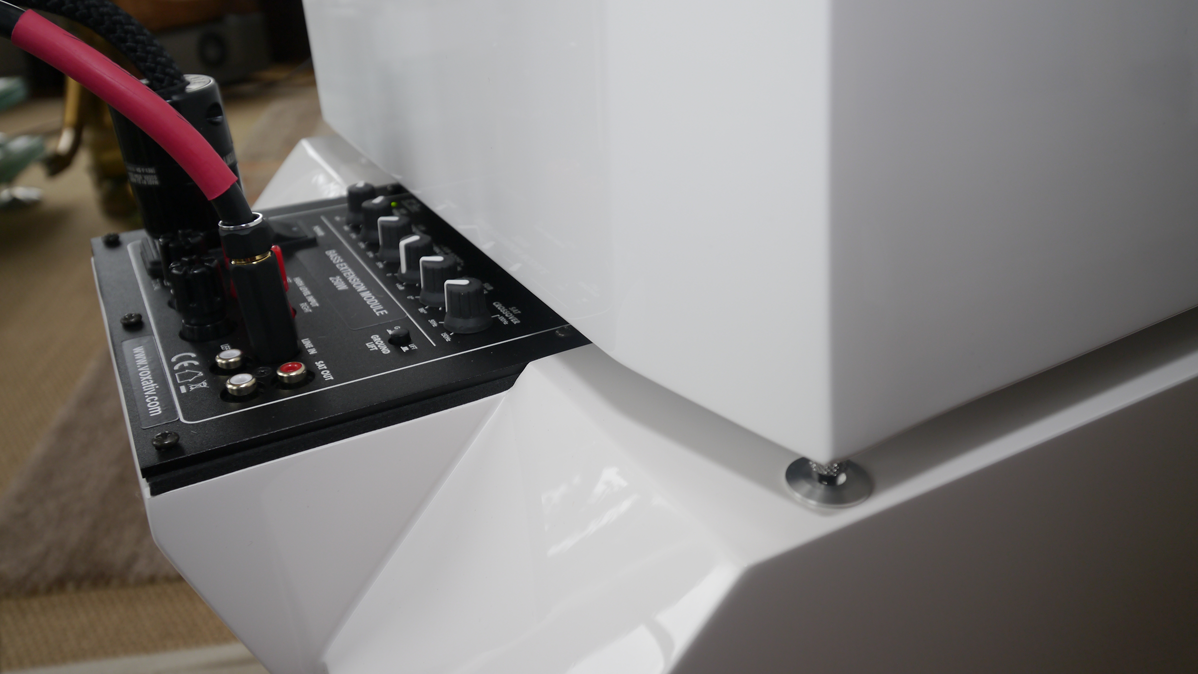 |
Experimenting—OCD alert—could devolve into twiddling with at least the attenuators for each and every album or cut. Above all, men love to love their knobs. That's the dark side of user controls. Some just can't leave them alone. With these being of the stepped sort, matching left/right channels and retrieving previous settings is child's play. The obsessive/compulsive brigade is fully catered to. Set'n'forget types should stick to the 100Hz default and not touch any of the others save for the bass volume. Chances are that one initially dials that too high just because; until temporary hifi adolescence catches up to one's real age and easy does it again.
|
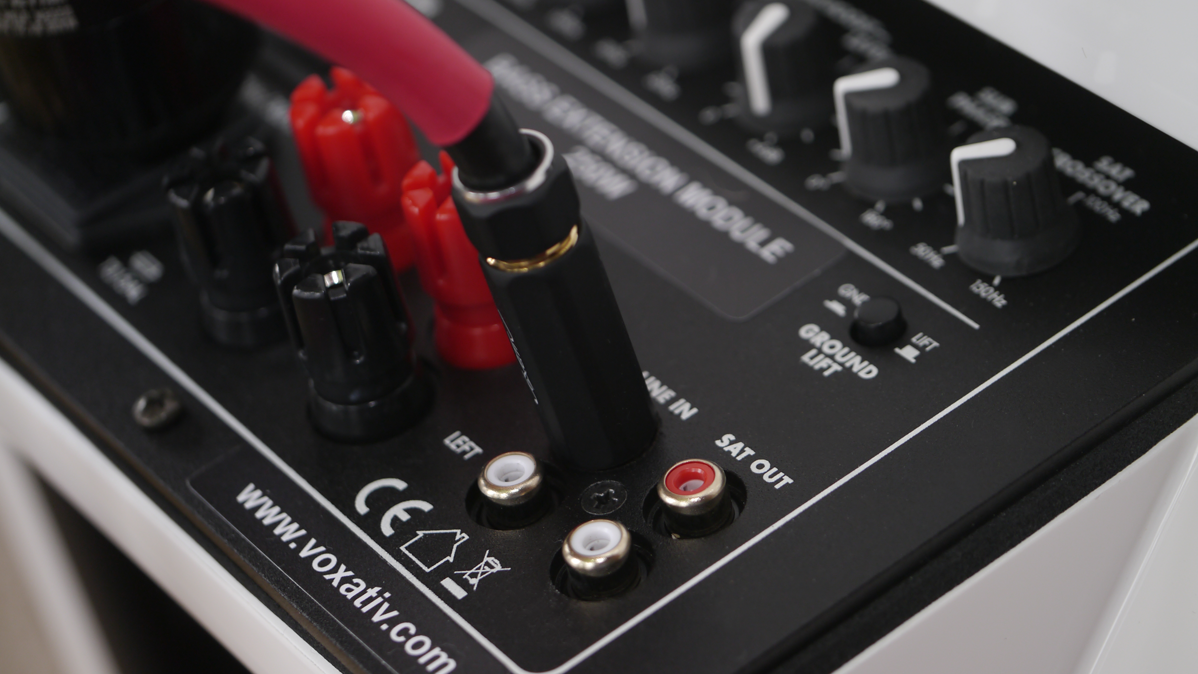 |
Having a formal excuse as a reviewer, curiosity wanted to know what the widebander would sound like unplugged, sub set to enter at its lowest 50Hz. This meant removing the twice-folded felt sheets from the horn throats. By contrast, the unplugged Pi reinforced how at least in our space, 100Hz for the plugged Pi generated too much upper-bass energy. Armed with test tones, my most linear response had the low-pass at 75Hz , bass boost at a max 6dB/30Hz. Now 30Hz was only very slightly down compared to 80Hz; 25Hz still audible but barely so; and 20Hz entirely inaudible. This illustrated perfectly the H-frame's self-canceling nature with descending frequencies. A true infra sub it is not.
|
 |
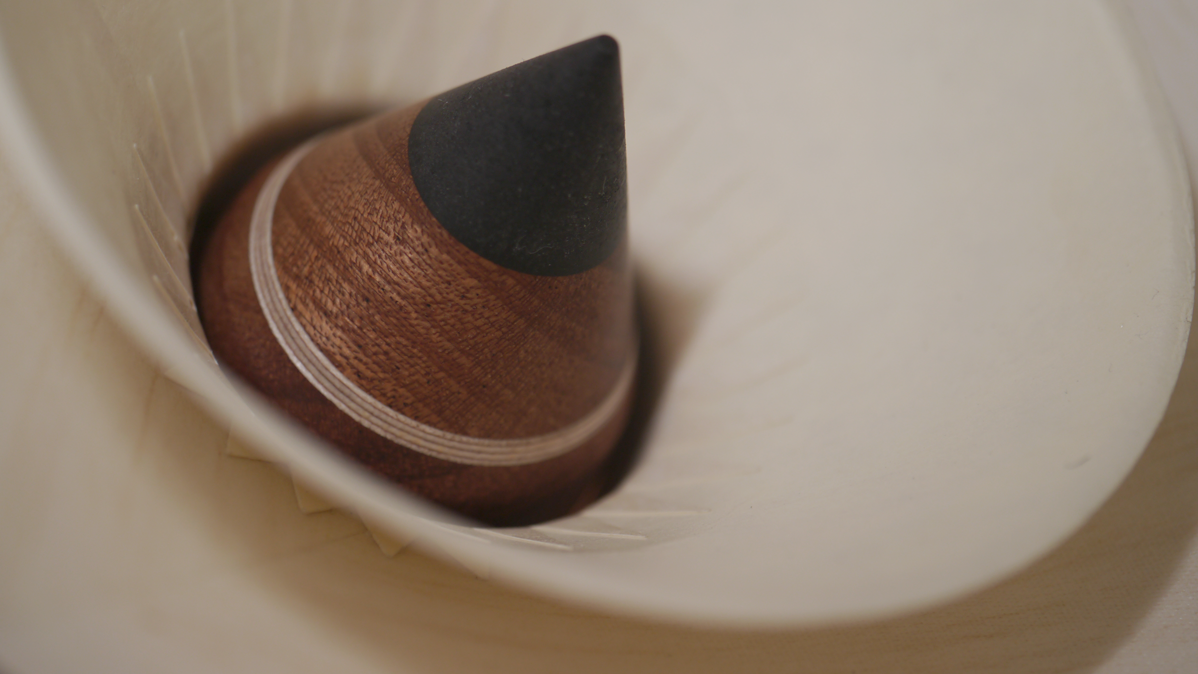
The bodacious bubble-butt but enters as soon as one compares the entirely non-boomy directional quality of this bass to the omni room-loading disturbances of traditional subwoofers or full-range speakers. Whilst the 9.87 system misses half the bottom octave, what it recovers above it really operates in a different league of clarity and pitch definition. It's the ancient quality-vs-quantity conundrum. Here the gain in quality so utterly dominates the very minor loss in quantity that the conundrum turns humdrum. Checking in with Holger on which widebander had been fitted, "yours have a pair of AC-4D drivers. So that's the top model for €34'900 just like Dan’s pair. Of course you can start with an AC-1.6 or 2.6 paper-cone driver at €23'800. The phase plugs are a design experiment of our designer Sebastian who loves wood and creates new ones every day. Yours are Mahogany, Ply and black MDF."
|
 |
"You can do everything with the stuffing. Without it, it’s a serial Pi system. The only difference with the AC-4D driver is that its Qts is a bit lower (0.29) which also lowers the bass over what the normal Pi with the 1.6/2.5 drivers puts out.
A good experiment I made was to put one woofer in the middle using the stereo inputs; and the Pi with their throats open on the regular stands. This works if the max. crossover frequency is 50Hz." Having performed just that experiment myself, albeit with two subs since I didn't have separate stands, I reverted to sealing off the Pi. My only divergence from the default settings were the low-pass and bass EQ as described above.
|
|
 |
|

|

|
|
