|
|
|
|
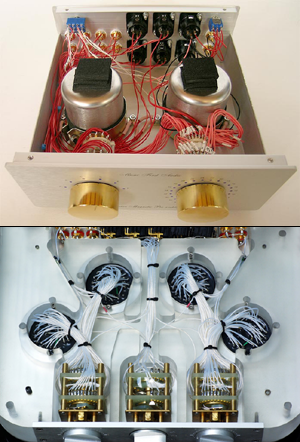 |
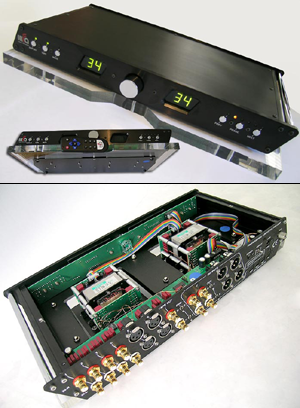
As autoformer passive preamp. For a mini history lesson, consider the Music First Audio and StereoKnight units at left. Their construction truly epitomized the rat's nest approach then endemic to the breed. StereoKnight's fully balanced nature entailed four attenuation transformers and accordingly complex mechanical switches. This also explains why, if LIO gets XLR i/o options, it'll be convenience not true XLRs at least for the AVC module. There's simply not sufficient space to accommodate two of the current AVC boards.
Back to history. When MFA wanted remote control, they contracted for it with John Chapman. Their unit at right shows the suddenly far tidier internal assembly whilst its outer cosmetics directly mirrored John's own Bent Audio TAP-X. Subsequently MFA revoked the license for his use of their British volume transformers. That kicked off John's eventual collaboration with Dave Slagle. His TAP-X was now fitted with Dave's autoformers rather than MFA transformers. And that exactly is LIO's lineage when fitted with just the i/o boards and AVC module. It's a latest-gen TAP-X version.
Where it goes beyond its various precursors is with that single no longer twinned display. It converts to temporary balance mode whenever the remote's left/right arrows are used to lock in up to 12dB offset in 1dB steps. Then it reverts to regular volume again which now ramps up and down at the set balance difference. And LIO goes beyond its various precursors again with a far posher enclosure. For lower pricing, John had always kept his own units cosmetically basic. To get real enclosure luxury with MFA meanwhile means offshoot The Bespoke Audio Company and top pricing. Whilst it's hard to predict how many folks will configure LIO as just a purist passive, it's certainly a terrific option with fully mature well-proven autoformer tech. |
|
|
To suss out its performance, I'd use my €9'000 COS Engineering D1 DAC/pre as the 'bypass' control unit with 256 x 0.25dB step resistor-ladder analog volume. LIO as AVC preamp would then contrast against the D1 in fixed-output mode and my Esoteric C03 transistor linestage. Part 2 would swap in LIO's RVC module. Part 3 would add the tube stage and contrast that against my Nagra Jazz valve preamp. Whilst the tube stage no longer conforms to the passive moniker, its lack of voltage gain—it acts as pure current buffer—places it somewhere between a true passive and the usual active preamp. Perhaps think of it as an activated passive. With today's high-output sources, preamp gain has become redundant and is usually thrown away by the bushel. Eliminating such waste to begin with benefits the signal-to-noise ratio. And for micro-output cartridges, LIO offers its gain-loaded phono stage. That's how our correspondent from Oz, John Darko, ordered his all black LIO review loaner. For his findings, you'll want to visit DigitalAudioReview.net.
One final bit of pseudo tech talk. In my review of Chord's Hugo TT which combines batteries and super caps despite its stationary not portable designation, designer Robin Watts explained why. "The reason the TT uses batteries was for guaranteed noise isolation from the mains supply. The TT project started in Feb 2014. At that time we were not sure how much of the portable Hugo magic was down to the batteries. So the decision was made to go for the guaranteed low-risk approach and use the batteries. The 2Qute program started much later. Only a few weeks ago did I confirm that we can get battery-quality sound by using lot more RF filtering and regulation. So if TT were designed today, I would go for no batteries, having proven that it can be made to sound identical. The TT can give a bit more power than the Hugo due to the beefed-up output stage, bigger batteries and super caps."
|
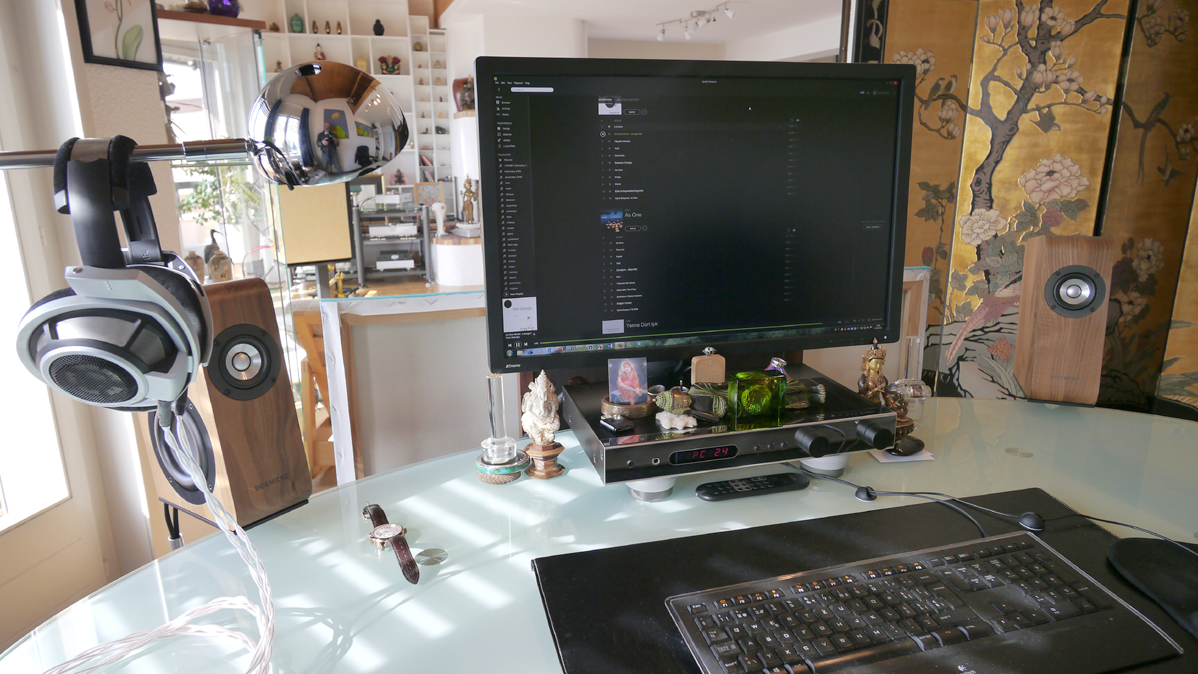 |
The earlier mentioned Aura Vita.
|
Vinnie's own propaganda too cites noise isolation from the mains as the primary ultracap (previously battery power) advantage. And it's certainly true that it creates AC-invariant performance. No matter the state of your utility power—many listeners have observed how their systems sound better at night when there's less draw on the grid—such components will always sound the same. And you don't need costly or even cheap power conditioners and fancy AC cords to make it so. But as the above quote confirms, I happen to think that the reason for the general sonic advantage is overstated. I have heard plenty of gear with conventional power supplies every bit as quiet. The primary contribution of Vinnie's first battery now ultracap power supplies at least to my thinking is their very high current and ultra-low impedance. That's what I believe is directly responsible for their full-fat tonal splendour and what makes their lower power ratings behave rather more butch and muscular. Of course in the end the why and how don't matter, only the what. If it were a speaker, this recipe does create a Harbeth, Spendor, big Trenner & Friedl, original WLM or Zu sound.
It makes skinny runway fashion models illegal.
|
 |
Vinnie: "Thanks for seeing the bigger picture! It's not just about the clean/isolated power. LIO's ultracapacitor-based power supply has extremely low output impedance. It plays a large role in that sense of "more power than the rating suggest." There is no internal AC/DC conversion, hence no added impedance ('choke') of a transformer; or rectification, no matter tube or solid-state. The instantaneous current on demand is intense! If you were to short-circuit the bank—do not try this—the wire shorting it near instantaneously becomes liquid metal with a white flash of light. That is from hundreds of amperes of instant current flow due to the super-low internal resistance of the caps. It's not an electrochemical reaction like a battery but an electrostatic discharge. Think lightning bolt or the mini arc you see when you touch the door knob whilst dragging your feet on your carpet during a dry winter day."
|
|
|
|
|
0.25dB x 256 steps : 4 = 64dB. That's the attenuation range of the D1. LIO packs 63dB. The only area where theory predicted a possible handicap against the D1 was the added Zu Event MkI interconnect. It'd create four more connector junctions. In practice, I wasn't sure I'd hear that. (It's good to admit biological or personal limits to separate meaningful stuff from stuff which only matters in theory). And I sure didn't hear it. There was no sudden intrusion of even subtle opacity, of lessened immediacy, of even minor response alterations or other suspicious telltale signs of meddling. The same couldn't quite be said for the Esoteric. Even in no-gain mode, that heavy did create a bit of softening to undermine separation on for example a Khadja Nin track which already leans to wall-of-sound gruel. Whilst the $10'000 C03 behaves as nearly a passive at zero gain, it does introduce a mild, perfectly pleasant and sometimes wanted, texturization. By contrast to the LIO/D1-direct options, it was mellower, slightly laid-back and as such, slower. Engaging Esoteric's 2-stage voltage gain (12/24dB) packs consecutively more mass and bass but keeps hitting the deccelerator as it fattens up. If an amp/speaker combo like here the XA30.8+M1 is ideally balanced between these aspects, one doesn't want to introduce any preamp signature. Yet many DACs are either fixed gain; or come with an inferior method of volume control. Now a pure passive with proper drive, in this case 6m interconnects, is the right solution. At room-filling levels, I sat at 23dB below unity gain. That left plenty of headroom for recordings whose average level is low to accommodate highly dynamic peaks (far more common with classical than Pop albums where 10dB of dynamic range is the norm if that).
|
 |
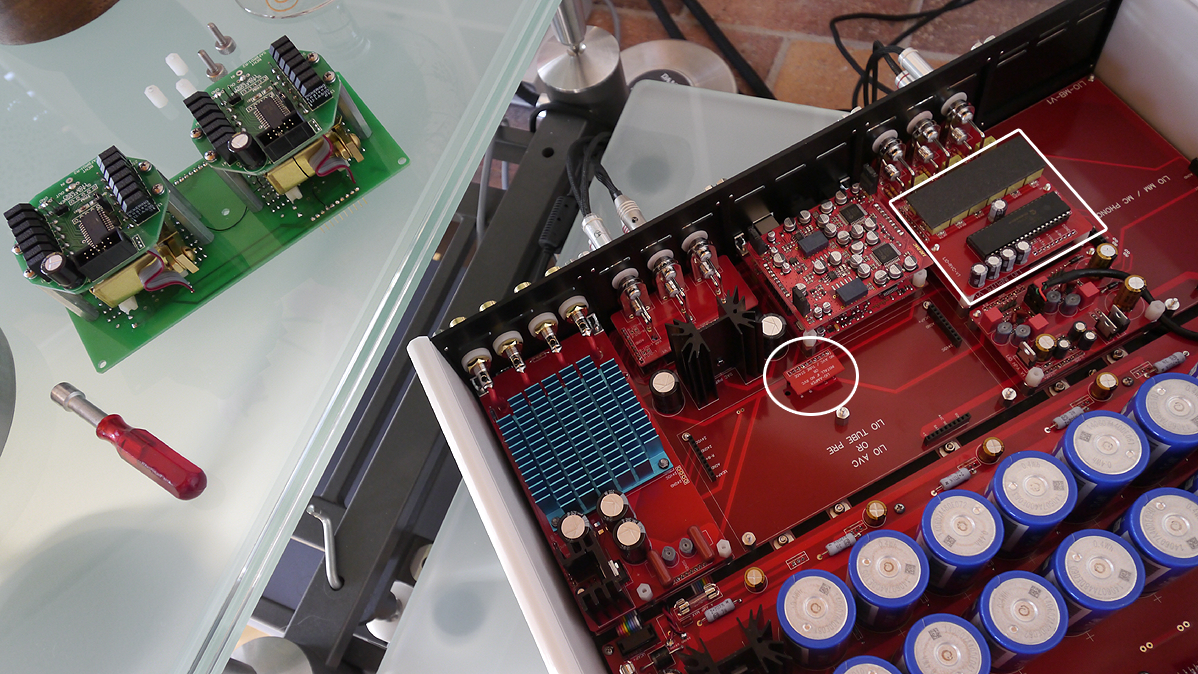
As RVC passive preamp. How would it compare? Not very well. Unlike on the desktop where zero cables were involved, the RVC—not so surprising, actually—had issues with my 6-meter interconnects. This was starkly audible as a lack of drive, sparkle, bass grip and general conviction. The sound was lacklustre compared to the truly cracker-jack AVC. It was sleepy and pale. In fairness, for a traditional passive, bridging this type of cable gap is far from ideal. LIO's RVC module merely fell in line with what's normal. Whilst the AVC option is considerably costlier, it obliterates that common limitation. Be thee gone, Shaitan! In such situations, you very much get what you pay for. Below we see the RVC installed. That requires that you move the jumper from the input board and plug it into the central header of the vacated AVC/tube-stage real estate. If you forget the jumper, you won't have sound. (If you want to run LIO as just a Mosfet amp, you'd remove the RVC and plug a second jumper in its place; or run it at 63 which, by relay, bypasses the attenuator says Vinnie.) Obviously my findings don't invalidate the RVC. If you run LIO as an integrated for example, this module only drives a few inches of circuit trace.
|
 |
It was time to pop a bottle or two. Out with the jumper, in with the tube board, lid back on, charger back in, Nagra Jazz on top for easy cable swaps. Aside from being wildly more expensive, the Nagra has optional transformer-coupled true XLR i/o; is just a preamp; but has selectable 0/12dB of gain, hence can play louder off the same source. For less than half when fully loaded, LIO does practically everything. Different strata, different audience, different value equation. Focusing purely on sound as a valve-buffered volume control, what separated these two?
|
 |
|
I cued up an all Turkish playlist to suit a mood and put my ears to work. (If you pay attention to just one of these seven albums, get Dokunmak by Erkan Oğur. It's a lyrical treasure of the very first order and insider classic! Sample it on Spotify or Tidal.) In this context—D1, XA30.8, Mythology 1—the Nagra adds more fluidic textures as though my room's RT-60 time were slightly increased. Think more acoustic reverb or less damping. This more generous wetter ambiance and richer tone come at a slight cost of lucidity, incisiveness and ultimate transparency. Transitions are slightly softer and the aspect of hard separation gets fuzzier. As always in hifi, it's about a deliberate trade-off, not getting something for nothing. I enjoy this system with or without the Jazz equally. What changes is what I enjoy about it in particular.
|
 |
|
 |
When I say that the Jazz ladles on a bit of sauce over running the COS deck direct, I'm not referring to Rattler's Bite hot sauce. That would be LIO's AVC option to clean out all the cobwebs and keen up the vitality. What the tubes do is more unctuous and succulent; like cream sauce. Things grow a bit ponzified. They plump out. That's not really a Ponzi scheme where thieving from Paul pays Peter. Nobody gets scalped. It's a gravitational shift. The sound becomes more anchored and dense. In that downward scheme, LIO played it saucier than the Swiss. Colour temperatures went up to get more burnished. Stage depth aka layering diminished. The foreground became more concrete. The top end where violin flageolet lives toned down. Turkish players like Adnan Karaduman and Baki Kemancı are experts at bowing with such light pressure that they trigger various amounts of upper harmonics—what woodwinds call overblowing—without tipping over by losing the fundamental. Here the Nagra went higher into the glinty flickering upwardly mobile aspects. It also cast more depth with less focus on the first plane.
LIO instead played it ballsier and warmer.
If there were such a thing as a tone turbo boost, something akin kicked in. That made the violins of my modal heavily ornamented players bigger and woodier. In Vinnie's à-la-carte scheme, it's actually sensible to build in more rather than less contrast over against the purist AVC. The Jazz split the difference to basically cut it in half. As a very modern tube preamp with wide bandwidth, very low output impedance and 118dB S/N (measured on my personal unit), it downplays its valve virtues more so than the LIO does. Again, doubling the distance to its autoformer option only makes sense here. It means vanilla and chocolate for some meaningful choice, not a narrow vanilla vs. French vanilla iffiness.
In the bass, the AVC had been wirier and snappier; a fast welterweight punch. With the 6922, it came from a fatter fighter; more welly, slower reflexes. The staging with the AVC had been deeper, wider and airier. The 6922 did their image casting more compact but in trade were more robust and fully beamed down. I'd not call theirs a more midrangy sound per se. The bass underpinned the vocal band too powerfully. Yet the tonal center did move down. That accounted for the gravitational shift. Whilst the valve fingerprint with LIO was coarser or more overt than on the Jazz, it far from embarrassed itself by contrast. It was simply a stronger dose of quite similar medicine.
As such I'd be leery of pursuing the type of costly NOS glass which does the Mullard midrange thang. The stock JJs with ultracap backup don't need help in that department! |
|
|
 |
| |

|

|
|