|
|
|
|
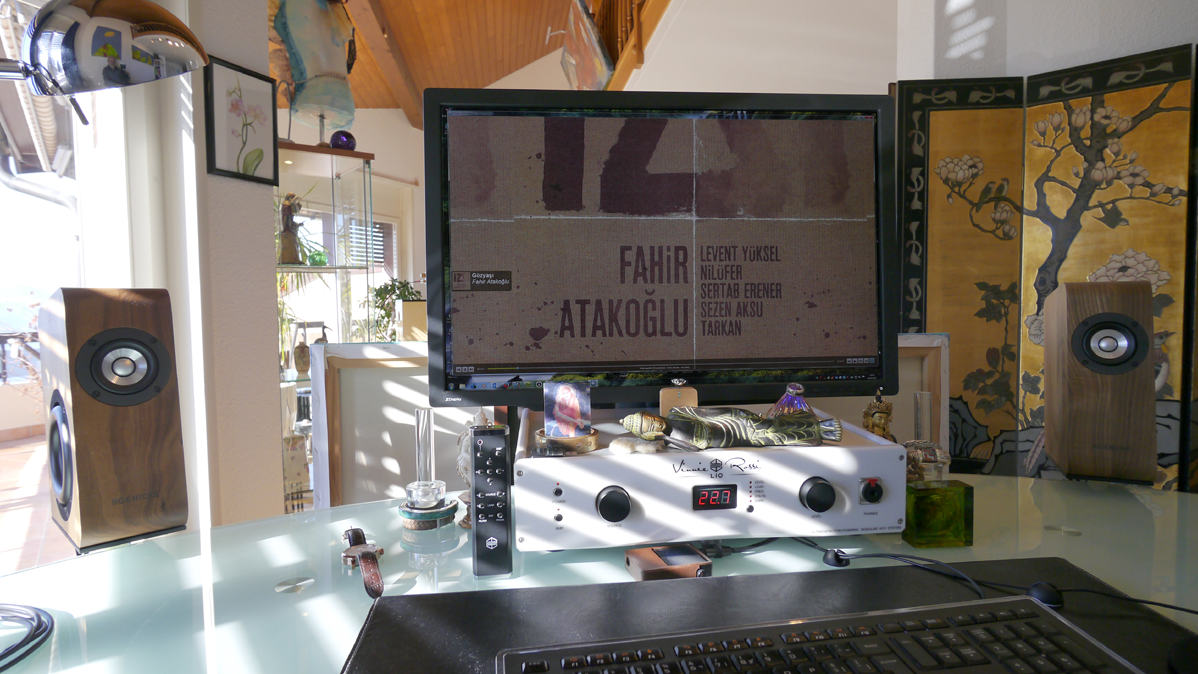
In use. On his DIYaudio forum, I've repeatedly seen Nelson Pass questioned on the audibility of class A/AB transitions. Somehow people fear a Harley-Davidson type clutch whenever such an amplifier leaves pure class A. Obviously that's perfectly inaudible. Otherwise the concept itself would be a ka'klunk! kaputnik. LIO's microprocessor constantly shuttles between its two ultracap banks. Select the display's volts mode to illustrate how. Its figure descends from 22.9 to ~18 over a few minutes. Then it hits 22.9 again for the fully charged bank. Presumably this switch is controlled by a relay. As owners of inferior stepped attenuators know all too well, ratcheting through their relays will elicit audible clicks like a busy sewing machine. Not here. Be it switching autoformer taps to adjust volume; be it the self-switching ultracap circuit; I had no mechanical noise*. Just as self-deprecating was the display convention for dark mode. All the red lights go out except for the one next to 'dark'. Without that last one, you'd have no visual feedback on whether the machine was on or off. But there is one strangeness. Whilst switching 'amp' off defeats the speaker outputs to let you do headfi, it doesn't simultaneously mute the variable outputs. As I learnt, a connected subwoofer will still play. Unless you want that rumbling along with your headphones, you must manually turn it off. Or connect it speaker level. No biggie but perhaps a bit unexpected. |
|
|
______________________________________________________________________________________________________________________________________________________
|
* "When you install the RVC, you will hear clicks inside the casing because its relays are louder than those of the AVC but you will not hear them over speakers or headphones." In short, mechanical not electrical clicks. About the preouts, the obvious answer was that "we wanted to allow LIO to be used
as a preamp even when the internal amp is off."
|
 |
|
 |
Also, the headphone port remains live whenever 'amp' is on. Leaving your cans plugged in whilst the speakers play isn't on unless you want it to be. Finally, the display's 'freq' mode shows digital sample rate, not file density. Whether you stream 320kbps Spotify Plus or 1411kbps Qobuz Hifi, it'll say '44' in either case**. Don't believe your MP3s were magically up-rez'd to Redbook. Though LIO might as well. That's how good Fahir Atakoğlu's As One album sounded on Spotify+ because Qobuz don't stream it. Yes, his Iz album there sounded even better at full resolution but, calling especially simpler fare via 320kbps MP3 terrible or bad is either ignorance or snobbism speaking. In fact, LIO most reminded me of Simon Lee's Vita integrated under his April Music sub brand Aura. Having just listened to that 50wpc Mosfet deck whose headphone socket taps directly into the main output stage with a voltage divider, I had serious déjà vu. Regular readers will know that even rewired by ALO, the HD800 aren't my favourite headphones. That distinction goes to the original Audeze LCD2 or its sealed LCD-XC competitor. Alas, I reserve the right to reverse that opinion with amps like Goldmund's Telos HPA1 or Crayon Audio's CHA-1. Those catapult Sennheiser's top dog into the highest good-dog heaven. Now add LIO to their short list. The 800's super airy and resolved but also bright-ish demeanour had so much counterweight and full-fat tone that it outshone Dan Clark's Alpha Prime on resolution without any hint of harmonic bleach. No skinny girl's non-fat breakfast. No bland homogenized yogurt with a slice of twice-baked Knäckebrot covered with feather-thin cucumber slivers. Any amp that turns the HD800's flagship status on specs and pretty graphs into the same flagship standing at my ears has my highest admiration.
Think big countrified portions with Michelin-star finesse. Comfort food with class. |
|
| ______________________________________________________________________________________________________________________________________________________ |
** Incidentally, the Toslink'd feed of my Astell&Kern portable elicited a '0 freq' despite being bona fide 16/44.1 or higher AIFF files. For me the sample-rate confirmation only worked via USB.
|
|
|
|
|
|
To press the point, an automotive connection. Late last year our aged four-wheel Subaru Forester
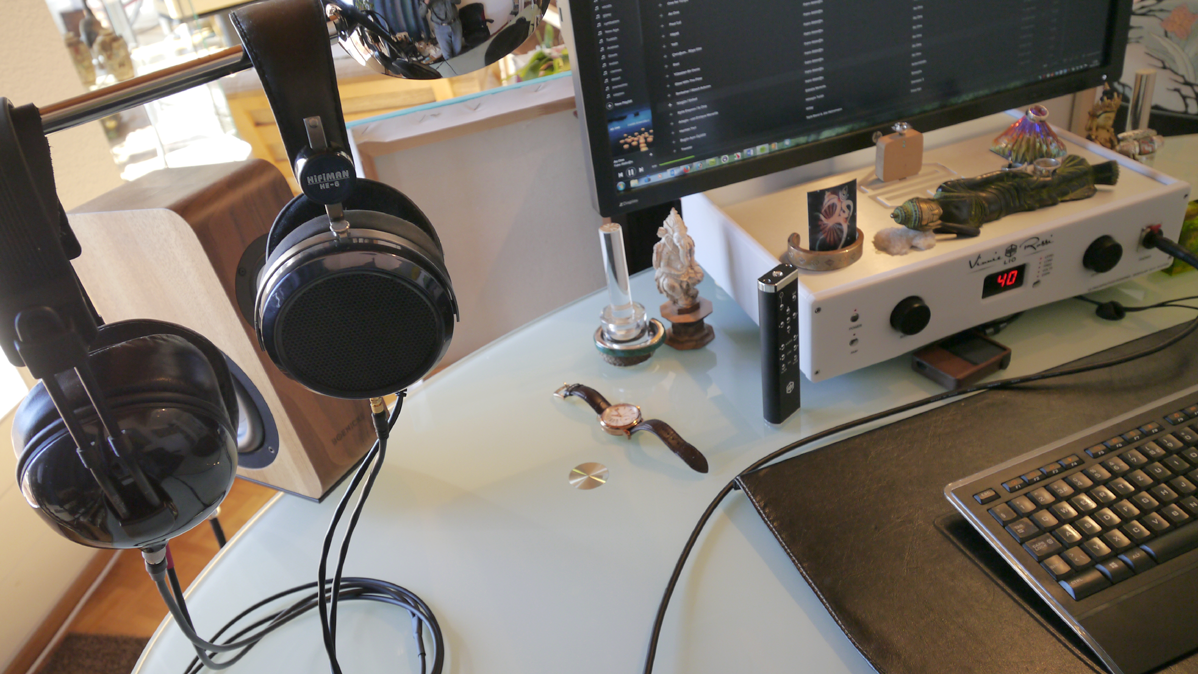
Turbo finally exhibited stress signals of soon needing costly repairs. So we replaced it with a compact Volvo C30 T5 two-door hatchback of ultra-low mileage. This version puts 230 horses behind a turbo 5-cylinder engine. That means more power and torque than the bigger heavier Subaru. It manifests in all manner of ways evident to any driver reading this. With its speaker power rating, LIO is a small car. When used as just a DAC, preamp or headamp, it's in fact only a lightweight motorcycle. Now its burly power supply becomes a V12 engine. As generally daft as such hifi tie-ins with cars are, it still illustrates an elemental truth. On the desktop and into headphones even as thirsty as HifiMan's HE6—think 40 on the dial of a possible 63—LIO didn't act like a twitchy 4-cylinder affair of all zip but no grunt. Even without valve buffer but ultra-purist AVC volume controller, the sensation of weight, harmonic completion, dynamic resources and bass grippitude (grip + Rock attitude) behaved like a Cayenne or Tuareg super SUV. That's big 4x4 stuff with unrestricted Autobahn potential. It goes fast but different than a small plastic car. If you've read my Pass Labs XA30.8 review, you know how it compared to the same-powered FirstWatt F6. It goes without saying that LIO stands in for the former. It's bona fide muscle gear of simply lower power than most of its kind.
|
 |
I've heard plenty of headfi amps which played the HE6 loud enough. They simply lacked the vital credential of true gumption. That was audible as brightness, harmonic anorexia and annoying edginess.
Front those inefficient planars with true power and they get mellower, sweeter, fatter and far ballsier all at once. An extreme example thereof is the Aura Note V2. It uses its big ICEpower modules into the ¼" port through a basic load resistor. That's exactly how LIO behaves and sounds. And that's exactly why it transformed the Sennheiser HD800. From that 300Ω
load to the ~50Ω planars from Audeze, HifiMan and MrSpeakers, LIO even with the 6.3mm jack (the 4-pin XLR has more power still) proved to be a cracking drive-all headfi proposition. I'd rate it just like the Aura Vita and Aura Note V2. That's high praise even if those decks don't register on most people's headfi lists. That's only because they're not dedicated headphone machines but integrateds or receivers. Theirs is a deeply satisfying highly caloric but rollicking sound built from the bottom up. It's far more compelling than what I'd recently gotten from a Sabre-powered DAC. Its headphone socket had seen op-amps and on-chip digital volume in deep attenuation. Nicht gut. In my first application as a DAC/headfi combo, LIO was a real winner. And that was well before I rearranged its innards with the tube stage and RVC attenuator.
|
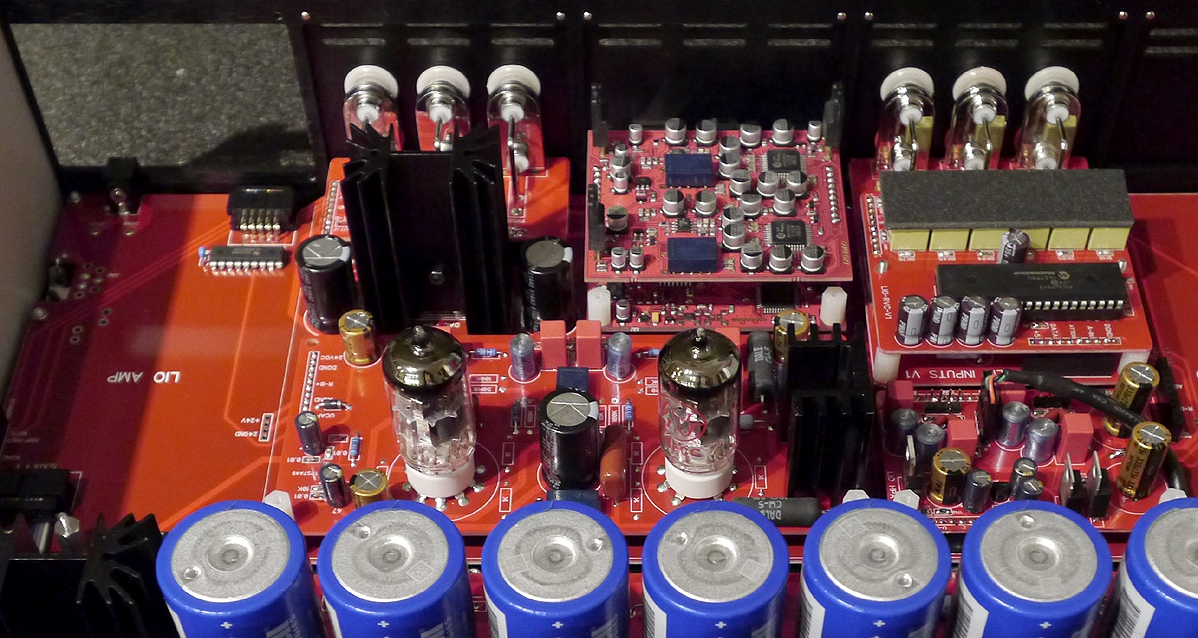 |
Relative to that miniature operation, here we see the Mosfet power module removed just for illustration and to learn how easy that would be (peasy!); the green AVC module replaced with the tube stage; and the RVC board installed which piggybacks right atop the analog input module to...
|
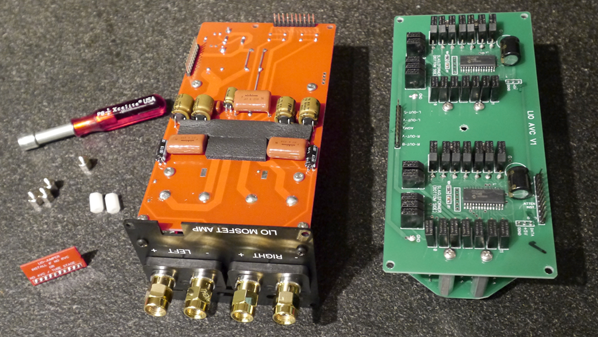 |
... in turn remove the tiny jumper board Vinnie mentioned earlier. Here we see the bellies of the removed modules. Their header pins stick up like a bug's legs when flipped over. If you can screw in a light bulb, you can roll the LIO expertly, no buggery involved. The holes in these boards act as perfect guides to align the pins with their receivers. Simply press down gently and tighten the Nylon caps (and the back-panel metal screws if applicable).
Relative to valve contributions and headfi mode, one arrives at clearly softer transients, a slightly mellower overall mien with more watercolour transitions, thicker tone and denser images at the cost of clarity and penetration power into the musical fabric. As someone who comes from the Bakoon/Crayon/Goldmund aesthetic and given LIO's intrinsically big meaty not vegan sound—my reference headfi rig runs the Metrum Hex into the Bakoon AMP-12R—I preferred the straight-up AVC sound even on the HD800 for being the decidedly more lucid. The valves however do add macrodynamic wallop.
With the Boenicke woodies in my work area playing LCD-era Audeze to our Albedo Audio Aptica in the big rig which are a Sennheiser-type speaker, my own bias followed suit. On the
desktop, I'd most fancy the AVC followed by the RVC which isn't quite as immediate and direct. Having such choices with in-home trial privileges will be a most terrific earducation to those who aren't inveterate hifi show groupies already! |
|
|
 |
|
|

|
|