 |
|
|
Reinhard also believes that room acoustics are a vital piece of the puzzle, not merely an afterthought. The same goes for general audio furniture. I also learnt that Thöress don't worship dogmatic tube design. Reinhard uses the whole palette of ingredients to cook from them as refined a meal as possible. He does everything in his power to provide the tubes with their optimal operating conditions and then simply lets them work at their best. Yet some things are verboten. Reinhard says a big fat 'no' to integrated circuits and printed circuit boards except for remote control purposes. But even there he eschews OEM and builds his very own small PCB. He has a number of valid reasons for this preference yet this wasn't something he wanted to discuss. Point-to-point wiring is his credo for all products with the Thöress logo. Most importantly, he winds all his transformers by hand. Output transformers, filter chokes… everything is executed in-house to the highest possible standards. He believes that his output transformers are among the best in the world and those in his 845 monos probably the most elaborate, ever. That's one strong statement. For his power transformers he looks at reliability, quiet operation and low leakage. Again, Reinhard winds all the coils himself. If that's not devotion to our hobby, I have no idea what is.
|
 |
The tool for this virtuous purpose is a vintage German Auman winder made in 1964. Curiously that's also the year of his birth which I saw as a fortunate and funny coincidence. Some things are obviously meant to be. In Reinhard's world, amplifiers, speakers and all other audio components are simply tools to serve committed music lovers and help them broaden their exposure. As such, these can be valuable appliances but they are not be exploited as status objects or as toys to show off to big boys. As to visuals, bling is off the table and a form-follows-function approach is favoured. That attitude is very apparent with all his machines. Hence their 'Puristic. Audio. Apparatus.' inscription. It fits even better though it also reads more than just mildly vintage. Still, the task for all Thöress apparatuses isn't to delay or transfigure the vanishing age of tubes. They're built as an homage and tribute to a great tradition.
|
 |
|
|
|
|
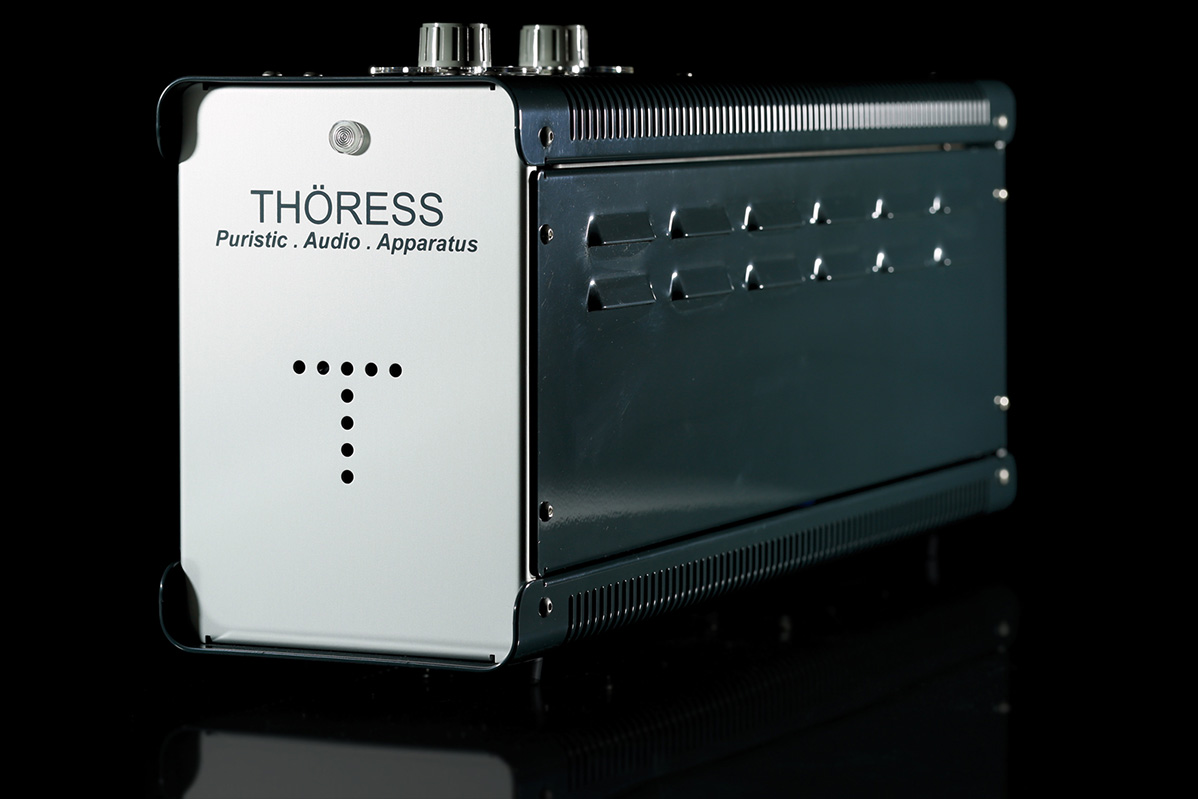
| Today's review subject is an integrated amplifier so a preamplifier and power amp are found inside the same enclosure. Nothing new there, just add speakers, a CD player or DAC with transport. Just so, this single-ended 6wpc triode affair, unchanged, has been on constant sale for 15 years already! The reason is simple. To Reinhard, his F2A11 is a finished project, case closed. Surely it looks atypical with its 26 x 15 x 57.5cm dimensions which suggest a downscaled tram car whose paint resembles a Soviet era tank. Just consult the pictures. Compared to the wide yet low and shallow machines of today, finding a place for the rather deep and tall F2A11 integrated might be a bit difficult. Some shelves might cut off to soon. Mine barely made it. The good news is that our integrated runs cool to be safely placed virtually anywhere as long as its tubes have some space to breathe. Which gets me to its undeniable charm. This slender creation simply stands out. That merit is highly subjective of course so we'll leave it be. The enclosure is made of six pieces. The front and back are clear-anodized aluminium panels whilst the sides, bottom and top are painted green. This unusual combination recalls bygone times from before when CNC milled chassis had become a thing. In addition the chassis edges are rounded, another detail that makes the vintage look quite dominant. Each panel affixes with small hex screws very meticulously and in perfect symmetry. No piece protrudes more than it should. Once I'd removed the sides to peek inside, I had no issue getting them back on. Normal? Not. CNC-milled chassis ought to be more precise than the fully handmade F2A11 case. Yet over the years, I've had countless issues with threads and screws refusing to see eye to eye after they'd come apart. Reinhard's case was a superb exception. So let's take a closer look.
|
 |
|
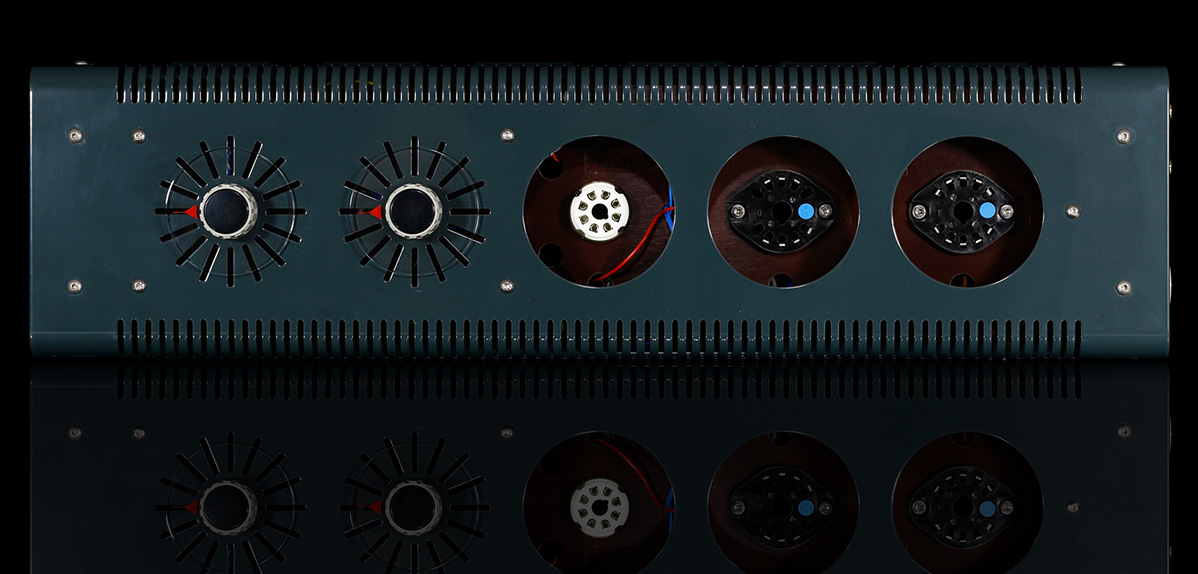
There's a small red lamp on the upper front; yes a lamp not a diode which marvelously fits the overall retro theme. A bit below there's a rather large logo and below it the short but self-explanatory 'Puristic. Audio. Apparatus.' line. Another tasty detail is the large perforated T mark. It isn't just ornamental but adds ventilation. The top and bottom covers are slightly longer than the frame to add visual accents. Multiple perforations of different shapes are located in several places. Each side sports two rows of angled vents and numerous cuts all across the product's depth. Two large knobs which turn acrylic discs combine into a volume control with integral balance. The translucent rims with small red arrow look at sixteen radiating chassis slots below to double as clever volume scale. Both knobs are very precisely centred and quite resistive for tactile feedback. Behind them there's a 12SN7GT driver socket, then two German F2A11 beam power tetrodes, one per channel. Since all valves mount on top with generous space around their sockets, access to them is very easy. On the back are three gold-plated Neutrik RCA inputs. The input selector is close by and resembles the volume knobs. The IEC power inlet below is accompanied by the on/off switch and a self-replaceable fuse. The speaker binding posts felt good and did the job but looked rather common. No fancy WBT jewelry here.
|
 |
|
Let's return to the venting. It caused zero complaints. Shortly past arrival, my loaner had to be burnt in. This meant constant duty over several days. No matter how hard it got pushed, the enclosure grew barely warm. Of course the power tetrodes themselves ran hot but the area around them wasn't any warmer than elsewhere. German engineering at its finest? Quite. To take a look inside meant just four hex screws. The innards looked peculiar but impressive. Everything was assembled point to point. The obscure NOS Siemens F2A11 tetrodes originally showed up in German Klangfilm cinemas after WWII. Reinhard personally measures each and of a good batch, 70% make his grade. But why tetrodes? Because they best fit the job. Their low internal resistance (Ri) is comparable to a 300B. This parameter drastically affects transformer distortion D (indirectly proportional to Ri) and frequency response. In a nutshell, the lower the Ri, the better. In addition, the F2A11's drive requirements are reduced by a factor of four over a 300B. This equates to four times lower distortion for the same power output. The 12SN7GT tube is one of the most linear medium-mu triodes ever made, a fact which is generally accepted and frequently proven by measurements. In the German integrated, its idle current is set quite high for the most linear operating window. Here Reinhard employs a certain type of custom-made transistor which serves as the so-called active load for the driver triodes. How our engineer has rolled this part remains his little secret.
|
 |
|
|

|
|

