This review page is supported in part by the sponsors whose ad banners are displayed below |
 |
 |
|
| For some unknown reason I got stuck on playing the 1976 Thin Lizzy album Jailbreak [Mercury SRM-1-1081]. This album is hard rock. While not the best recording, it was a good tool for hearing what the FEQ did. On the hit cut "The Boys Are Back In Town", turning on and off the FEQ showed that in addition to the bass improvement, the center of the soundstage got more dimensional and focused. Also the lead vocal popped out more in front of the stage. I liked everything the FEQ did and felt that the bass and soundstage dimensionality improvements wrought by it were significant enough to recommend it for any high-end system. |
|
|
In a phone conversation I had with Peter Hansen, I dug deeper into his initial warning that the HFT/FEQ system was incompatible with my Stein Harmonizers/Magic Stones. Peter clarified that it was the FEQ (not HFT devices) which was incompatible with the Stein Harmonizers. He said that if the Steins are used in the room with the FEQ, they will "fight each other" and you won’t hear the full potential of the FEQ. He went on to state that the effect of the FEQ is actually more powerful than the Steins, claiming that one FEQ is more powerful than four Stein Harmonizers. They are now experimenting with placing more than one FEQ in a room too. They have placed a second one on a sidewall up high and it purportedly added even more sense of space from the front to the back of the room.
A reader emailed me when he saw this review announced in the upcoming review section. He asked whether the FEQ produces a Schumann resonance like the Acoustic Revive RR-77. Peter said that the FEQ has nothing to do with the Schumann resonance. However he also warned that the Acoustic Revive RR-77 was not compatible with the FEQ.
|
|
|
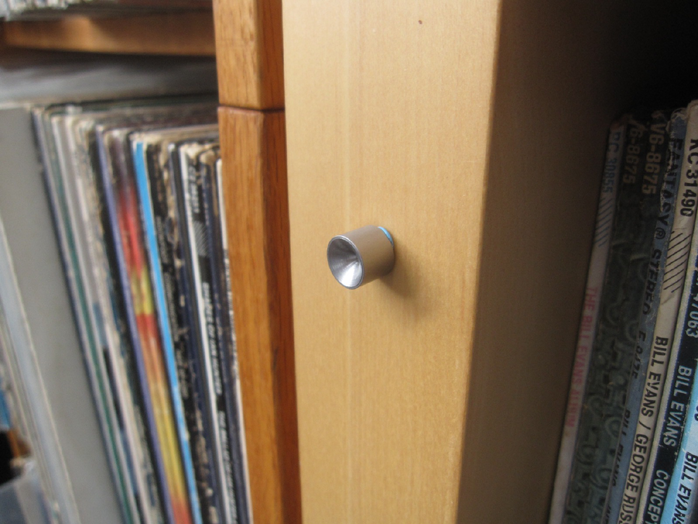
Next I asked Peter more about how the HFT devices work. He confirmed that the 8mm diameter horn-shaped opening is critical to their function. In fact the HFTs operate as an acoustical driver and somehow cancel harmonic noise at ultrasonic frequencies. The HFT effect on these ultrasonic harmonics has a positive effect on the harmonics in the audible range since harmonics from even ultrasonic frequencies extend into and affect those in the audible range. The HFTs are "creating sympathy between harmonics." He added that the HFTs "create a uniform energy field in the room."
Since some of what we hear from our speakers is delayed and reflected sound, it's helpful to address the nature of this reflected sound. Placing an HFT on a wall (or any surface in the room) creates a harmonic structure in this reflected sound that is more in sympathy with the direct sound from the speakers.
|
 |
Getting back at Synergistic’s list of sonic benefits, I must say that I am somewhat hesitant about claims number 5 and 6. While I heard these benefits relatively speaking, I hear much more lowering of the noise floor from a good power conditioner like the Nordost QRT power purification products (QX4 and QBase) which I use. In other words, the HFT/FEQ system will not substitute for a good power conditioner nor is it intended to do so.
Since I normally use a set of 4 Stein Harmonizers and their accompanying 10 Magic Stones as acoustic treatment devices, I decided to remove all of the Synergistic products and go back to the Steins as a point of reference. This was not a fair comparison on a cost basis since my Stein system retails for $3’999 while the price for the five packs of HFT devices and the FEQ was $2’245.
|
|
|
|
After the requisite 15-min. warm up for the Stein Harmonizers, I listened to the same musical selections as before. Bass had a bit more heft with the Steins than HFT/FEQ. Also the Steins produced a warmer sonic signature, fleshing out the midrange without any accentuation of the high frequencies. The Steins give a similar sense of soundstage expansion but the effects are not as completely enveloping as the full-blown HFT/FEQ combination. The ambience does not extend out in front of the speakers as far. Nor does ambience seem to be coming from the sides and behind the listening seat.
For me a major attraction of the Stein Harmonizers is that they improve dynamics. I do not hear this effect to the same degree with the HFT/FEQ system. With the Steins, instrument solos just soar into the room and become completely detached from the speakers. Despite being advised against it by Peter Hansen, I decided to try the FEQ with my Stein Harmonizers/Magic Stones. While I may not have been experiencing the full effect of the FEQ, I could clearly hear the benefits in the bass and soundstage imaging I heard before. For me this combination worked to my satisfaction.
|
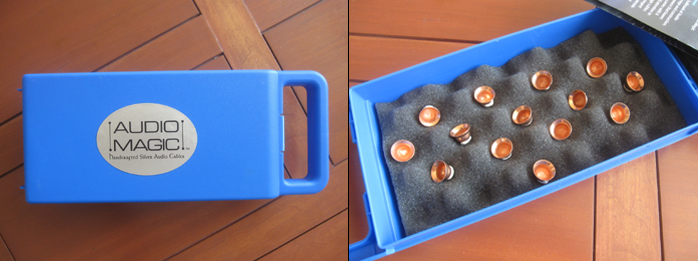 |
While I was finishing up my experimentation with the HFT/FEQ devices, a dealer friend of mine asked Jerry Ramsey, proprietor of Audio Magic, to send me his own acoustic devices that adhere to the wall in the same way as the Synergistic HFT devices. I certainly had no intention of stealing any thunder from the Synergistic products featured in this review but it seemed like a good opportunity to compare another approach to treatment of room acoustics - especially one that was similar to the HFT devices in implementation.
|
 |
  |
 |