 |
|
|
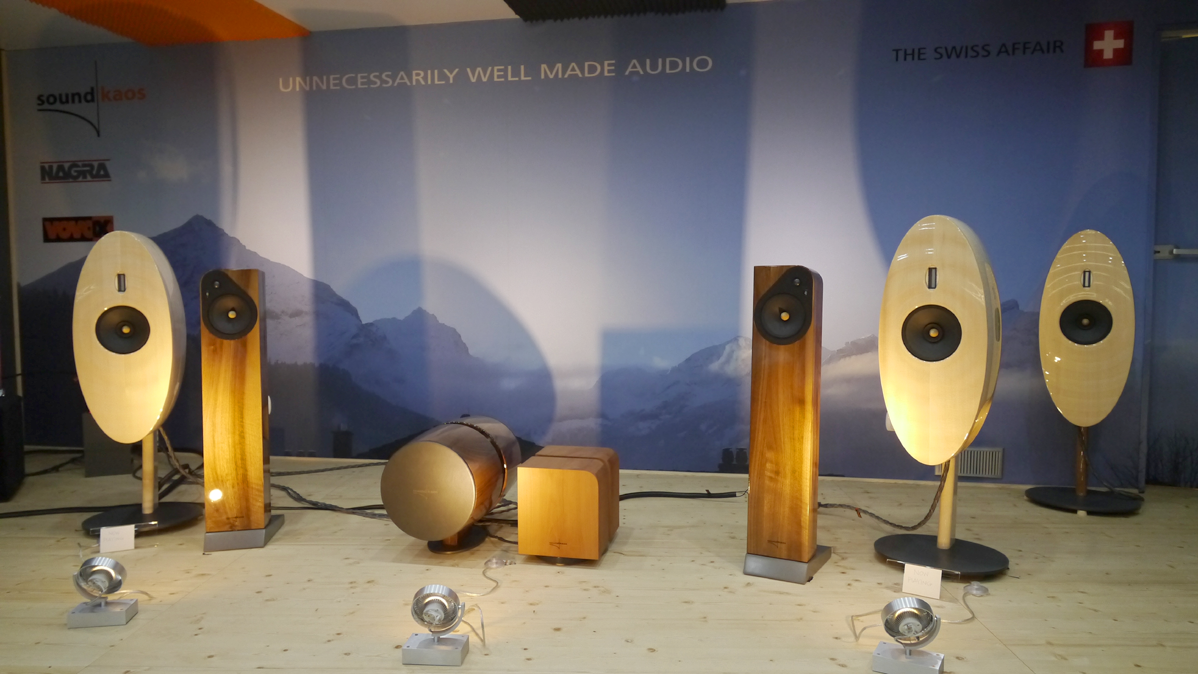
The time line of this narrative now skips over the Munich HighEnd 2015 show. For it Martin had once again pulled out all the stops to improve over the window-less cosmetically drab acoustically compromised cubicles which management provide on the ground floor for starting at €8'000. Dubbed the Swiss Affair, Martin had teamed up with Nagra and Vovox, with only the Artesania Audio equipment rack crossing south of the border.
|
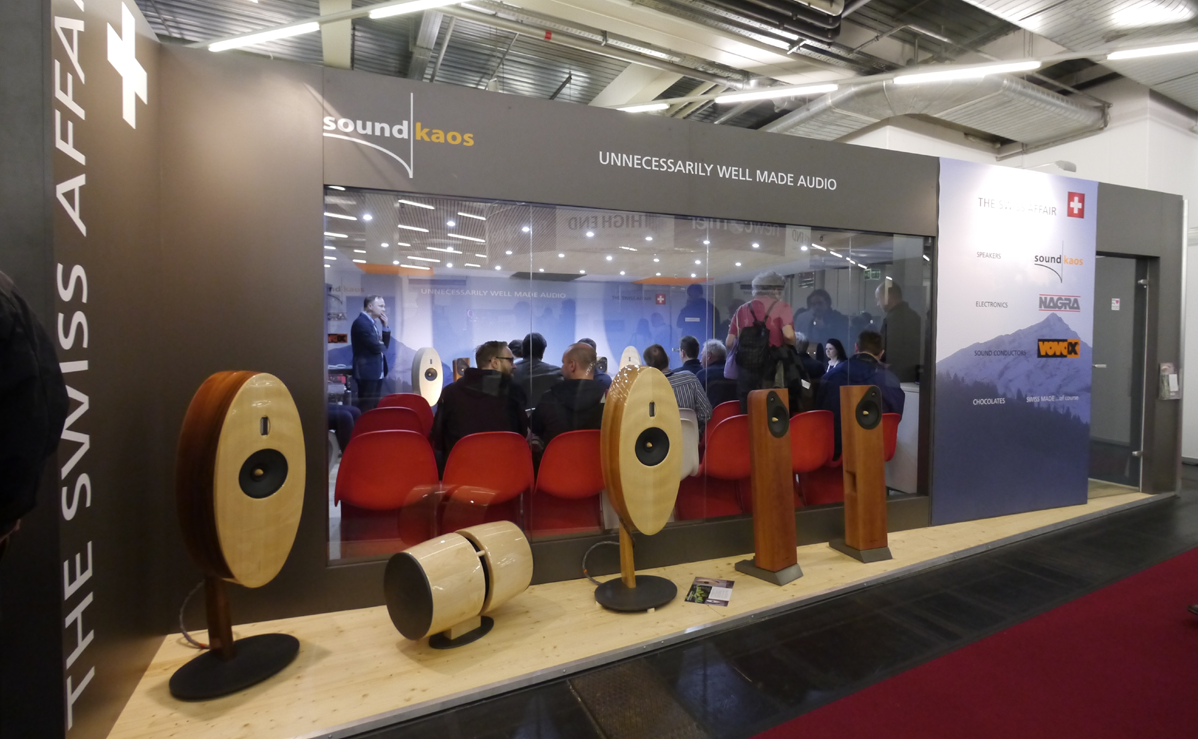 |
Original review pair on the outside.
|
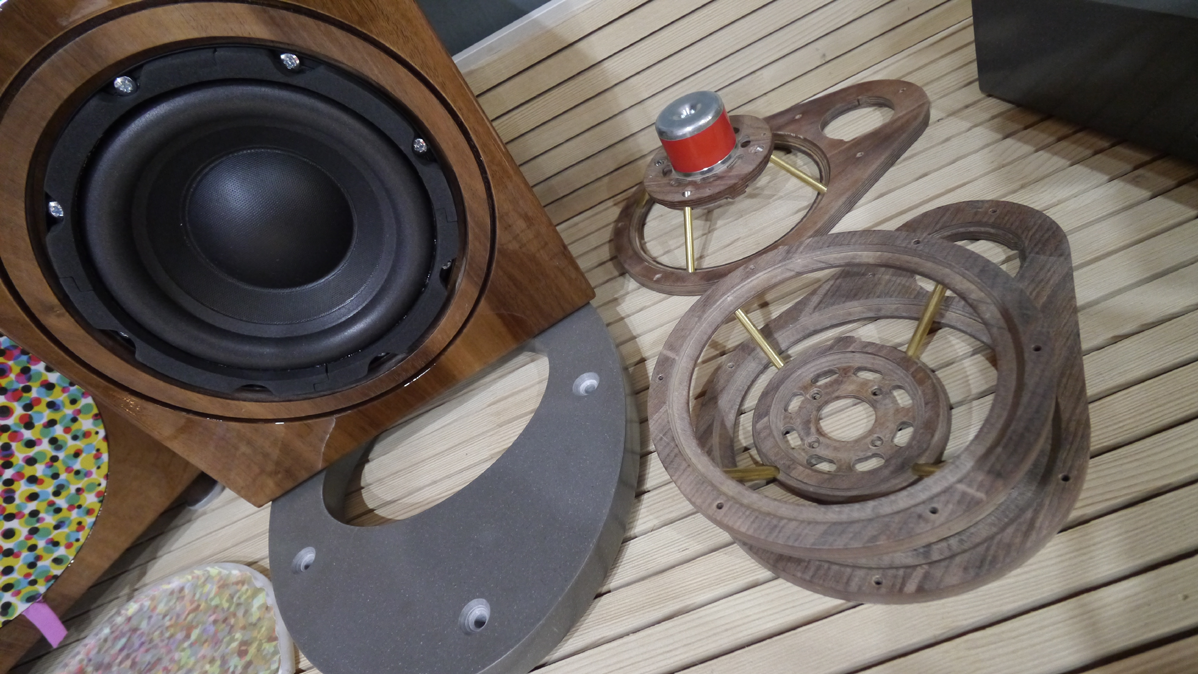
New were gloss finishes on the final executions of the subwoofers; a Corian joiner plate for the SK16's bass companion in isobaric mode; and final production Panzerholz driver assemblies for the SK16.
|
 |
|
 |
Looking real close, the attentive observer would also have noticed tiny Japanese Take-T super tweeters integrated into the Skiny's tear-drop driver modules. Martin was keen for me to hear those. Hence completion of the review would provide me with those very show samples. He and his alternative healer wife who works within the established mainstream medical
system both credit the Take-T units also with energetic advantages. Sound-only commentators routinely overlook a plain fact. During playback, only advanced yogis could turn off their other four senses. If for example a water fountain, essential oil dispenser or Amethyst geode in your listening room made you feel better, this pools very naturally into your audition. How could it not?
Ditto for a comfortable chair, comfortable clothes and shoes. If Franck Tchang's miniature singing bowls aka acoustic resonators, Steinmusic Harmonizers or Tachyonic devices improved the Feng Shui of your space—which is to say, made it and hence you feel better, never mind exactly by what means—how could your ear/brain mechanism remain immune and stand aloof like an independent referee? Or perhaps for you it's turning off your WiFi, using ionizers or plants to improve your oxygen and enjoying a well-lit harmonious décor to put your biology and psychology at ease. Whilst such very basics continue to exceed textbook acoustics, quantifiable test-bench graphs and standard reviewer commentary, it's all part of the totality of the playback experience; and plain common sense.
As regards the Take-T's aural contributions, this tiny version's efficiency is considerably lower than the other drivers. Unlike many external add-on super tweeters, it sports no matching adjustments. To compensate in a fashion, it wires directly into the full-range signal. Thus it relies on its own mechanical behaviour for bandwidth limitations, not any electrical filter restrictions. Just so, Martin feels that it delivers an airier feel than the same speaker without it. It should go without saying that rapid A/Bs often skip over any real chance for our total sensory systems to acclimate to potential extra-audible changes. This type investigation requires more patience. It relies on inquiring also into our feeling dimension. Even if it's less about 'hearing' and more about a vaguer 'sensing', it does pool back into the overall listening experience. Hence even seemingly tangential items like greater ease, higher bodily relaxation, a less busy mind and such (should!) count as success and validation. Or, you could write it off as imaginary.
|
|
|
 |
|
|
|
|
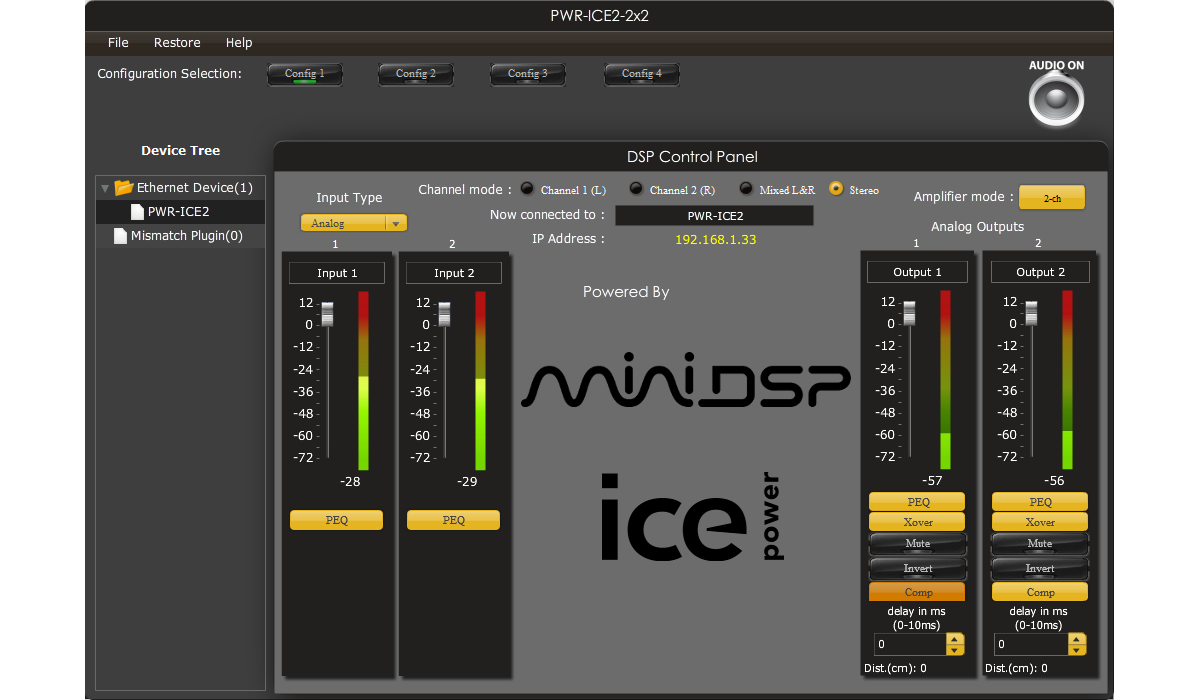
Back in the harder domain, Martin showed me how access to the MiniDSP engine of the 2-channel ICEpower'd sub happens by connecting the sub's Ethernet port to my Internet router and loading the proper software onto my PC via provided USB stick.
|
 |
| |
 |
Next we see the parametric EQ curve as preset for the SK16 companion stored as Config 1; finally the designated high- and low-pass filter values. Here a customer or dealer can store another three entirely independent configurations and tweak to their heart's content. Up to 8th-order filter slopes are available.
Whilst I had Martin on hand delivering the glossy show loaners, I elected to shanghai him into short-term slave labour to ferret out which the best-matching amplifier from our inventory might be: the Pass Labs XA30.8, FirstWatt F5, F6 or SIT2.
Into this load, the XA30.8 was all wrong. It sounded pale, strangulated, dry, overdamped, compressed. Uninteresting. We both heard it. The verdict was quick and ruthless. Next. The F6 was a truly different ball game. Now we had traction with "a completely different-sounding speaker". Except that the amp had changed, not the box. Anyone who frets over cables or DAC swaps puts the cart before the horse. The amp/speaker interface is most senior. Tend to it first.
Things got even better with the F5 whose slightly more piquant reading and higher separation power from a 3rd not 2nd-order THD envelope better intermeshed with the Skiny's naturally denser more fulsome midband. With the SIT2, things regressed again. It was similar in flavour and gestalt to the F6 but lacked the same conviction. For this room and into these speakers, the F5 had both our votes. Don't you hate yes men parties?
|
|
|
With that vital pre-review business sorted, serious listening could commence. Martin got duly sacked as my right-hand ear and I was on my own again. Which seems like the proper place to mention how educational and fun it can be to listen with experienced audiophiles whilst comparing impressions. It teaches one how different people may hear different things; or how they express the same things in different ways which perhaps shifts the emphasis or 'avenue of approach' but does lead to a perfectly shared observation.
As they had during their first stay, the speakers were once again set up with the tweeters facing in and the isobaric sub disassembled into its two halves sitting right adjacent to each SK16 and being fed discrete l/r channel signal, not a summed-to-mono
version.
A useful little new feature on the separate Corian bass amp box were the four now magnetized rubber-bumper footers. They make for instant conversion of the box's orientation. Place it upright or sideways.
Running my COS Engineering DAC/pre meant that its single RCA outputs wired into the FirstWatt F5 whilst the soundkaos sub amp connected via XLR. Having a sub panel with both RCA and XLR inputs proved really useful for occasions where a preamp may lack paralleled (multiple) RCA outputs; and avoids the otherwise necessary splitters. A final shout-out is due the glossy Walnut finish of the second loaners. Our household found that finish option rather more fetching than the first. Having different options is great. Maple, Cherry and Walnut fetch €7'085, €7'603 and €8'155/pr respectively, gloss lacquer adds €876. The Subwave D8 is €4'152 in standard matching wood species and adds €783 for the gloss option. The bigger Subwave D12 gets €4'752 in gloss. |
|
|
|
 |
|

|

|
|

