 |
|
|
Because the Sigma 2 are very bass capable—their 29.9Hz tuning is for real—an amp which plumbs it given how this ported alignment is properly damped becomes a sensible choice. As it turned out, the dual-differential Son of Ampzilla II fully played up that potential. It thus exxed out any even subliminal subwoofer dreams which in the first place would need to segue in at 10Hz to avoid unwanted overlap even with a standard 4th-order low-pass yet contribute a mere hence questionable ten cycles. At $3'000, this upscaled James Bongiorno circuit revived by EJ Sarmento's SST Audio offers dead-quiet 350 class A/B watts into 4Ω. That made for one very strong Sigma 2 contender. At $6'500, the class A 60 x 4Ω watts Pass Labs XA30.8 added more warmth and textural weight to stand in for a tube lover's push/pull choice. At €899, the 100 watts into 4Ω Clones Audio 55m op-amp monos gave up some sophistication and LF crunch but rewarded with a bouncy feistiness that acted far in excess of their physical petiteness. Grzegorz's response linearization made it so these small amps didn't sound stressed to deliver their best without turning into thermal novas. Swapping amps took note of what changed, what didn't. It was confirmation on core values one should tap pretty much regardless of appropriate electronics. With the Sigma 2, expect a firmly grounded bottom-up sound that's properly incarnated, never bright, capable of astonishing punch and very good focus.
|
 |
That last item appeals to audiophilia's visual aspects of imaging, stage mapping and layered depth. The majority of all the former items weigh in on uncomplicated life-sound satisfaction in row 10. That revolves around tone density, dynamic wallop and in-room tonal balance which inclines in the bass and declines in the treble as a straight but tilted line. Add a level of finish sophistication which had Voxativ's visiting Holger Adler at spontaneous hello to inquire about origins (today's Voxativ lacquer is applied by a Polish piano maker to set top standards.) Now Sounddeco's Sigma 2 appeals to rockers and sophisticates alike. After hours at the 2014 Warsaw show, they'd played Yello at serious party levels. This left zero doubt about their SPL stability. It fully demonstrated the power of these Satori drivers at volumes far beyond what we tap at home. In today's context, it'd be a lengthy detour to try and answer why so many high-end speakers don't sound good with popular music. They require a specialized audiophile diet to justify themselves.
Here we simply say that the Sigma 2 isn't one of them. For domestic purposes and beyond, it has sufficient dynamic headroom to scale in linear fashion without compression effects like dissonant higher-order distortion or other uglies.
|
|
|
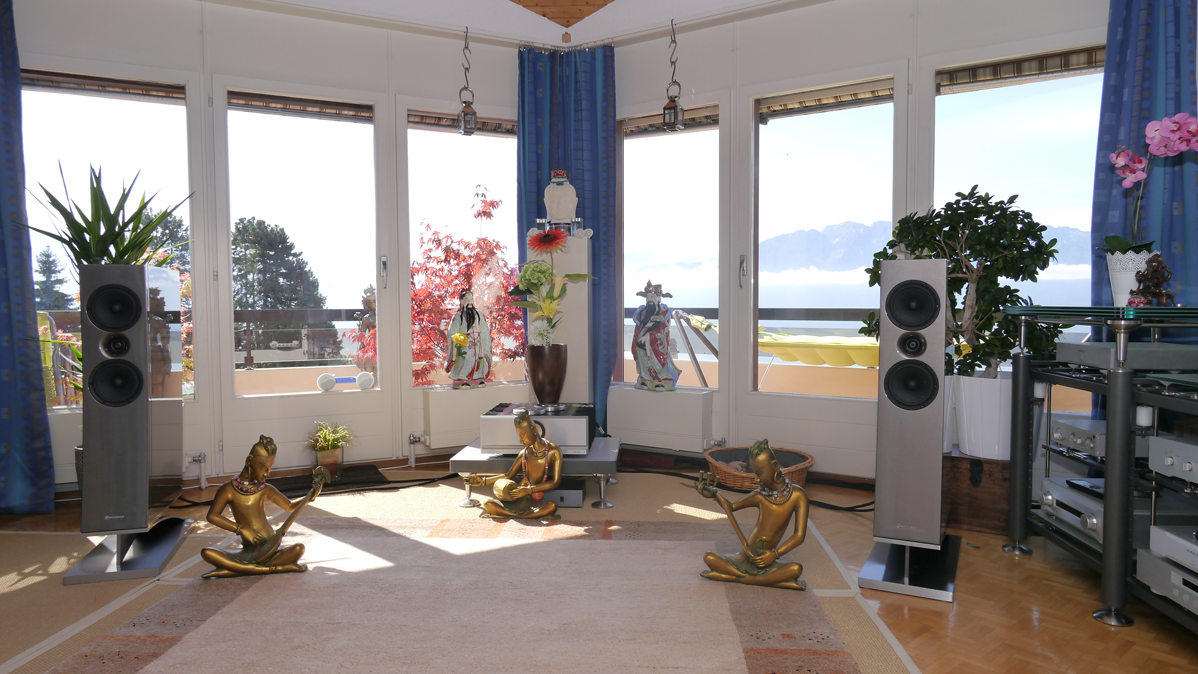 |
Quasi hornloading the tweeter bestows some extra headroom on it to keep up with the clearly endowed bigger drivers. Its textile diaphragm will also behave different than metals. Whatever the exact final reason, this speaker suffers no spot-lit treble, artificial airiness, stridency or undue sharpness. Peaks and high bass levels cause no anticipatory cringes. That becomes the comforting element. What advances beyond being a generally Rock-ready design of high output capability, solid bass, potent shove and benign treble are good focus and projection powers. Those qualities are likely due to physical time alignment and minimum-phase filters. Classical is thus served equally well. Here soundstage precision, timbre veracity, the challenges of massed strings and great separation become challenges to which a standard Rock speaker wouldn't be equal. What it all adds up to is a lack of fussiness. Such fussiness might sound stellar on a few truly great recordings but triggers endless compensation efforts to make 'normal' music productions sound enjoyable (or otherwise eliminates them from consumption altogether). Here one ends up with an all-purpose speaker which demands no special diva treatment to deliver across all genres and production values. It's an unbiased real-world proposition. Unlike the temperamentally similar Trenner & Friedl Pharoah which preceded it in the review queue, the Sigma 2 with its narrow baffle also is a domestically easy box. Its necessary cubic volume is concealed in depth, not flaunted by width. And it's a higher-resolution design than the darker thicker Pharaoh was. That required the DC-coupled wide-bandwidth Goldmund/Job 225 amp to cut through fully. But even then it didn't project as well as the Polish d'Appolito.
|
|
|
|
|
Compared to our Albedo Audio Aptica 6" two-way with ceramic Accuton drivers, the Sigma 2 behaved chunkier, dynamically more aspirated and tonally more generous. Versus our M1 EnigmAcoustics monitor, it wasn't as airy or explicit in its uppermost harmonics but retaliated with stronger lower bass, a fatter midband and a generally larger more pressurized demeanour. Minus its lesser bandwidth and lower dynamic range, the probably closest in-house kin was actually Sven Boenicke's compact but potent solid wood W5se. This was a good reminder. Quite different roads can lead to rather similar destinations. One can't judge speakers on appearance, parts or concept alone. Or as Ivette put it when sitting down with the Sigma 2, "someone had very good ears to design these." Quite; though a more careful observer would add "ears in accord with our own" given how much disagreement there is on what constitutes good sound. My own favourite thing about this sound was how it combined uncomplicated and high end. Without exception, all of our electronics worked. Not one disqualified for lack of balance. Not one caused poor results. Such easy click appeal is rarely mentioned. It more sounds like a dating site's slogan than hifi quality. But how else does one deliver good results to the larger majority without secret handshakes of unpredictable compatibility?
|
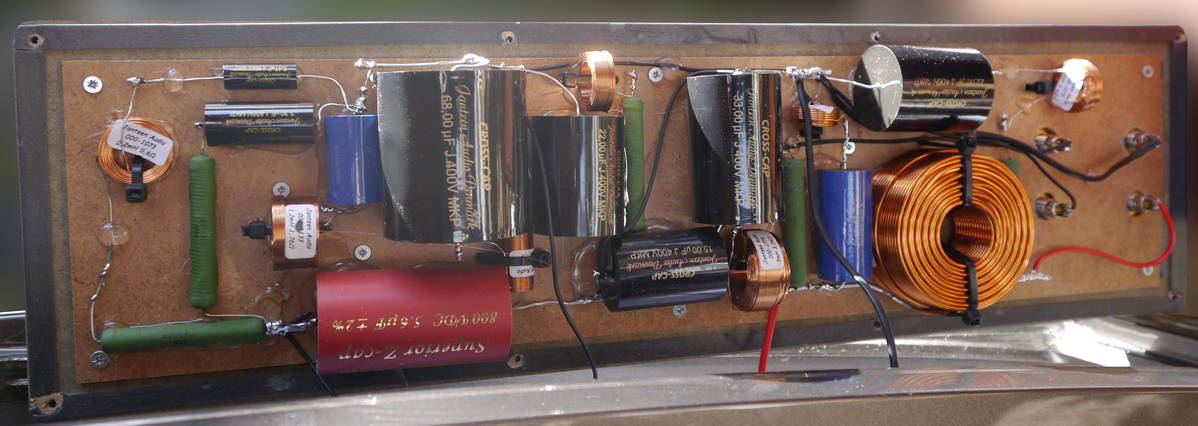 |
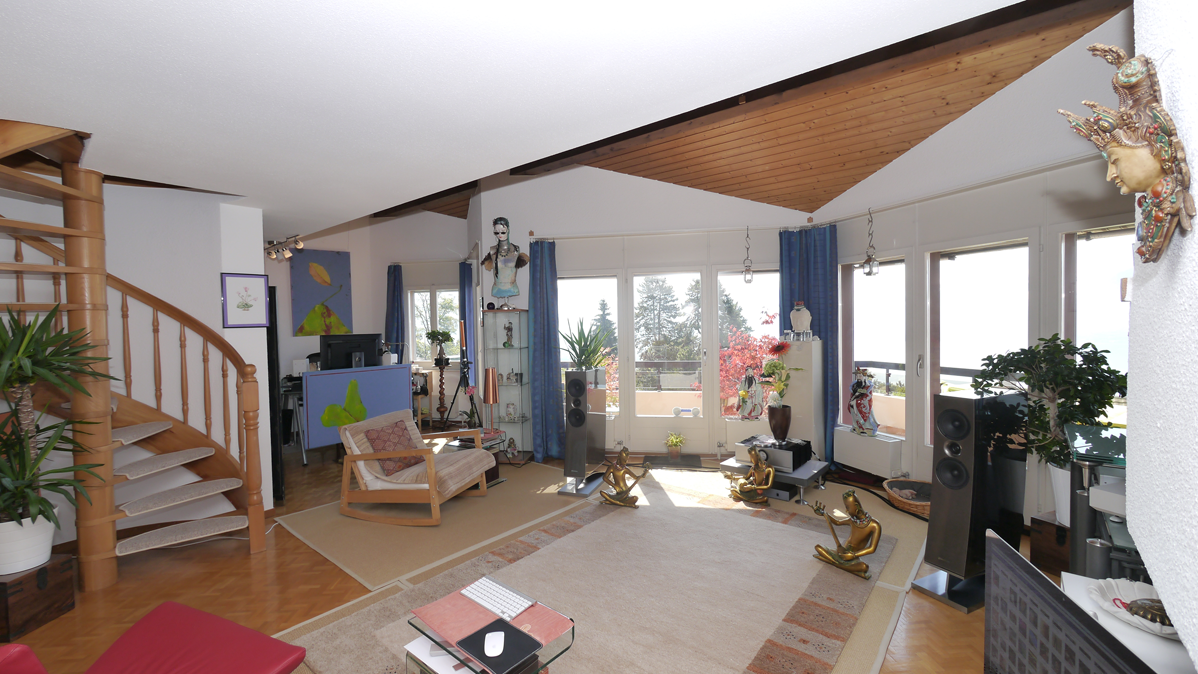
Going against minimalist 1st-order dogma, the above 22-part filter is clear if perhaps visually counterintuitive cause. Its effectiveness speaks directly to that famous dictum attributed to Albert Einstein - that things should be made as simple as possible but no simpler. The big wiggle room is in the last three words. Back to the leitmotif of projection power. A most practical benefit is not having to sit anywhere near the sweet spot. Despite the obvious wide-angle distortion, the next shot illustrates it. Even sitting at my work desk behind a large 30" monitor in what other renters would probably have made their dining room, the sound lost none of its substantial conviction, tonefulness or communicativeness. Whilst soundstaging and image localization obviously collapsed, listenability and satisfaction did not. If you find enforced sweet spotting asocial and unacceptable, the Sigma 2 is a far more social animal. In my book, that and not having to play loud are a big plus-sized plus.
|
 |
Veni vidi verdict. Following in the footsteps of Dutch contributors Marja & Henk who reviewed, awarded and kept Sounddeco's Alpha F3 as a reviewing tool, today's conclusion leads quite inexorably to an award. Whilst €8'000/pr are far outside an everyman's comfort zone or ability, the Sigma 2 in all other ways is a high-end everyman speaker. It's sized right, looks attractive, is easy to drive, plays without prejudice to musical genre, SPL or ancillary gear and sounds great well outside the typical stereo triangle. It complements typical multi-tasking and listening with a group of people. It's refined and uncomplicated. Given chosen distribution through a dealer network, fine execution and quality ingredients constitute fair value. The only 'iffy' part at time of publication was the early state of Sounddeco's global reach. Being able to audition a pair at a regional dealer was still very limited. For many readers, this review remains a preview of sorts; of something to watch closely over the coming years. Our award is not only well deserved, it should underline the worthiness of keeping your attention on something that will require some resourcefulness on your part to seek out. In this instance it's not the mandate of good things are worth waiting for—this speaker is available now—but that good things are worth pursuing despite potential obstacles and personal effort involved!
|
 |
Quality of packing: Individual custom crates per speaker shipped palletized, strapped and wrapped, with plenty of inner foam liners and a final cloth cover around the speaker.
Quality of finish: Caused Voxativ's visiting Holger Adler to compliment it who uses an actual piano factory to execute their famous piano-gloss black and white finishes.
Weight and size: Sized appropriate for most mid to larger sized rooms. 70kg per speaker includes a very substantial welded steel plinth which can be unbolted for transport.
Special application conditions: None. That's the entire point of the award caption.
Distribution: Developing dealer network.
Options: Gloss white and Sepang Brown lacquers standard; other colours by request.
|
 |
|

|
|
|

|
|
