This review page is supported in part by the sponsors whose ad banners are displayed below |
 |
 |
Playing musical chairs between the price-competing units arrived at a very easy conclusion. The SOtM played it white, the April Music black. Spirit and flesh. The SOtM was airier, lighter, leaner, quicker; the Stello meatier, darker, heavier, stately. One convenient but likely extraction would do a 50:50 to call SOtM's converter superior and April Music's amp circuit better. Adding fuel to that was triangulation via the Eximus. It added SOtM's qualities atop the MkII to combine meat and sizzle, black and white, material substance and light-filled airiness.
|
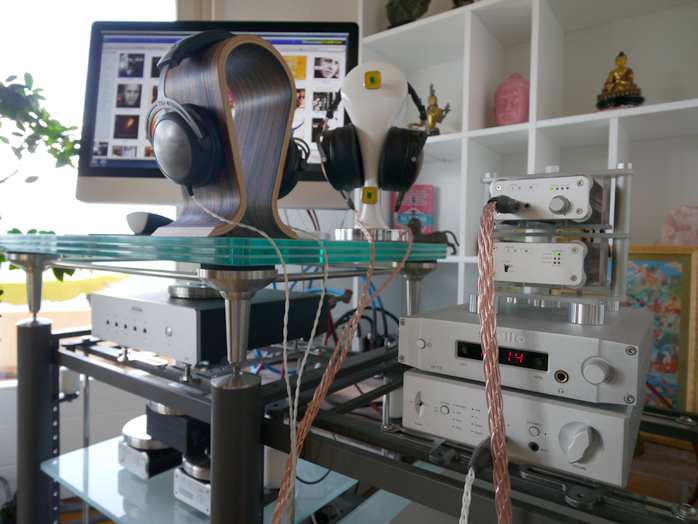 |
with beyerdynamic T5p and Audez'e LCD-XC
|
At double the cost, that even made literal sense. The Stello's 'weakest' link is its USB implementation. It serves as a stop gap to its matching full-bore standalone DAC. Meanwhile SOtM's primary area of expertise seems to be digital. The sHP-100 adds a quality headphone circuit which arguably isn't yet quite equal to Simon Lee's years of experience in this sector. Whilst it's risky to isolate integrated functions joined at the hip, this at least would be my read. The key attraction of the SOtM is its high-resolution converter. The 6.3/3.5mm ports become the added value.
|
|
|
On drive as to what loads it can get to desired levels without distress signals that would indicate pushing the margins, 3:00 o'clock on the dial out of a possible 4:30 produced decent loudness with HifiMan's super inefficient HE-6. On raw gain expressed as amplification factor, the sHP-100 proved to be mightier into low impedances than its petite dimensions and weight let one. That the HE-6 wasn't ideal was - er, driven home by nearly maxing out the pot; and knowing what the same load sounds like off the Aura Note V2's very powerful ICEpower module. Barring the justly notorious HE-6, all other cans in my collection remained within the SOtM's comfort zone though it's fair to say that unrepentant headbangers might close to or actually max out in certain combinations.
|
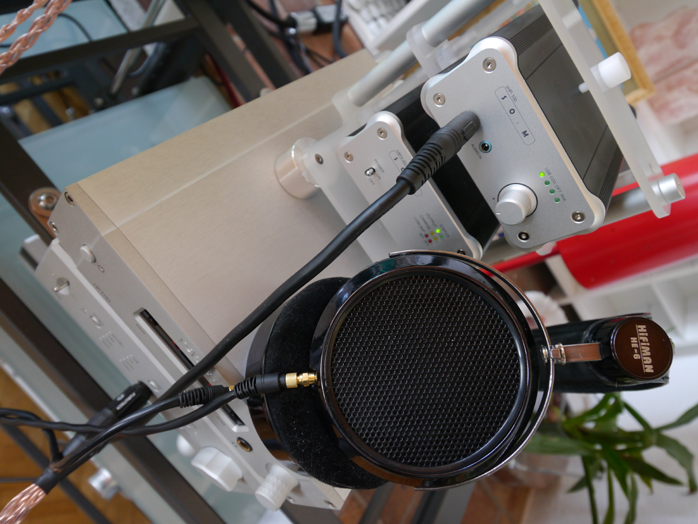 |
with HifiMan HE-6
|
As an unapologetic Audez'e fan, Sennheiser's HD800 occupies the opposing polarity. I admire it more than I love it. That the HD800 is capable of true greatness I learnt from the über-expensive Crayon Audio CHA-1. On sonically related amps of lesser coin (Bakoon and Questyle which likewise excel at speed and being lit up across the audible bandwidth), I find the Sennheiser slightly on the hot brisk incisive side - supremely airy and spacious but a bit sharp. That particular quality the SOtM played down a tad to personally hit a better balance. From this logically followed that a very earthy, dark, chunky headphone à la LCD-2 or MadDog wouldn't get as full a grease-cutting caffeine injection as it would from the HPA-21 or CMA-800R amps. The sHP-100 thus struck me as being quite close to the mythical middle. It worked as well with dark chocolaty cans as it did with bright airy ones. It didn't cater to any of them especially. There was no Burson-style lushness for the Sennheisers, no Bakoon-style acceleration for the planars. Even so I'd single out a small tendency for enhanced top-end air with its side effect of a fluffier than wirier sound that prioritized spaciousness over ultimate material weight.
|
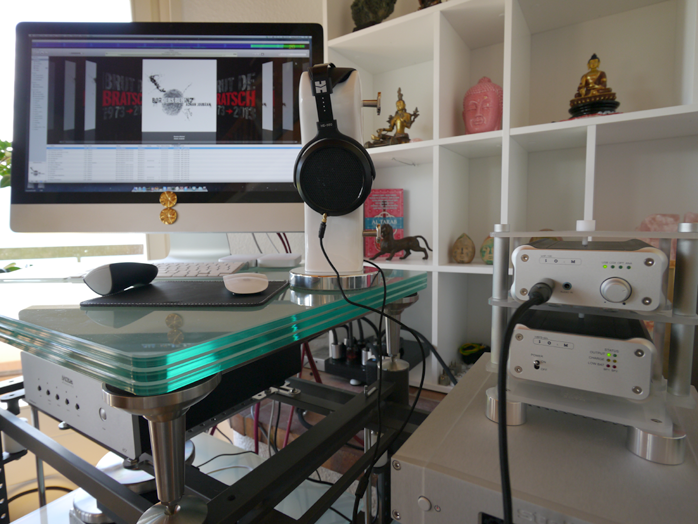 |
with HifiMan HE-560
|
HifiMan's new HE-560 is the first planarmagnetic which to my ears grafts atop the breed's minor lushness and darkness a more electrostatic treble. Whether it's the single-sided magnet array which doesn't create a partial barrier between ear and membrane I couldn't say. Either way the 560's treble is the most informative yet properly integrated of any ortho I've thus met. Its top end betters all three Audeze I've heard and the Oppo I reviewed. It's also more cohesive than the HE-6's and sidesteps its forwardness. The sHP-100 took to these aspects like a duck to water. I felt like witnessing a rare zoo birth. Two usually incompatible species (a dynamic driver's treble, a planar membrane's textures and richness) had crossbred to create a new hybrid. An inherently darker fleshier amp like the Stello would have played down some of that. With the SOtM I felt quite ideally positioned for the HE-560.
|
 |
Be it Reinhold Friedrich's soaring piccolo trumpet on Melchior Molter's Baroque concerts or the enormous studio-crafted soundscapes of Mercan Dede, the sHP-100 with the HE-560 excelled at Gallo-esque space mining and a very impressive recreation of audible 3D. The only criterion not as impressive was the <50Hz range where a swap to the other Koreans from April Music dug in deeper. Particularly with Dünya this was relevant. Mercan Dede loves to combine acoustic instruments with synth-generated infrasonics. |
|
|
Whilst Fang Bian's HE-560 isn't as bottom-end bodacious as the pre-Fazor Audeze—hence I hold on tight to my original LCD-2—it was capable of a bit more than the SOtM got from it. This reconfirmed that our battery-powered amp plays it minorly top down not bottom up. But the Stello rerun also confirmed that on detail magnification the sHP-100 kept pace with the Eximus, company in which the HP100MkII found itself outclassed when it came to ambient recovery and recorded reflections. Now we'll make a very brief detour into Ethernet cables under the header "the spirit was willing, the flesh was weak". The flesh were my trusty pink bits. Though I was mentally fully prep'd to hear a difference, SOtM's 10-meter Ethernet leash streaming Qobuz FLAC files didn't sound any different than my garden-variety cable. When not using my iMac for anything but streaming, I had no drop-outs or occasional weirdness from either. Yet double-teaming the iMac for web surfing and streaming, I had the usual interludes of skips and misses with both cables. For now I plead the fifth against self incrimination when it comes to audiophile-approved Ethernet wires.
|
|
|
|
Conclusion. Small and spread out over two main boxes with a small third one aka the switching battery charger, SOtM's tongue-breaking sHP-100 with mBPS-d2s and umbilical spreads out more than some could fancy. Hence the optional stand to get fully sorted if spending a bit more is in the picture. The power-cycling 'endless' battery supply is fully mature and well-proven tech. I can vouch for it with extended ownership and daily use. SOtM's digital chops are equal to April Music's. Their big converter/preamp competed directly against a Metrum Hex or AURALiC Vega and fell sonically right in-between. It was neither as lush as the latter nor as timing keen as the former. The DAC inside today's headphone amp struck me as equivalent to what's in the Eximus DP-1. That's high praise. The headphone circuit by comparison seemed more lightweight. But because it's integrated to bypass an analog interconnect, it avoids some related losses. It'll drive all the usual full-size cans to solid if often not extreme levels. I found a particularly fortuitous match with HifiMan's HE-560. This combo created a lovely balance of very high resolution, easeful airiness and cubits of space to make for dense multi-layered staging. Yes, soundstaging. It does happen even with headphones when the right bits come together. In short, the sHP-100/mBPSD-d2s is another successful bonsai-audio entrant into the very happening headfi sector. It's also a reminder that a lot of excellent hifi today comes from the very same country which for smartphones has topped the almighty Apple: South Korea. It's home of course to Samsung and Hyundai/Kia. But it's home also to Allnic Audio, April Music, Bakoon, Codia Acoustic Design, Takt... and Soul Of the Music. |
|
 |
 |
|
 |
|