|
|
|
"Artyom passed on how information about the forthcoming SE version might be of interest to your readers so here we go.
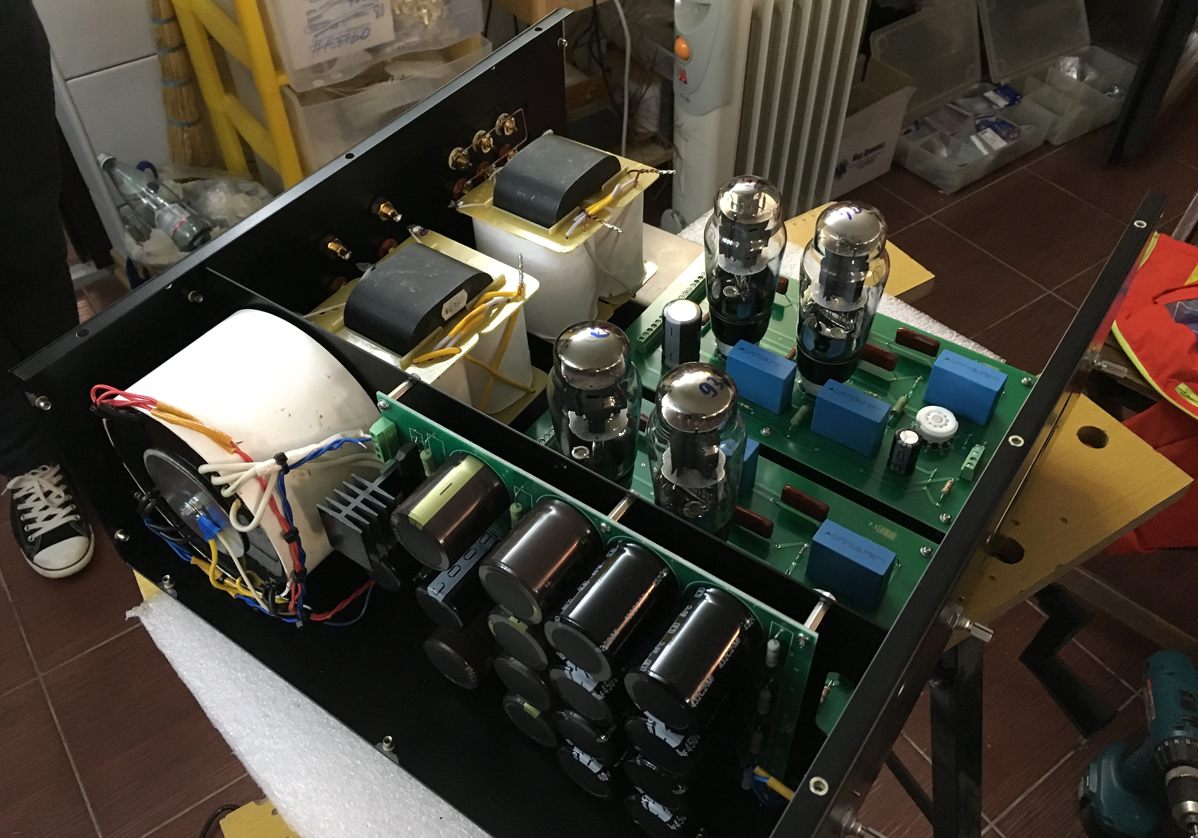
It all started with the Blackbird. Honestly, I didn't expect such high-speed interest in this model. I had 15 orders over just 2 days. When thinking about the opportunity to create an affordable series for hi-end lovers, Blackbird was the 1st-level model at about €1'000. Then I thought what I might offer for subsequent levels at €2'000, €4'000 and so forth. Now we have the Level 2 SE at €2'300 which includes delivery to any EU country. Its power output scales to 30 watts into 4Ω. That of course requires a totally different level of power and output transformers, so more serious expensive iron. Later levels of this platform will operate single-ended, not push/pull. One more important point. When I started work on the Blackbird amp, I realized how each level can't exceed 50 units as my valve inventory is limited."
|
|
As chronicled elsewhere, I used to own a number of valve amps over the years, from PX25 to 300B to 45 variants from Art Audio, Woo and Yamamoto to EL84 and high-power 6550 push/pull pentode models from Trafomatic and Octave. Then immersion into the FirstWatt catalogue of low-power class A transistor amps of the single-ended and push/pull persuasions instigated a change. It had me divest myself of remaining tube models. This shifted thermionic contributions to line-level signal in the Nagra Jazz preamp and Aqua Hifi LaScala MkII and Fore Audio DAISy1 converters. For a while now though I'd wanted to add one or two valve amps to my tool box again to be a more comprehensive reviewer. They'd simply have to suit my 85-93dB speaker harem which lacks ultra-efficient specimens of the Voxativ/Rethm widebander or Avantgarde hornspeaker sorts. With power specs like a FirstWatt F7 transistor amp, a Blackbird SE fit that bill to the 't' for tube. I thus ordered a unit for personal use with the ivory/off-white face plate option to play to my "I hate black hifi" mantra. Alexey confirmed that he'd be able to ship a unit by the end of January. This review would thus close out with a postscript on some friendly sibling rivalry between low and mid-power Blackbirds. |
|
|
|
|
|
Literary detour. Eric van Lustbader keeps doing it for Robert Ludlum's Jason Bourne character. Now David Lagercrantz has done it for Stieg Larsson's Lisbeth Salander aka the girl with the dragon tattoo. After the deaths of their wildly successful creators, these writers obtained permission from the estates to pen further novels about their colleagues' famous characters. It's first a stylistic challenge—the reader shouldn't notice a different writer—and then one of fluid seemingly inescapable character development whereby, spinning out from seeds left dormant or plots unfinished, one learns more of these beloved protagonists. Deeper layers of their psyche peel back. Outward exploits continue. Earlier gaps not recognized as such are filled to retroactively serve completion, deeper meaning and new connections.
Having over Christmas read Lagercrantz's first contribution to the Millenium Series, I marveled at just how seamlessly he steps into Stieg Larsson's world down to syntax, structure and secondary characters. This spotted a connection to our subject. The first author is the recorded signal, the original creator. The new writer is our system as the co-creator.
This hits upon the divide between two camps on what hifi should be. One is the "open window on the recording", an oxymoron at best since nobody but the recording engineers know what the recording is. The rest of us guess through the distorted lens of our systems. The second view not only admits to the lens effect but asks whether a carefully assembled hifi cannot be more than a flawed Xerox copy machine. Such people view themselves as playback's co-creators. By implication, it makes their hardware part of the co-creative process. The recorded world and its chief protagonists are recognizable in full detail down to their tattoo on the back. Beyond that, one also should—or at least could—expect or hope to see things in a new light.
|
|
|
That's where it gets interesting. That's where it moves beyond dumb scope-jockey graph worship into enhancements of gestalt, alternate points of view and strategically administered lighting effects to pursue something new and different. One may enter the theatre of playback through various doors to arrive at a different perspective though all end up in Rome. There's the door of timbre and texture. There's the door of dynamic contrast. There's the door of soundstage mapping, of in-room projection and presence. One could view the experience solely on the basis of its somatic impact on one's blood chemistry. And so on. Either way, there are never more or fewer performers on the virtual stage. The basics remain. They are encoded in the recording. No hifi is bad or invasive enough to delete them or exchange instruments for others. Changes in perspective simply alter the relative weighting of certain values. They shift priorities and a such, the aroma and feel of the performance. Here the Blackbird does speak with a unique voice.
|
 |
|

|

|
|