|
|
|
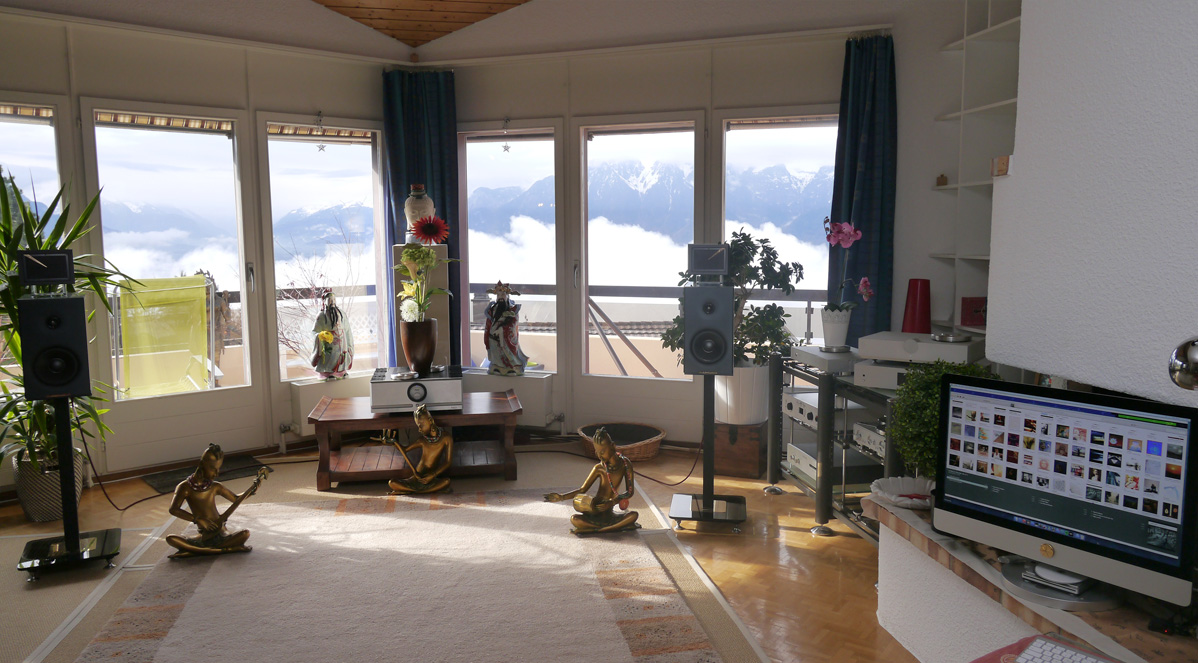
iMac | PureMusic | Phison or COS | Pass Labs XA30.8 | EnigmAcoustics Mythology M1. Leashing up the DAC/pre and amp balanced, this was a low-impact system on box count and complexity. For even greater integration, the Phison/Pass combo tag could buy you a Gryphon Diablo 300, albeit not yet with its optional digital module. Whilst I keep two tubed converters on hand—the Korean Fore Audio DAISy1 and the Italian Aqua Hifi LaScala MkII—I'd not holster their lot for this shootout. Phison's design brief is all about neutrality, minimizing noise and increasing resolution. It's not about injecting flavour. Hence I was far more interested in how two costly transistor DACs with proper analog volume and balanced circuitry might still differ. Or not. If the latter, my thinking of the previous page would explain it. On the same subject, nobody ever listens to digital. Design in the digital domain (ICs, filters, firmware customization, digital receivers, upsamplers, clocks & Co.) occurs purely on the scope. It's only post conversion that effects of changes in the digital domain—perhaps even disregard of certain application notes for specific silicon—can be listened to as a now analog signal. Of all the components in a hifi, a DAC could most easily be designed purely on the test bench, no auditions involved. Whether such a lab-rat approach would make for top sound is an interesting question - for another day. Today we'll get on with the listening of us subjecto cats.
|
 |
For starters, costing 50% less whilst sporting the snazzier GUI didn't handicap the Phison's sonic performance. Not in the least. COS Engineering has gone extra miles toward extremist metal finishing without Phison's visible fasteners on top. Such designer clothes simply cost big even if they do nothing for the sound. Following on the heels of the sobering if not unexpected sonic realization came that these two machines were far more alike than not. There was some difference but following our reader's lead, it was about different, not superior vs. inferior. Noticing this was one thing, dissecting and abstracting it to neatly fit the usual audio lingo another. It wasn't about tonal but temporal balance. An empty bath room has a heavy temporal balance. Decays linger long. This creates layered overlap, like playing a piano with the damper pedal disengaged. It enhances tone like 2nd-order octave-doubling THD does. An anechoic chamber has the lightest possible temporal balance. There are no reflections, no venue-based decays. When a tone stops, it stops dead without delay. In hifi terms, the first extreme is a very wet, redolent, reverb-intense underdamped acoustic. The second acoustic is dry, ultra precise and overdamped. The reality of most listening rooms falls somewhere in-between (though not in a linear fashion across the bandwidth). The D1 presented the recorded acoustic as a bit more wet. Its sound had a tad more inherent bloom. The PD2 played it a bit drier and more damped. You could say that one was slightly heavier on the trailing edges, the other on the leading edges. In terms of perception, one felt slightly more poetic, the other a tick more accurate or precise.
If you buy into MQA's 'temporal smear', you'd say that the Phison had less of it. |
|
|
|
|
That, essentially, was it. To sprout out this observation's seed form, we see obvious consequences. A drier acoustic enables crisper separation with less feathered edging. A drier acoustic also removes a bit of atmosphere. That's equivalent to the typical enhancement around solo vocals when a recording engineer deemed them slightly lean to tweak up richness with some faux reverb. The logical upshot is that on intense percussive material—clicks, ticks, beats, clacks, steep noises—the PD2 exercised stricter apartheid. Its separation powers were more crystallized. Just as logical is that the D1's tone was more texturized and round, hence its transitions were a tick softer or fuzzier. Now we must step back and reiterate that these were minor shadings. This was not about more bass, less treble and other rudimentary liberties. Neither DAC ballooned up images or exaggerated soundstage scale like some tubed converters do with very deliberate action. Neither seemed in the business of fattening up or dropping weight, of speeding things up or slowing them down. Obviously audio neutrality is unknowable. As far as we think that we can intuit it via triangulation and experience, I'd call both DACs designed according to strict neutrality, diverging little enough to both feel smack 'in the middle'.
|
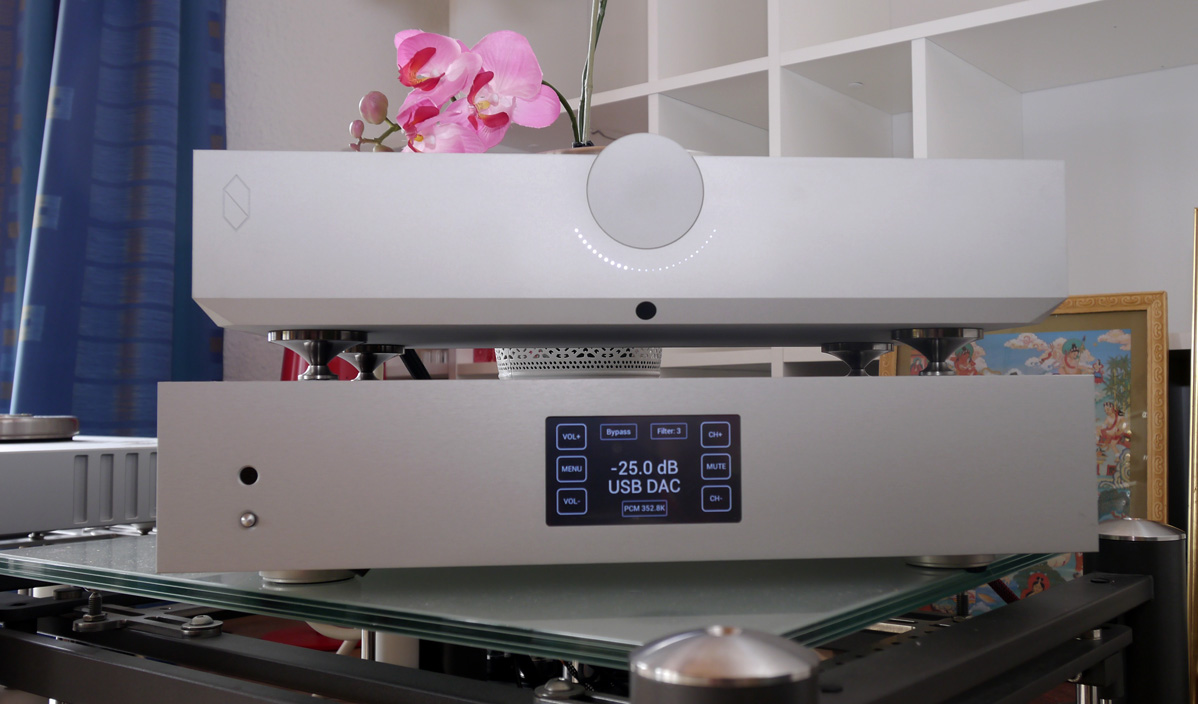 |
Filter 3 was my favourite but it's a subtle more feeling than thinking thing. DSD works as advertised but my library contains less than 10 DSD albums to make that irrelevant.
|
|
Relevant whenever one invokes sharper separation—the ability to keep convoluted musical strands separate without clumping up—the Phison still exhibited that innate soft touch or gentleness which offsets the needly pixilated qualities particularly vinyl lovers often accuse digital of. The PD2 managed to sort, separate, spread out, define and articulate the soundstage in its breadth and width without deep-fried crispness. It was precise and mellow at the same time. High resolution wasn't paid for by feeling pushy, clipped or nervous. I could hear Anouar Brahem move his oud relative to the microphone and how his fades intermingled with the piano and standing accordeon notes without any sense of pretense. I heard the vaguely steel-drum harmonic reactions of Manu Delago's hang [left] on Anoushka Shankar's new Land of Gold album. In my personal vocabulary, this quality goes by 'easeful hi-rez'. |
|
The fact is, close-mic'd recordings can present detail density far in excess of a live concert in the farther rows, even in the hotter posh seats. Treated by detail-obsessed hifi, such albums can soon leave us feeling badly assaulted, overrun and finally exhausted and turned off. The Phison's detail delivery didn't. It was easy, elegant and incidental, not a self-conscious show-off. That quality is often called flow to oppose choppy or metronomic. Whatever you fancy calling it, the PD2 had it. None of it shifted, crumbled, faded or turned when the volume went down. Unlike on-chip digital attenuators which nearly always bleach out at subdued levels, the Phison categorically did not. If you fancy the occasional 'daydream' session fully focused on the music in your inner zone to require little SPL, the Phison will accompany you very late into the night. If you want more detail, refer to my prior COS Engineering D1 review. You already know how close these two machines are and exactly where and how they beg to differ.
|
 |
The wrap. In my view, everything sounds good loud is simplistic but close enough. A hifi's true test sits, sharp pen and test score in hand, at the opposite end. How satisfying, compelling and addictive is it at low volumes? The Phison aced that test with flying colours. It worked flawlessly and was functionally complete. Had I encountered it before the COS Engineering D1, I'd have acquired the PD2 instead and saved some coin. For those who see no sense in a separate preamp today, a DAC/pre with legacy analog inputs and XLR/RCA outputs to include an active subwoofer is the perfect solution. If an amp/speaker combination is well matched, a separate preamp with additional cables can't really improve the sound. It can change it; make it different. But why should that be desired if the vital amp/speaker unity is properly addressed? If you're homunculus digitalus, all you need is a premium DAC with proper volume control that will drive long cables if necessary; and has enough gain. Even if you're homo vinylus, Phison's expansion bay will have you covered. Not tested but supposedly the cat's meow is PCM-->DSD conversion in computer software. What's left to say? With their new hifi brand, Philip and Sonny Anderson have their work cut out. Distributors and dealers are overrun with more choices than space or money. If the forthcoming amp proves of equal calibre as today's deck, Phison Audio could simply become a super-short line. That makes it far easier and more attractive to slip into small retail gaps. You needn't displace an established brand. You can be added whilst offering another complete system. From build and featurization to performance, the Phison PD2 from Denmark is the real deal. It's also a really smart buy if you shop in the <€10'000 league but prefer to spend closer to half. Quite the rocket of a launch then...
|
|
Postscript: Due to how I buy music and listen to it (local and cloud files), not a single of those albums is in DSD. I keep just a few such files on hand to test a DAC's ability to digest them, not because I want to listen to their music. To me then, DSD is an utterly irrelevant fashion fad. I previously did review three DACs which treat all PCM as DSD (APL Hifi, Meitner, Nagra) and found them to exhibit a similar, slightly sweet soft signature whose treble was less resolved than PCM equivalents. I concluded that I preferred PCM as PCM. I thus never acquired a DAC for personal use which does native DSD. Obviously others have different music and sonic tastes. To them DSD is important. That includes Sonny. As he put it, he specifically selected the AKM chip for its DSD abilities. He was thus keen that I report on PCM-->DSD conversion. To facilitate it, he contacted me post publication and offered an HQPlayer license for my iMac. As for testing the PD2 as preamp, I no longer own analog sources. Even Sonny agreed that it'd be a bit silly to run another DAC into his machine. If you own a DAC you love but need volume control, it makes no sense to spend money on a new DAC/pre. All you need then is a basic preamp; or a passive volume control like this $295 remote-controlled R-Cube.
|
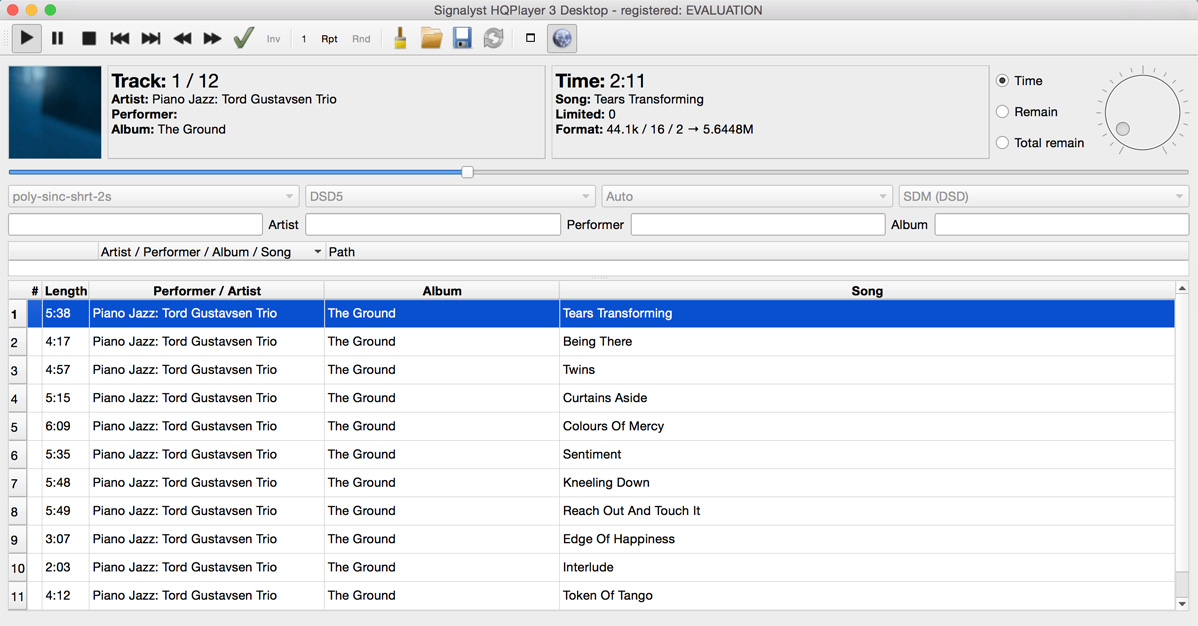 |
Space. The final frontier. Trekkies recognize the words. PD2 users running 44.1kHz --> 5.6448MHz conversion would, too. The primary effect I heard was of more pronounced spaciousness. This was coupled to a softer gentler more ethereal feel. By contrast, PCM processing sounded more matter of fact but also—and to my ears, this was decisive—more robust and substantial. Opinions on transient handling would probably diverge. PCM as DSD was mellower. Those who find standard digital too sharp could prefer it. I found curious in DSD mode a subliminal sense of what I can only call a form of dither. It's what seemed at the root of its enhanced spatiality. After all, space is emptiness. Audible space is silence. When silence is silence, why would that of DSD sound or feel different? Imagine putting some sort of markers on it. Think of how motion capture does it with green dots on otherwise black-suited actors. Think Andy Serkis as Gollum or the rebellious Caesar of Planet of the Apes. Now you would, somehow, see/hear space in a more heightened mapped fashion. The DSD dither sensation I felt acted like those green markers. As I had during earlier DSD encounters, I again heard more muted treble with less sheen and shimmer on triangles, less brilliance on a piano's upper registers. Personally, I remain an unrepentant PCM man. I favour more substance over that slightly ethereal thing. But, I can appreciate how someone else could favour the DSD flavour. And it seems fair to call it a flavour. With the Phison, you needn't own a single DSD file to enjoy it. You'll just need a software program like the rather geeky HQPlayer—I'm told Roon can overlay it for a better GUI—to convert your entire library on the fly. It's math-intense work but exploits your computer's modern processing power. Alas, if you misconfigure HQPlayer's settings, you can generate very nasty noise. Be sure to carve your learning curve with the volume way down just in case. In the end, I found DSD far from superior. I'll continue to call it different. The Phison gives it to you both ways. Decide which you prefer. Change your mind. Adapt to mood and material. With the PD2, it's all in a single audition's work.
|
|
 |
|
 |
|

|
|