|
|
|
|
As anyone can read directly in NAD's so-called white paper, the Masters Series M2 kicked off in 2009 with a novel take on digital feedback. NAD call it noise-shaping error correction. Dubbed DirectDigital™, it appears also in the M12 and M51. NAD name their Director of Advanced Development Bjørn Erik Edvardsen as the responsible party who tracked the progress of UcD and its present culmination in nCore to pursue this new collaboration with Bruno Putzeys. Unlike NAD's digital amplifiers where a PCM signal is converted to a PWM equivalent which switches the output devices directly, nCore is an analog switching tech which consequently relies on analog inputs. The M22 and its 7-channel M27 variant are fully DC coupled from input to output to avoid all signal-path capacitors. With ~150mW standby draw and typical class D efficiency, the M22 is a very green modern proposition. A two-stage discrete power supply offers >120dB ripple rejection for all the low-power circuits including input stage and nCore driver/modulator whilst using synchronous rectification for "low losses and elimination of supply pumping". Safety comes from electronic rather than relay protection to eliminate the more common output relays with their negative impact on output Ω. The driver and output stages are discrete.
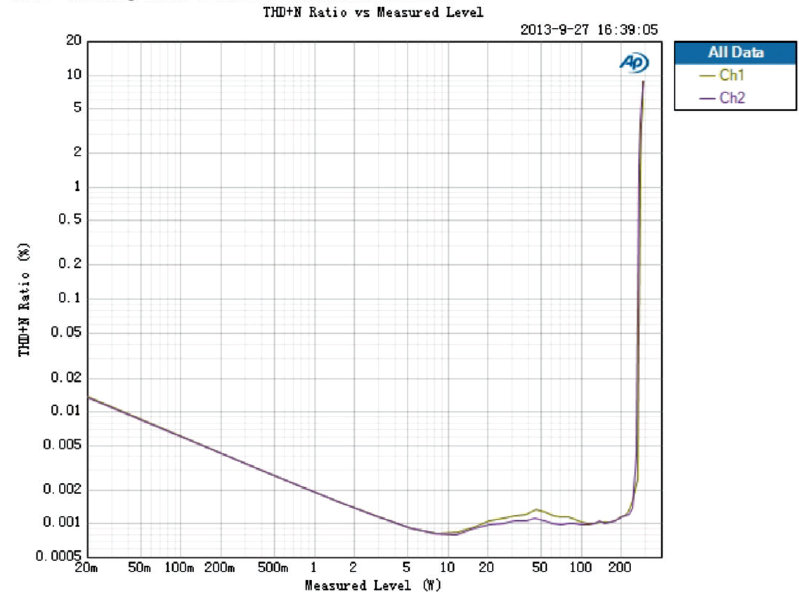
A look at the performance specs is telling. RMS power is 250 watts from 8-2Ω. Dynamic power (1kHz/10ms) meanwhile is 350w into 8Ω and more than 600 watts into 4/2Ω. THD+N is claimed invariable at 0.005%. It remains stable up to full power regardless of whether measured at 20Hz, 1kHz or 6.5kHz. Intermodulation distortion too doesn't vary between 1-100 watts and merely tracks impedance, being 0.002% into 8Ω, twice that into 4Ω and 0.007% into 2Ω. Full bandwidth S/NR is -102dBA, gain is 28dB. Against these basics, it's now sensible to ask Greg Stidsen about NAD's custom modifications to nCore. |
|
|
Did you consider TI, ICEpower, Pascal and Abletec/Anaview during the M22's R&D cycle at all or was nCore the decisive discovery which led you to reinvest in analog switching amplification?
Given that all existing commercial realizations of nCore are based on the NC1200 module and far higher retail pricing, how did the customization of the NC400 DIY module come about and what were NAD's specific goals and requirements behind it? Was NAD's volume capacity a decisive influence behind being granted a special license for this customized technology? What can you tell us about the team work between the Hypex and NAD engineers who collaborated on this project?
Who manufactures these boards? Are they sourced from Hypex's suppliers or NAD's own?
Is the switch-mode power supply Bruno Putzeys' original design or has it too been modified in concert with the 400 module? Did you at any stage entertain a linear power supply as AURALiC have chosen for their take on modified UcD 400 in the Merak monos? If not, what in your opinion makes a properly designed SMPS superior or more desirable in this application?
Aside from cost, what do you view as the advantages and disadvantages of the M22 vs. M2 technology relative to an end user who already owns your NAD M12 preamp to have the option of connecting to the M22 with the analog outputs or to the M2 via the digital outputs? What should the decisive purchase considerations be?
Given NAD's embrace of class D topologies, do you believe that the days of linear gain topologies are numbered? Or do you believe that if cost was no issue, class A or A/B still has some sonic advantages which class D can't as yet equal?
With NAD's 'new' price points of the M Series
relative to the humble 3020i beginnings, does the company have an internal mandate for a price ceiling beyond which NAD won't press? Put differently, is your embrace of new technologies always contingent on being able to scale it to specific price points; is there room for some cost-no-object future product; or *are* the current M Series range toppers NAD's take on cost no object?
As NAD's man looking forward at emerging technologies and likely uses and applications to help shape your company's product portfolio, what do you foresee for hifi's future over the next 5-10 years?
Relative to insider grumbling about Chinese outsourcing in certain quarters, what has your experience been of manufacturing upscale gear like the M components in China? What types of protocols were required to assure the consistency and quality you demand? Do you at all suffer from being cloned and having your IP violated? If so, how do you deal with it? Finally, how big of a company is NAD today?
|
|
|
|
|
| |
| |
| |
| |
| |
| |
| |
| |
 |
|
|

|
|