This review page is supported in part by the sponsors whose ad banners are displayed below |
 |
 |
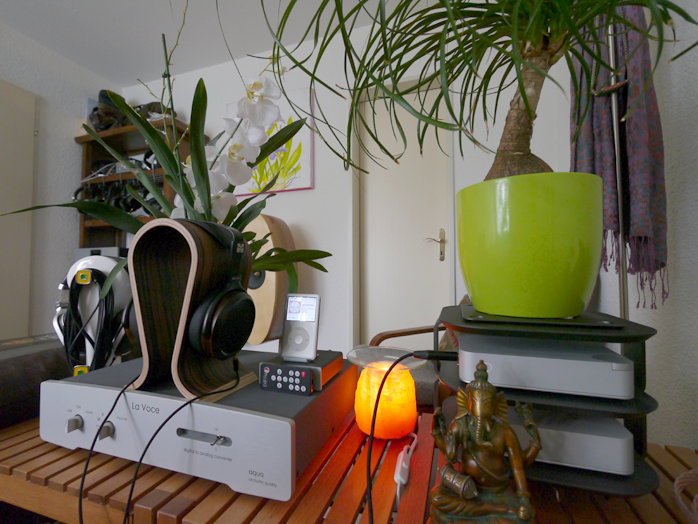
Sibling rivalry. To place the newcomer into its family's hierarchy, I ordered up two pairs of upgrade pads via HifiMan's online store. Those quickly shipped from China. Whilst one could debate whether the ideal comparison would have used original or identical pads and/or cable, I opted for the same pads but then stuck with the original cables to accommodate instant plug 'n' play swaps without fumbling around with HifiMan's cursed connectors. For these comparisons I used the below bedside system with Crystal Cable for power cords and analog interconnect, Chris Sommovigo's very best Tombo Trøn S/PDIF between dock and DAC and a Furutech passive power distributor.
|
 |
HE-560 versus HE-6 with new pads. This rather instantly recalled my prior assessment of the old flagship's built-in brightness. On hotter fare it got unpleasantly glassy and strident to strike me as too energetic in the presence region. Think standard single-driver widebander à la Voxativ not mellowed with valves or listening distance but driven from ultra-fast transistors in the extreme nearfield. The HE-6 also was physically rather heavier and as such less comfy to wear. On fit and finish too the new arrival trumped it. Extra sonic bonus points went to the HE-560 for more fluidic textures where the HE-6 sounded drier and more damped. This difference is related to adjustable amplifier feedback. Amps with variable NFB—usually tube types—routinely get drier and more rigid under higher feedback (depending on musical complexity and bandwidth challenges, feedback could also have advantages but that's another story.) On actual treble detail and concomitant effects on subjective airiness and soundstage illumination, the HE-560 and HE-6 struck me as surprisingly equal. What the HE-560 avoided were the cayenne bits of bite and sharpness whereby the HE-6 suggested exaggerated dynamic contrast and/or a frisky response lift in a very critical band. In the bass the HE-6's relative dryness made for the slightly greater sense of control or grip. The HE-560 felt rounder and less chiseled.
|
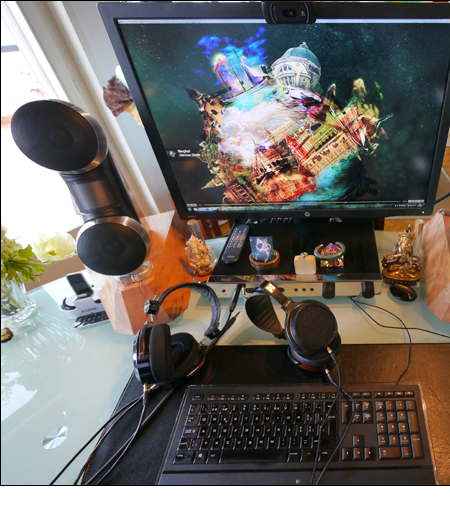
Streaming 16/44.1 FLAC files from Qobuz into the Aura Vivid integrated on the work desk.
|
 |
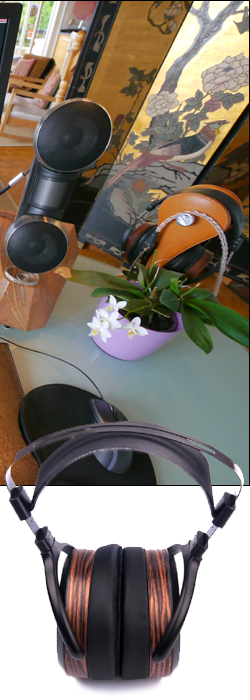
Without considering price, weight, looks or comfort, I call these siblings head-on competitors. I preferred the HE-560 and also thought that it cast the stronger tone colours related to its richer textures. Others might nod at the HE-6 for its even wider staging, tautness and crispness. Once our excluded aspects return, it seems unavoidable. The HE-6 is overdue for a replacement. At $400 more, I can't envision (m)any who'd currently pursue the financial range topper purely on sound. That crown has been passed down.
The HE-500 still struck me as warmer/thicker than the HR-560 whose greater treble clarity combined higher lucidity with a somewhat cooler but certainly far from cold overall demeanour. |
|
|
|
|
|
|
Benefiting from the new pads to open up more on top, I predict that the HE-500 would be preferred by those who'd lean towards Oppo's PM-1 and its juicier midrange. Compared to the HE-560 which felt a tad more tuned for speed and transient resolution, the HE-500 favoured a touch more opulence. These weren't drastic offsets. Compared to either, the PM-1 was more 'popularly SET-ish', meaning more midrange-centric, softer/fuzzier and less explicit on top. Those wishing to split the difference—to perhaps overstate these distinctions—would go 500. Those who are after a more balanced HE-6 to simulate an HD-800 walk through Planar Park will want the 560.
|
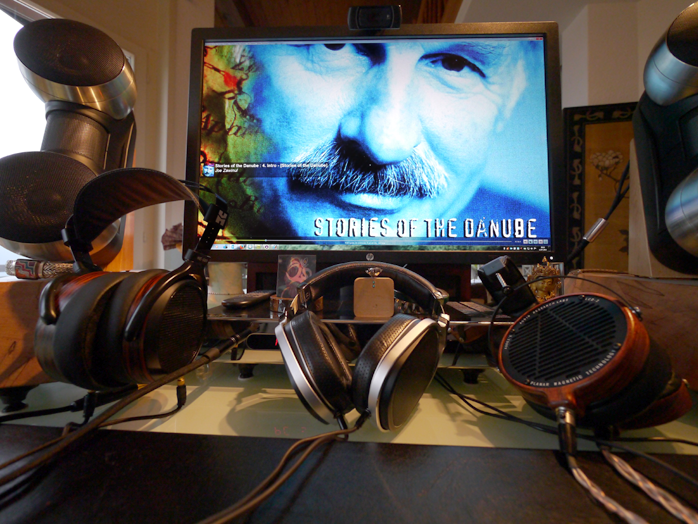 |
The Oppo PM-1 as indicated already is a softer mellower more portly fellow. In regular speaker terms call it an 8-inch two-way like the recently reviewed Apertura Edena. Where it diverges is replacing the latter's Serbian Raal ribbon with a WLM-type 2-inch paper-cone tweeter. Or think of the PM-1 as a vintage Vandersteen in contrast to the HD-800's Mårten Design ceramic. In that terminology the HE-560 would be my Italian flame, the 1st-order transmission-line all Accuton Albedo Audio Aptica - simultaneously very transient-specific but ultra smooth to rewrite the ceramic myth.
|
|
|
The Oppo's bass was noticeably fatter and bloomier than the HifiMan's. Like the Aptica, the HE-560's low end majored on power tempered by articulation and quickness. That said, none of these designs touched the pre-Fazor Audeze LCD-2 on bass weight and reach. And by the same token, none of them were as chewy, dark and downwardly heavy. To clone that vintage Audeze signature albeit at a loss of sophistication requires a MrSpeakers™ AlphaDog. On raw fit'n'finish and slick physical textures, large corporate Oppo's resources still set a standard none of the planar competition I'm familiar with can match as yet. Though narrower than HifiMan's, Oppo's particular pads are also the coolest to wear. They are the summery thin silk stockings to Fang Bian's wint'ry woolen socks. In the context of what one today calls high-resolution sound meanwhile, the HE-560 of this bunch would find itself most in conformity and as such, stand out as the most advanced.
|
|
 |
  |
 |