This review page is supported in part by the sponsors whose ad banners are displayed below |
 |
 |
Right after the first tones it was clear how the W1 deserved a better front end. Where we first characterized the sound as being too bright, the DAC from Denver completely corrected that impression. Violins regained their silkiness in adagios but did not lack for fieriness during marcatos. When the complete orchestra got going and we didn’t restrain our SPL, there was that sensation of very many musicians each individually contributing to the whole.
|
 |
So far we mentioned classical music where the W1 excelled. Why so genre-specific? Because in general classical music is less screwed up in its production values than most other genres. With the Daudio DAC/pre it was hard to endure many recordings. This was not a particular flaw of the Daudio W1 as it is inherent with any full dipole. Hybrid dipoles where bass comes from direct box radiators do not show this behaviour. What makes for the difference? True dipoles, bipoles and ripoles lack the standing wave effects of monopoles. Monopoles thus grab the room, play and load the room and make it part of the musical deal. In modern music, a substantial part of the end product is a mastering manipulation [see here for a basic primer on the subject – Ed] which anticipates the effect of the playback room. The goal is to sound full in an average room when average i.e. common types of speakers or headphones are used.
|
|
|
Run-of-the-mill productions over the Daudio W1 won’t be as satisfying as carefully mastered productions. The overall sound will be thin and imbalanced to have the speakers blamed without being the true culprit. With the right musical source, we found that the W1 with the ASP/AMP driving the entire bandwidth could create a very involving and convincing musical illusion.
|
 |
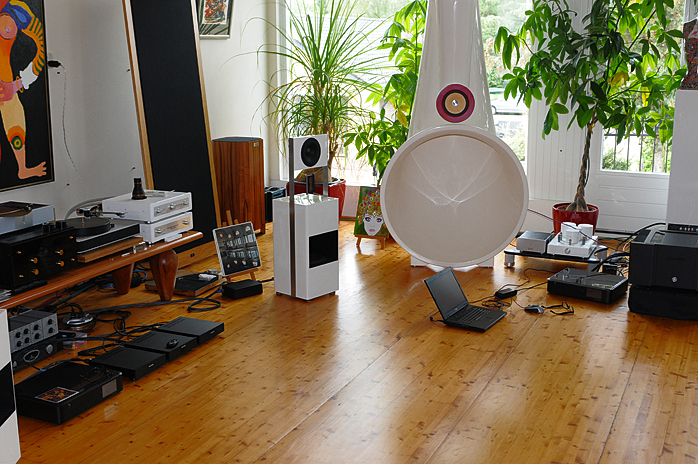
Nevertheless we feel compelled to add a few general remarks. Daudio is completely new to the market yet start by introducing a product just under €20’000 which sells direct. Their product is a true dipole for which the market is limited. Outside the DIY market, the merits of dipole designs aren’t really well known or acknowledged. Setting up a dipole to best effect can severely undermine a homely décor to become a necessary purchase consideration. Whilst the W1 with its own DAC/pre creates a complete working system—just add digital or analog source—this did limit its ultimate potential. In short, the speaker deserves better.
|
 |
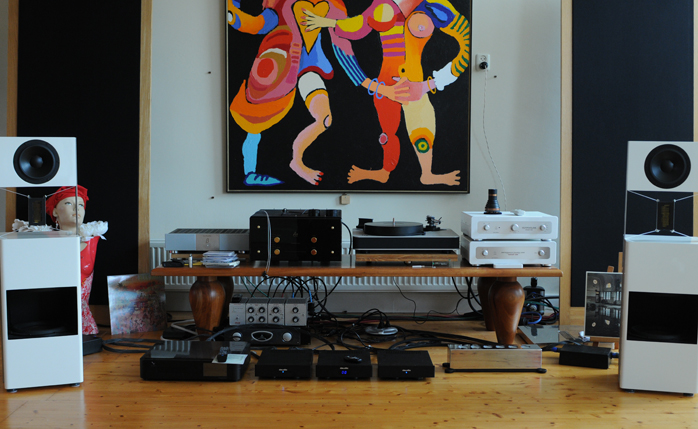
When we replaced the Dutch line-level box with the DirectStream DAC for CD spins and iTunes or Qobuz streaming via S/PDIF and USB, we heard how a better source improved the results. We foresee further upgrade potential when driving the mid/tweeter section with a separate amp. Now performance should fall more in line with the €20K asking price.
|
 |
Still, we retain some concerns over the target market. Who will volunteer a very substantial amount on a new product from a new player whose success in the market 5 years down the road is hard to predict; and which additionally needs plenty of space to bloom fully? That said, those ready to take the plunge should be in for a very musical and involving experience.
|
 |
|
|
|
Condition of component received: Hand-delivered in preliminary crates.
Reusability of packing: Unknown.
Website comments: Simple and informative in both Dutch and English.
Completeness of delivery: Complete..
Human interactions: Friendly and forthcoming.
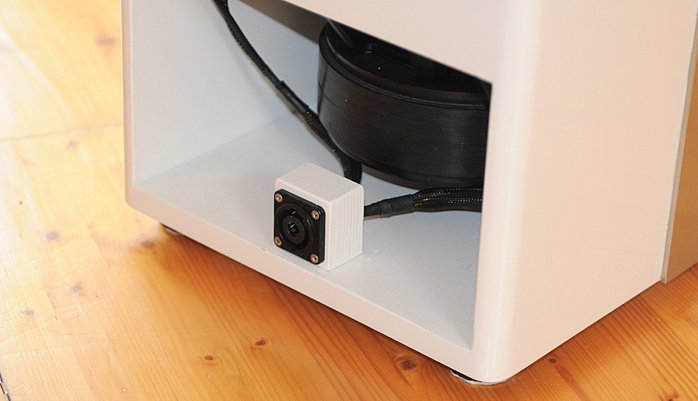
Remarks: Final production will have a black painted cavity on the back whilst the woofer mounting nuts will be capped. The wires leading from what will become a built-in xover will funnel through a milled slot in the vertical strips. On demand the speakON connectors can be replaced by more common WBT connectors. Finish of the W1 can be any RAL colour or a choice of several wood veneers, some for a surcharge.
|
 |
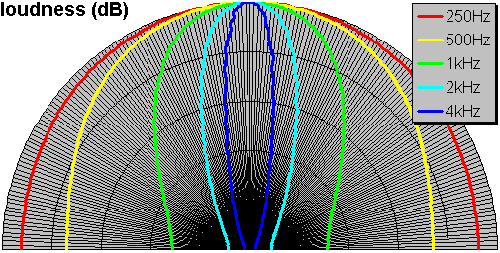
Manufacturer’s remarks. On our claim that their design has some ripole traits, Daudio remarks: "It is just a dipole. The volume of the cavities is of minor influence. There is plenty of room around the woofers. What matters is the surface area. The front is indeed 0.8 times that of the woofers’ surface area but still too large to be a real ripole. A lowering of the resonant frequency of the woofers is not yet in effect. There is however an effect on the midrange well above 150Hz and thus outside the working range of the woofers."
|
 |
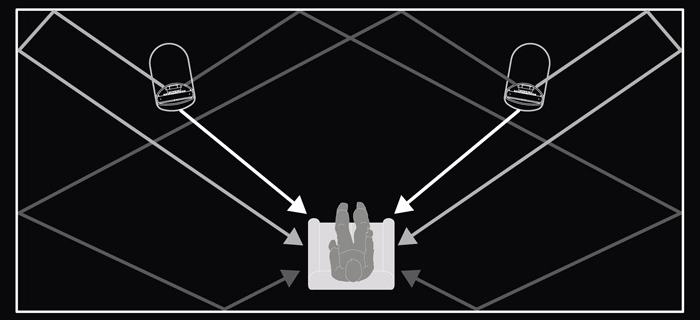
Regarding our finding that a dipole needs space to fully bloom, Daudio remarks: "It is a pity how this was accentuated. Our experience is quite different. Even in tough conditions where a B&W or Magico would have more problems, this system delivers a convincing image. At 1 meter from the front wall, the speaker already beats many others. Also the tonal balance you mention is not that bad. Possibly this was an effect of your room. We cannot explain it as we were not able to hear it at your place." |
|
In general: "What surprises us is that you mention classical music as sounding very nice whilst other kinds of music was less so. We understand your observation but think it was strongly overstated. Also many people do not agree with you that a dipole needs to be distant from the wall to sound right. Personally we think it unfortunate that you doubt our existence in 5 years’ time. We talked about this. Such a remark is, we think, very negative. We try to refresh the audio world with our concept by promoting dipole sound and design. Personally we expected more support from you."
|
 |
 |
|
 |
