|
|
|
|
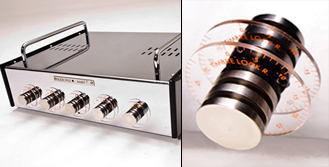
"The six TimbreLocks are bias pots. Most mistake the scheme for basic bias adjustments. That's not it. It's rather more far reaching. Obviously these pots adjust the load line of the tubes and range from 78mA to 92mA. But this also affects the load in the associated output transformers and the operating points of the magnetics where we get 90% of pentode power efficiency and the curves of a triode. That’s quite the trick. We obtain 15—almost 17 watts—from a single-ended KT88 in class A1 but with a triode transfer function due to how the series-parallel connected six amplifiers operate.
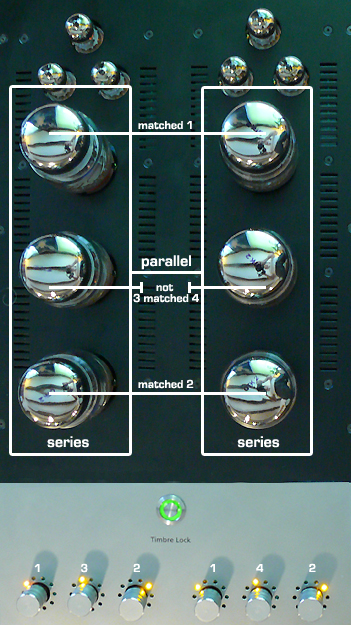
The taps in our transformers are different, the way they connect to the tubes is different. There is a screen tap which used to be called ultralinear and another winding for the cathode for a type of local feedback. A Stockham paper from the 50s showed how a triode can be modeled as a pentode with feedback by removing the grids. When you take the grids out of a pentode, you get inherent feedback between plate and cathode. It’s simply a matter of view. Even though six single-ended amplifiers tied together only at the outputs running strategically dissimilar output transformers are more complex than the two series-connected amplifier halves of the Model 88, their behaviour of a perfect high-power triode is actually more precise. The yellow or factory/start setting shown below is 10:00, 11:00 and 2:00 o’clock for both banks. The left and right tube of each trio should remain fixed while the center ones are the wild cards or kinky valves. Their output transformers are dissimilar unlike the other two matched pairs. The OPTs of tubes 1 + 2 are the same, the OPTs of tubes 5 + 6 are the same yet dissimilar from 1 + 2. Only tubes 3 + 4 have different transformers. That makes for a total of four different OPTs to require matched tube pairs. All six tubes don’t have to be matched but the individual pairs do. |
|
|
|
 |
"I should add that the output power of 100 watts—130 watts from KT120— was a fringe benefit but not the primary design goal.
The primary design goal simply relied on six rather than two variables to more accurately approach my theoretically modeled ideal triode behaviour. TimbreLock of course also accounts for tube aging. We can squeeze a lot of life from these KT88. I have run tubes for 2'500 to 3'000 hours without any decline I could detect. The way one detects small changes from tube aging is to swap in brand-new tubes. That’s what I did. I kept aging a complete set in the amplifier which I left playing 24/7. This set I compared at intervals to brand-new tubes. I tracked how many hours I could get from the original set before any changes became noticeable. It took more than 2'000 hours before I thought I could detect any.
That was admittedly running them without interruption. If you turn the amps on and off for individual sessions, this number could change.
"Back to Brazil,
our production line really works well now. But what would never work is state-of-the-art finishing and overall international customer support. I tried and spent huge amounts of money on it in the past to never attempt it again. If something broke, I’d send out another amp while the original was never returned. Instead it would eventually show up in the used market to have another repair requested. I just couldn’t keep track. The logistics involved were a nightmare. You could perhaps also say that I didn’t have exactly the right head for it and at the time lacked the proper partner who did.
What technically could go wrong with the Model 88 at the time was the power transformer. This wasn't because it was badly designed or poorly made. It was due to an ergonomic design flaw. If you remember, all the TimbreLock LEDs then were red. The last (right-most) LED would light whenever current was 96mA. That said, you could keep turning the pot to reach 120 or even 130mA. The light would continue to show red. It never occurred to me that people might use the amps in this fashion, i.e. way well outside their intended operational parameters.
"After the MkII version of the Model 88 in 2005/2006, international business pretty much came to an end. Now I made all the LEDs green and only the last one red. The instructions in the manual were to never use the red LED. Actually it was perfectly safe if you set it where it just lit up and didn’t keep raising bias current beyond it. So this was a design flaw of ergonomics that didn't foresee how a customer could interface with the device to eventually take out the power transformer. That was basically the only problem we ever had with the Model 88. With the MkIII or M88 A3 as we call it, I went to three colors. The TimbreLock LEDs are green, the last one is red and the preferred/initial setting is yellow. This proved to be altogether more intuitive and user-friendly. It simply works. You have the factory setting of the Model 88 at 10:00 and 2:00 for the left and right TimbreLock, you have the ‘don’t go here’ red one at the end and all the personal adjustments in-between. The MkIII version also got even beefier power transformers which now are toroids. Those have advantages and disadvantages but I worked around the latter. Now the operational temperatures are lower and there is much more power headroom. In Europe the new Model 88 monos retail for €19'000/pr., the matching Model 5 preamplifier with remote volume goes for €9'000. A set shipping from Brazil is €28'000. We eventually plan on stock in Switzerland to expedite European shipments but currently we deliver all shippable models from Brazil within 30 days and accompanied by a 3-year standard warranty. |
|
|
|
|
|
"We no longer use wooden crates. To do so now out of Brazil requires spraying the wood after the crates have been sealed and are readied for export to get an agricultural safety certificate. This adds five days whilst the product remains in Brazil for some silly formality to get bug-sprayed. We went to quality sturdy cardboard instead. The Model 88 is still finished in gloss black as you knew it 8 years ago but now it has a slightly more refined appearance with a minor profile sweep on the cheeks. Avantgarde red remains available too. People love that color. Regarding the relative importance of our Audiopax sound between amps and preamp? The amps are more important if one has the right speaker. But if one doesn’t, the ticket is the preamp with the customer’s existing amp and speakers. This gets still quite a bit of our signature performance. With the right speakers and our amp, our Model 5 preamp won’t make as much of a difference over a really good preamp which the customer already has.
|
"The Model 5 comes fully into its own when it replaces a very good preamp in an otherwise non-Audiopax system. A good/right speaker for the Model 88 would be 90dB or higher, with an impedance above 6 ohms (5.5 minimum) and phase angles not over 40°. If those factors are met, the combination should work very well.
The Mosfet version of the Model 88 which we currently don’t make behaves in exactly the same manner. It isn't intended for more challenging loads either. Sonically the minor tube microphonics give them slightly greater soundstaging capacity from their quasi dither. But my sound really isn’t about any particular output device, be it tube, transistor or hybrid. The moment such a device is coupled to a transformer, everything changes. Of course you couldn’t just use any transformer or tube. You must choose one that is copasetic with your concept so you can manipulate it to the desired point. It needs to be twisted in a kinky way to produce the real results.
|
|
|
"Think of a transformer as a transmission or automatic gear which couples, changes, adjusts and transfers power. It’s the same thing with voltages and current. A transformer doesn’t merely change this to that. Some of its behaviour is akin to a torque converter. There is some wiggle room which improves the sound if used correctly. People resist the notion that one mile of additional wire could improve the sound and not be heard. It must be worse, they insist. It can be better if the hidden trafo effects are exploited. On standard specs, the output impedance of the Maggiore is about 2.8 ohms, slightly less than the 3.7 of the Model 88. The input impedance is a standard 100K. For all its power, the Maggiore is actually quieter than the Model 88 by about 3 to 4dB. Highly efficient speakers are really no problem. And because each tube is protected by an externally accessible fuse, catastrophic tube failures are a simple plug ‘n’ play replacement. That is true also for the new Model 88.
"The XLR input on the Maggiore is for convenience. It is transformer-coupled to be matched to the single-ended circuit of the amplifier. People requested this feature to accommodate balanced variable sources and preamps. The driver tubes of this simple 2-stage circuit are 12AT7s, one per KT88 or KT120. The triangular layout of the small tubes is merely cosmetic and doesn't signify anything else. The drivers produce the majority of voltage gain (about x 35) while the power tubes are mostly just current buffers. The input sensitivity is 1.8V. As a basic guide on how TimbreLock affects the sound, if I use my own speakers—and this differs with load—low (left-most) bias is softer/rounder, high (right-most) bias sharper and more distinct. These adjustments affect our perception of space, ambiance and speed but that is hard to put into words at least for me. It’s not about tonal balance. It's not about more or less bass, more or less treble.
The TimbreLock range of fine tuning really moves between the poles of transients/decays, sharp/soft and taut/relaxed. These are performance aspects we don’t really know how to measure. It’s not about frequency response, step/impulse response or general THD. Those we can and do measure.
Not only are our ears nonlinear devices, they are very intelligent adaptive devices. As with nearly all our senses, we react to sudden variations, not steady-state or very gradually changing conditions. You hear a refrigerator turn off but you didn’t hear it run nonstop. This shows how we are sensitive to the variation of a constant condition.
This is true for all types of distortion. Steady-state content or behaviour is less noticeable than changes. So the question becomes, what is the 'natural' variation of a distortion? That’s key. What is the variation your brain will not recognize as artificial? It's not about keeping distortion constant or low per se. That's the matter I’ve been working on for a long time now."
|
 |
|
|

|
|