|
|
|
As one designer of discrete R2R DACs put it, their appeal isn't hi-tech when it's the oldest form of D/A conversion extant and chip-based R2R for hifi is mostly extinct. Instead it's freedom. A designer now works outside the fixed parameters of commercial chips. That distinction is important. Otherwise discrete R2R decks claim automatic immunity from implementation variability, even listener tastes where LampizatOr's Łukasz Fikus actually abandoned R2R Soekris boards for a new chip (ongoing Soekris users include Jay's Audio and LessLoss). Still, designers at AQ, Aries Cerat, Audiog-d, Denafrips, MSB (and adoptees like ReQuest and Ubiq), Rockna, Soekris and TotalDAC all favour the blank-slate freedom of their own resistor ladders over the fait accompli of converter chips from AKM, Burr-Brown, Cirrus Logic, Sabre, Wolfson & Bros. Just so, the glue logic which instructs how the resistors switch is executed on field-programmable gate arrays i.e. advanced chips. Discrete R2R thus isn't chipless. Control code is written to silicon as are USB transceiver and digital receiver duties. As we learnt from Cristian, the audible effects of revised firmware for his Formula xHD update surprised even him. We've heard the same from PS Audio and Nagra who convert all PCM to DSD; and from Devialet for their class A/D amps. Firmware updates for such machines can significantly alter their sonics. It makes some hifi hardware softer than it used to be.
|
 |
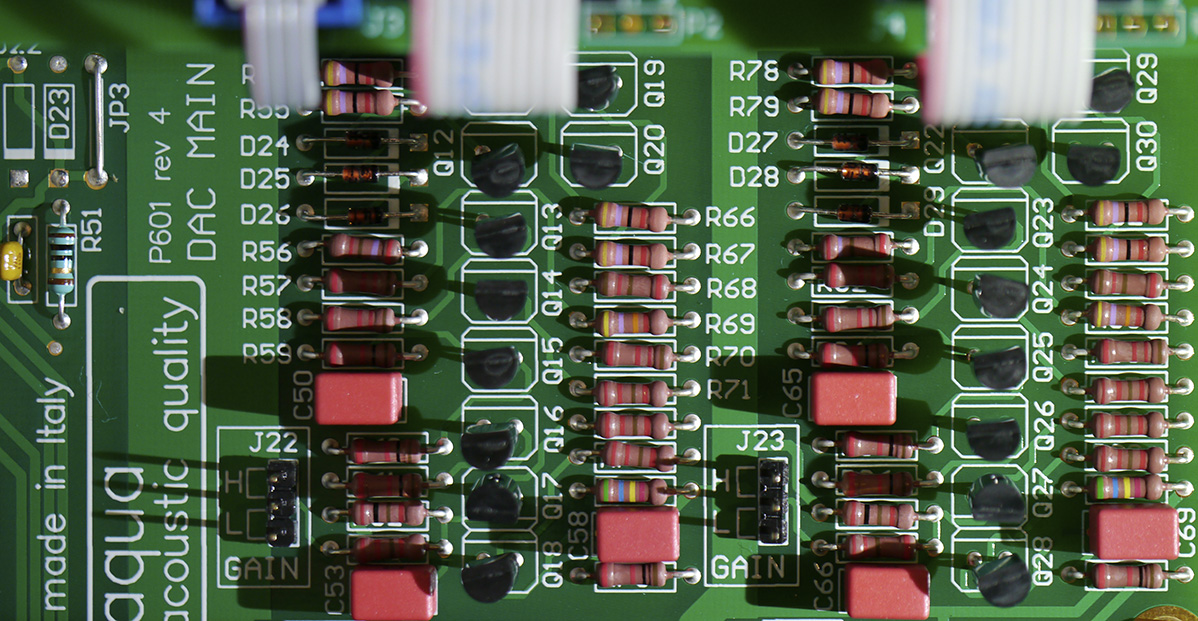
A small section of La Voce's resistor ladders.
|
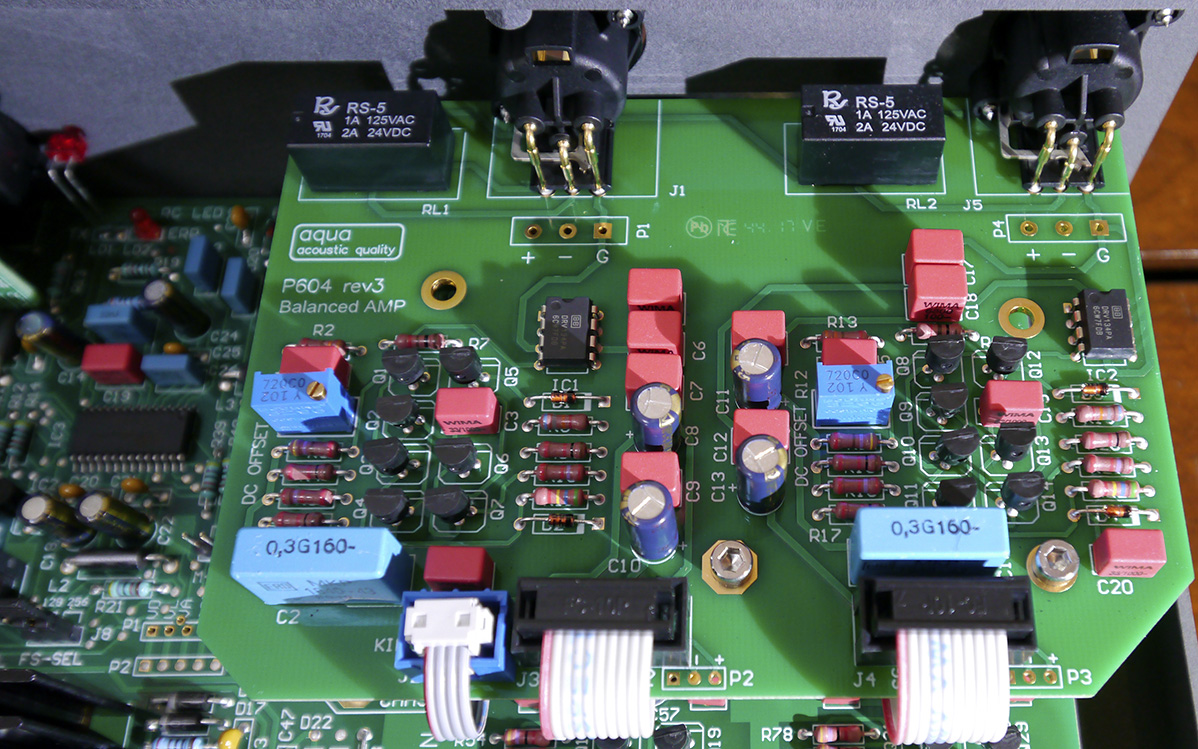
There's some confusion around how physical limitations in resistor precision affect achievable converter resolution; and how compensation correction in an FPGA controller can improve it. I asked Cristian to shed some light on that; on how his discrete resistor arrays process DSD; and on how La Voce's XLR outputs are derived. "The XLR outputs of La Voce are electronically balanced without transformers. There are no output capacitors on the XLR so they can correctly drive a low-impedance preamplifier (600Ω) as used in professional audio. Thanks to today's available high standards for the precision, tolerance and stability in top resistors, the right choice of parts for the R2R ladder network is relatively simple to obtain good measured performance but more complex to achieve the finest sound.
Many factors affect actual resolution, linearity errors and other important parameters, including the FPGA code and drive of the logic circuits. In the optologic design of LaScala/Formula, the logic circuits are galvanically isolated to improve many aspects. The effective bit-depth resolution of La Voce S3 Discrete is 19-20 bits while the previous S2 version with BurrBrown's PCM 1704 was 16-17 bits.
|
|
The balanced output stage board.
|
"DSD has some advantages on the recording side. One of them is the absence of processing like oversampling and interpolation. In our lab, a customized Tascam DA3000 DSD recorder and a Studer A80 master tape machine are the registration desk for our R&D.
For D/A conversion, one can transform a DSD stream to analog two ways: apply a low-pass filter to the output or convert DSD to PCM.
"The filtering may be done with an analog or semi-digital filter. With the analog filter it's difficult to obtain a good S/NR at least via a simple passive filter. The semi-digital solution is a FIR filter. That can create good results but is no analog filter. We experimented with both options. For best results in terms of noise, dynamics and natural sound for our R2R ladder DACs, our final choice became PCM conversion. It's not the simple easy way but in our opinion the best approach to DSD processing.
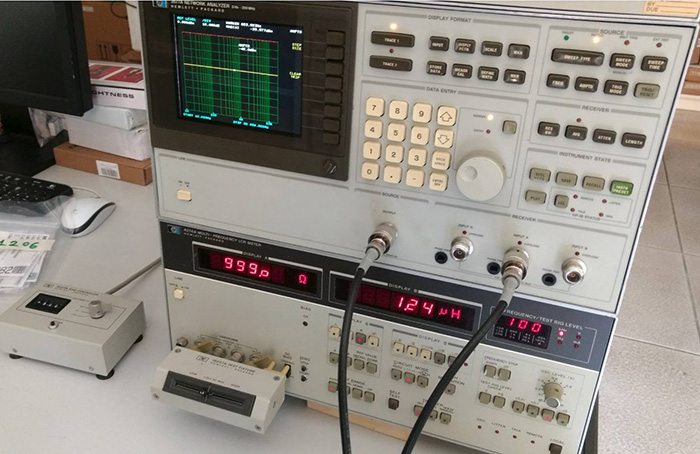
"In other words, we think that the best musical performance is obtained by using our high-performance R2R also for DSD instead of allocating to it a separate channel and filter inside the DAC's circuitry. Please see in the right photo our HP 4275 and 4275 multi-frequency LCR meters we use for testing our passive parts. Afterwards we proceed to listening tests which in our philosophy are the most important. And finally, the TX LED on the back panel is for S/PDIF signal lock. It lights up bright when the DAC receives a signal from a digital transport."
|
|
|
|
|
|
|
Leftness? For musical DAC chairs in our main system, there's a sabre tooth with valve buffer (Fore Audio DAISy 1), a burred brown (COS Engineering D1) and a discretnik (AQ Formula). Whilst the latter is my favourite, I could just as easily live with one of the other two. In fact, depending on current review loaners—especially speakers but also amplifiers—one of the chipsters might bed in better. Whatever I prefer in the Formula is then overwritten by what in the greater context of ancillaries become more dominant matters like a different tonal balance or alternate image density. Just as phase/time coherence in speakers isn't everything but, for the right listener, can be the final decider once everything else ticks off, so the particular R2R flavour can end up as the decisive difference if all the basics match up to one's system and ears.
|
 |
XMOS-based USB transceiver board.
|
Like with 1st-order/zero-xover speakers, R2R's mysterious je ne sais quoi, for those who clearly hear and favour it, can be hard to define. It just sounds right is the typical default. And indeed, no owner needs more justification when the vast majority of all purchases is made on the basis of a purely subjective call. It's in the context of a review that one hopes for more. That 'right' couldn't be the antithesis of 'wrong' to me is clear when two out of three of our main DACs aren't R2R. Perhaps 'right' is more how the Brits and their colonies drive on the left, steering wheel on the right. Now right is just not left. Still there are zones of grey. Consider our left-handed car from Switzerland. I now drive it on the Irish left - perfectly legit though harder to see during takeovers. Meanwhile my wife's car bought in Ireland has its steering wheel on the right. It puts the driver on the inside not outside track. In this context, left/right are equally right. They're merely man-made conventions, rules and habits. All this by way of undermining absolutism. It reminds us that if we don't hear any special something of an R2R DAC when juxtaposed to a Delta-Sigma design in the same league, it neither means right or wrong for us, others who hear different or the component itself.
|
|
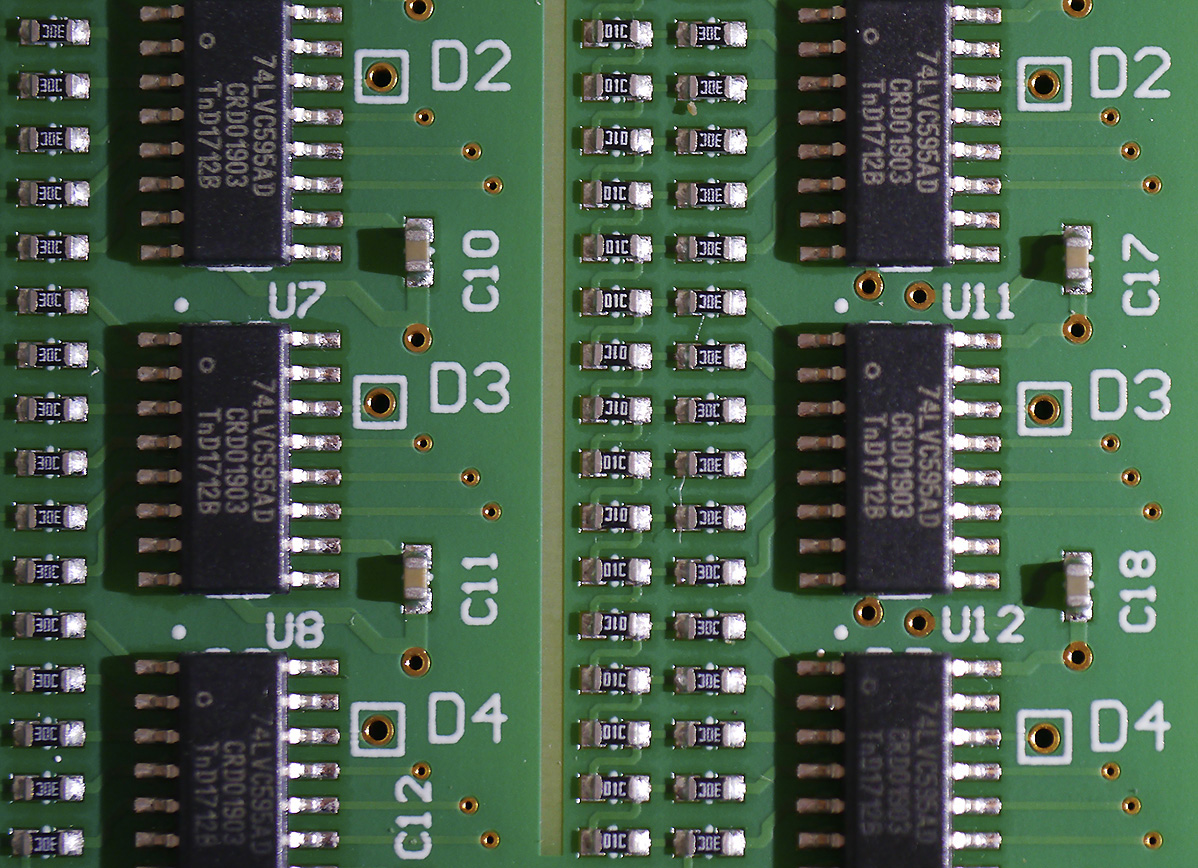
Section of main board.
|
When I fired up La Voce S3, it replaced the DAISy 1 converter from a previous review setup. Instantly that most familiar Aqua Hifi R2R aroma reasserted itself. How to explain it against the preceding context? Ease of perception perhaps. Now everything is in its right place at the right time. There's no mental effort to sort it out or believe it. If so, it speaks as loudly to the act of perception—how we observe—as it does to the content of perception, namely sounds arranged in time, pitch and loudness. Threaded in succession like pearls on a string, they create the rhythmic, melodious and chordal patterns which we humans perceive as music, not mere noises. (Who knows how much sense animals make out of our music?) To my mind, talking of easier perception, of things in their right place and time, points us at the time domain. That leads to transient fidelity. It's about capturing, without blur or shifts, those nearly vertical flashes whereby sounds with all their harmonics first arise out of nothing before they begin to bloom, sustain and fade. Whenever I ask myself why I prefer Cristian Anelli's R2R converters when I could just as easily listen to a ΔΣ specimen and possibly prefer certain other sonic aspects which to me in the end just aren't as important, I inevitably think time domain. It's not as vague as sounding right but perhaps not that far off. Still, it's my best effort. Now the reader might inspect the act of listening beyond the easily discussed frequency response aka treble/mid/bass and the equally obvious aspects of soundstaging. There's rather more to it. Looking into and thinking about this 'more' is, I believe, where today's R2R DAC excels just like its costlier stablemates do.
|
 |
|

|

|
|