This review page is supported in part by the sponsors whose ad banners are displayed below |
 |
 |
It is an interesting and commendable experience to listen to the amplifier first solo and then with its matching preamplifier to learn which presentation suits our expectations better. These two are quite different both with respective pros and cons. Owning the amplifier would give you a near perfect foundation for any system. The SS-101 in ‘bypass’ mode driven from my Lektor Air player with 6H30-based dual-differential output stage and analog volume control delivered very transparent open sound with great resolution but no treble harshness. Everything sounded exactly as it should have. Later one could modify this sound with a preamplifier of one's preference to get still bigger richer better saturated voices for example. But differentiation will suffer and the soundstage should lose a bit of depth for a tradeoff.
And forget about class A/B. This is meant only for the most demanding loads. Otherwise the SS-101 will easily drive the majority of loudspeakers in most rooms. The sound in class A is simply better – deeper, more liquid, with more involvement. Class A/B, though still very good, seems to be more economical on emotional delivery.
|
 |
Description: The SL-102 succeeds the SL-101 and was introduced in the middle of 2010. It is an extremely well built one-box device. I mention that because there is also the top two-box MP-L 201 from which many solutions trickled down. The chassis is assembled from thick slabs of clear- or black-anodized aluminium (other colors available for a surcharge).
The front panel is all metal except for a small inset of black acrylic or equivalent right in the middle to cover the display. There are no knobs, just round push buttons three each on either side of the display. On the right is volume up/down and mute, on the left source selection, menu and standby. The back panel is a real beaut with two rows of sockets, XLR at the bottom, RCA on top. There are 2 RCA and 3 XLR inputs, two RCA and two XLR outputs and one fixed RCA output for recording or a headphone amp perhaps. Exactly in the middle is the IEC power inlet with mains fuse and mechanical on/off switch. As I learned from the manual one of the line inputs might be transformed to MM/MC phono duty based on the RP-010 standalone device. It is also possible to change to unity gain, bypassing volume control and gain stage for home theater applications.
|
|
|
The main circuit modules are power supply, buffer modules, symmetrizing and desymmetrizing modules and gain stages, five per channel of the latter. First the input signal encounters a selector based on air-tight relays. Volume control is carried out via a ladder of high-quality resistors also switched with relays (21 per channel). As Ole Vitus says, this solution is bit different from others, with a constant resistance in the signals path at all volume levels via a parallel switched resistor value. Each step progresses by 1dB and the range is from -99 to +18dB.
The optional phono input works with interchangeable modules adapted to a particular cartridge. My loaner was delivered with Module 2 which allows for 100Ω or 1kΩ loading. There are four different modules available, each with 16 different settings. In the circuit layout the front is occupied by the power supply module based on two independent transformers, one per channel. There is a large voltage regulator for each section. The machine comes with the RC-010 remote control. It's quite handy and made of aluminum with a nice display to work with all Vitus devices.
|
 |
Technical data (according to manufacturer):
Type: True balanced line stage
Inputs: 2 x RCA,| 3 x XLR
Outputs: 3 x RCA, | 2 x XLR
Noise: <110dB
THD + N: <0.01%
Power consumption: standby <30W, operation <40W
Dimensions (H x W x D): 135 x 435 x 402mm
Weight: 24 kg
|
|
|
SS-101
The 85kg SS-101 is a huge beast. Its front is very similar to the preamplifier, with a similar black acrylic cover for the central display. Even the push buttons are exactly the same to prove how this in fact is an integrated amplifier. You can bypass the volume control via the menu but for safety reasons if you unplug the device it reverts back to variable gain. On the back there are XLR and RCA inputs as we saw on the preamplifier. Above them are sizeable plastic-shrouded speakers binding posts without the handy wings Solution and Reimyo use which makes them easier to operate
The amplifier is truly colossal and sports massive heat sinks on either cheek for what are a mere rated 50wpc in class A. On the other hand and if memory serves, Luxman’s M-800A had smaller heat sinks. Possibly fewer gain stages or hotter bias contribute to higher operational temperatures in the Vitus to require such large dissipation? They’re open to the sides but enclosed top and bottom to cosmetically render the enclosure more monolithic. Perhaps the entire chassis works as one giant radiator to explain why it doesn’t get as hot as for example the Accuphase A-65 or Luxman. Clearly the sizable fins do their cooling job well.
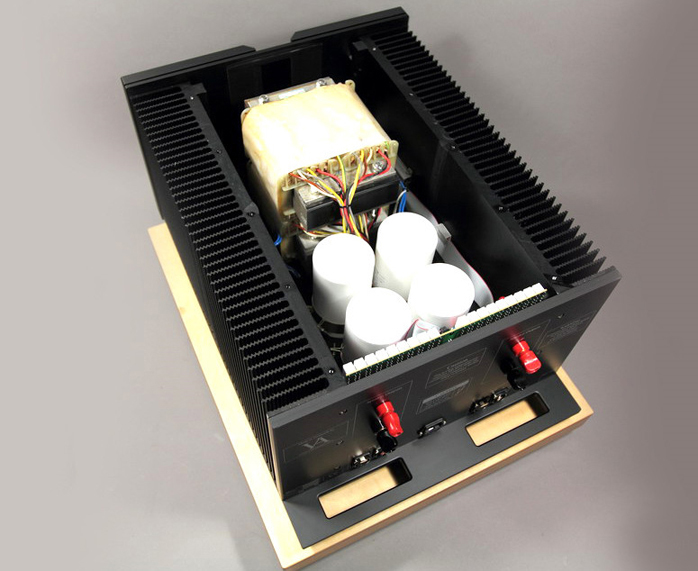
Inside there are two oversized double C core power transformers similar to those used by French YBA stacked one atop the other. In the monoblocks they use a single transformer sized like these two together. They clearly take most the credit for the enormous mass of the amp. In front of the transformers are four large capacitors and near the back is a vertical PCB with the volume control matrix. Just like in the preamplifier this is based on a relay-switched resistor ladder. The circuit itself is fully balanced. Ole Hansen states in the manual that each stage couples to the next "in a special way" but fails to get specific how. Like the preamp the amp is dispatched with the Andromeda power cord which uses the same wiring as the internal hookup conductors. I applied both power cords for the review.
|
 |
Technical data (according to manufacturer):
Type: stereo balanced integrated power amplifier
Inputs: 1 x RCA, | 1 x XLR)
Outputs: 1 x XLR
Internal cabling: Andromeda
Remote control: Available separately
Output power (switchable): 50 wpc class A | 100wpc class AB
Frequency response: DC-800kHz
Noise: <110dB
THD + N : <0.01%
Input sensitivity: 1.3 VRMS
Input impedance: XLR=600Ω, RCA=10kΩ
Power consumption: standby = 2 W, AB class = 50 W, A class = 500 W
Dimensions: (H x W x D): 310 x 435 x 610mm
Weight: 85kg |
|
opinia @ highfidelity.pl
|
 |
 |
|
 |
|
