This review page is supported in part by the sponsors whose ad banners are displayed below |
 |
|
 |
Is this how the emotions present during the recording session manifest themselves? Or is it perhaps related to the music unfolding over time? I am not certain. I lack a good reference point but there is something to this statement. Time relationships here are dead certain, very fluent and indivisible. Comparing digital to analog discs, the holistic sound of the latter is usually highlighted. Subconsciously digital sound seems incomplete by comparison. With the best CD and SACD players this problem is almost non-existent and they can behave very coherent and continuous as was the case with the Ancient Audio Lektor Grand SE and Jadis JD1 MkII+JS1 MkIII. But getting bodily choked by musical dynamics happens more often with a turntable. With the Argos this aspect was so developed that it became common place. We hear the vocalist and mostly think about how he sings and occasionally perhaps how she is placed on stage - but no longer in hifi categories.
|
|
|
The many hours I spent with the Argos did not get me closer to answering how the ideal turntable should sound. Exactly the opposite. It gave me a few more grey hairs and wrinkles. Solving some issues, it opened up others which earlier hid behind an impenetrable wall. The biggest problems are still the recordings. It’s the bottleneck of audio which we will never resolve. The Argos ‘interprets’ what’s recorded spectacularly well and does not confine itself to audiophile editions only. However, poor jobs like the new Queen reissue (a digital remaster) will sound miserable though with its huge sound which scales instruments in their natural size, this deck can minimize these flaws to some extent. Yes its tonal balance is a bit darker than the Caliburn, SME or Avid yet this isn’t a flaw as much as a different way of approaching the same recordings – and perhaps the most appropriate one. The Argos’s perfect calmness of showing both the totality of the event and its individual constituents was quite breathtaking.
Of the tables I know and heard, only the Caliburn/Cobra/Castellon and SME 30A/Series V approached what I heard with the Argos. The latter offers even deeper relaxation and more fully developed sounds with larger harmonic envelopes. Clearaudio’s Statement veers in another direction. There the velvety background, dynamics, details etc. are more visible from the onset to manifest more individually and never have us forget them while listening. I am not calling it bad, simply a very different approach which affords one a very easy choice between these two machines.
|
 |
The price of the Argos is of course completely abstract and to a certain extent absurd but it’s all within the right and providence of a manufacturer to price their top offering arbitrarily. Price/performance ratio flies out the window. Products in the statement, reference, master or ‘whatever’ category cannot be priced according to the same math. These are elite products from their very conception onward and never were envisioned to end up in many people’s homes. They must be priced exclusively to be what they are. Those without the means simply won’t buy them. At the same time, the Argos—at least in my experience—is one of the best turntables in the world. It does not employ rocket science as does the Australian Caliburn, simply perfect execution of basic mechanics like we will find them in other Transrotor models. It turns out that within such basic and well familiar solutions hide potentials we simply could not conceive of. Some of the Argos solutions will eventually trickle down but not everything can be transferred. Costs will pose a barrier that won’t be overcome. But there is going to be something in it for more of us.
Description: The Argos is Transrotor’s most expensive product introduced at the beginning of 2009 but it was only at the High End 2009 show in Munich that a working production unit was shown. It was the first in existence past the prototype. It is naturally impossible to invoke the concept of mass production here. To my knowledge only six of these have sold to date, five of which went to Hong Kong. From its construction concept, the Argos isn’t really a suspended but rather mass-loaded device (though not completely as we’ll see). There are no springs or other elastic elements which would separate the platter with its two tone arms from the three motors or support structure. But something does elude a completely non-suspended classic design. First, the top cover with its platter and tone arms separates from the bottom plate via four oil-damped pins. Those are not elastic elements as we find them in suspended turntables but vibration dampers that don’t introduce any horizontal deflection.
|
 |
|
|
|
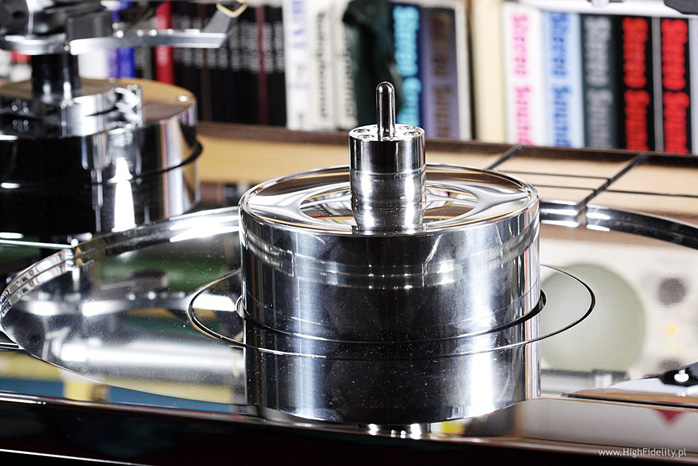
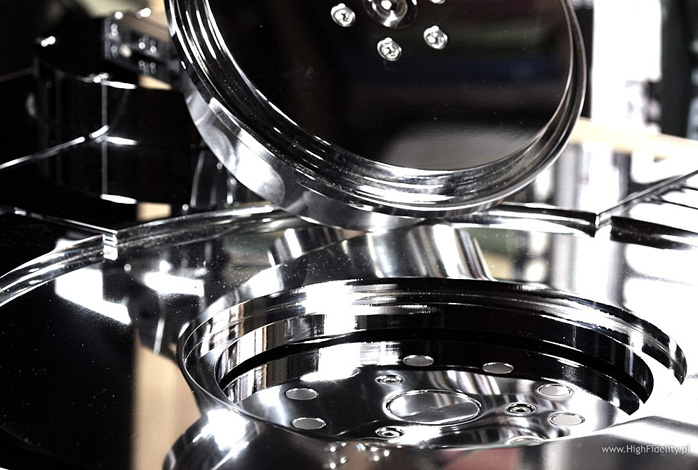
The Argos runs two stacked platters. Both are made from chromed solid steel. The very heavy top platter with its thick custom vinyl mat sits on a small sub-platter and thick shaft. A wide and heavy ring around the circumference increases platter inertia. This isn’t a removable disc stabilizing ring like Clearaudio or VPI use but a permanently installed affair that has no contact with the record. A heavy chromed record clamp couples the records to the platter.
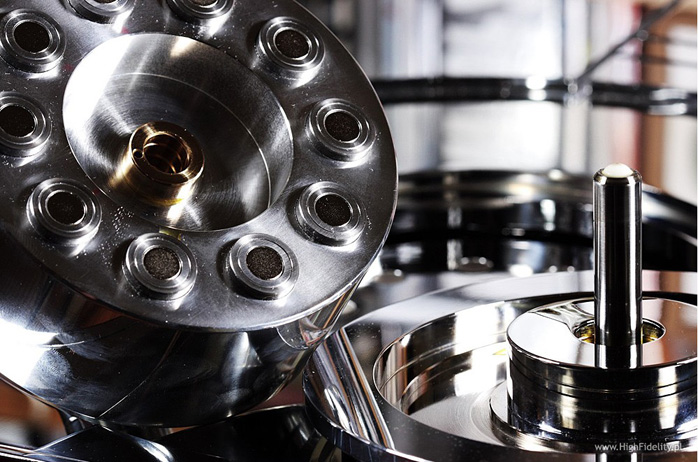
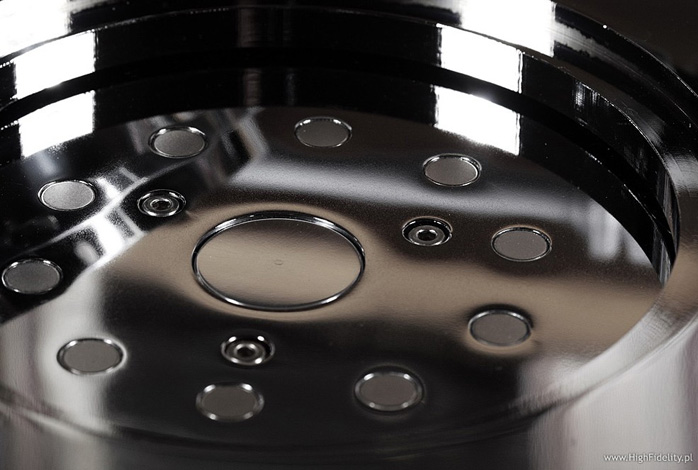
On either side of the platter sits a heavy tone arm pod. The loaner came installed with two 12-inch SME 312S on which a Transrotor logo suggested in-house modifications. The firm can also supply the top V-12 SME on request which should be tried. The sub-platter decouples from the top platter via ten embedded Neodymium magnets. This is called FMD or Free Magnetic Drive. The lower platter then is driven from a rubber belt. The oil-damped inverted bearing runs a steel shaft and ceramic ball in a phosphor bronze race embedded in the sub-platter.
The front of the upper plinth as well as turntable are slightly curved as are the backs but the fronts are convex, the backs concave. This trims the balance. The turntable has to achieve its center of gravity exactly in the middle of the small weight plate because the gyroscopic Cardan suspension base—here we encounter freedom of motion to go beyond classic non-suspended designs—can level the plinth only when the center of gravity isn’t altered. If it changes, the weight will shift to match the new center. That’s why nothing must be placed on the turntable. Besides which, we might scratch the deeply chromed surface.
The very heavy and stable supporting stand is bolted together of chromed polished rectangular stock and runs three 20mm hardened glass shelves. These looks good but I have bad experiences with glass shelves and find marble or wood to sound much better. On one of these glass shelves we will place the very heavy power supply in its steel enclosure. Its fascia sports a blue LED and 33 1/3|45 speed selector knob. This power supply runs three synchronized motors and is a finely calibrated affair. The umbilical to the turntable is a solid shielded wire with a gold-plated locking DIN plug for the PSU end and an ever better OCOS bayonet plug for the turntable. A quality power cable between this PSU and the wall makes a worthwhile difference.
The Argos is an example of advanced engineering and perfected machining. Tolerances counted in fractional millimeters, a splendid drive system and more are all worth writing about it yet these are simply evolutionary refinements brought to their extremes, not novel introductions to the world of turntable technology. This is no slight, just a simple statement of fact. The Argos is all about tradition in the best sense of the word. |

opinia @ highfidelity.pl
|
|
 |
|
 |
|