This review page is supported in part by the sponsors whose ad banners are displayed below |
 |
Description: The Glory is a stereo power amplifier from the German company Sovereign and in their prestige Signature Series, the cheapest amplifier in the lineup. The enclosure is perfectly constructed, resembling a modernist Bauhaus shape clearly designed by somebody who has a notion of industrial design. The Glory resembles the black cube which was exhibited in London’s Tate Museum by Mirosław Białka ("How it is" - "Jak to jest")... "a giant 13 meters tall and 30 meters wide structure covered from the inside with black velvet where even hundreds of visitors lose their sight due to the overwhelming darkness" - R. Romanowski, Gazeta Wyborcza, 29.12.2009).
|
 |
|
 |
|
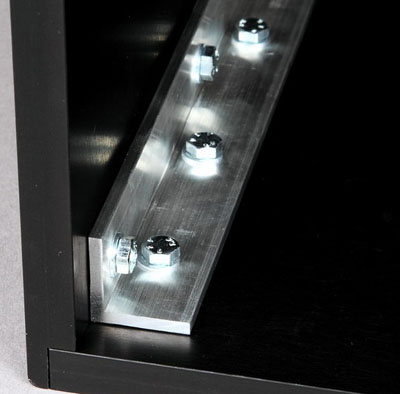
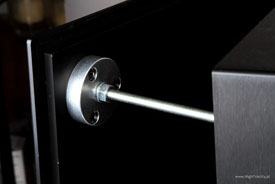
The ideal proportions of the German amplifier combine with perfect craftsmanship. Each of the sides is an aluminum plate fitted together with the others to appear as a monolithic block of aluminum. There are no visible bolts. The sides attach from the inside and the top and bottom by means of long bolts which connect with the very solid, slightly cushioned aluminum feet.
|
 |
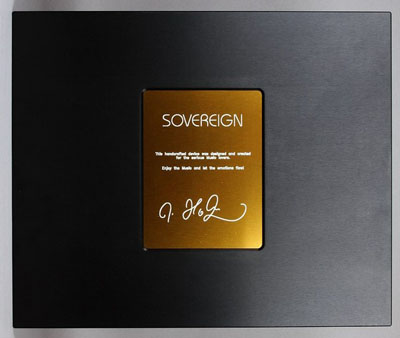
The front sports a small window recess which looks upon a gold name plate and blue LED. The top cover holds another big gold plate with designer Thomas Höhne’s signature and wishes to enjoy the music.
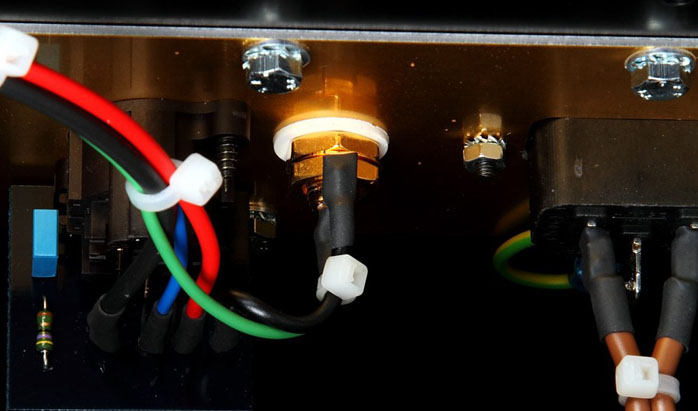
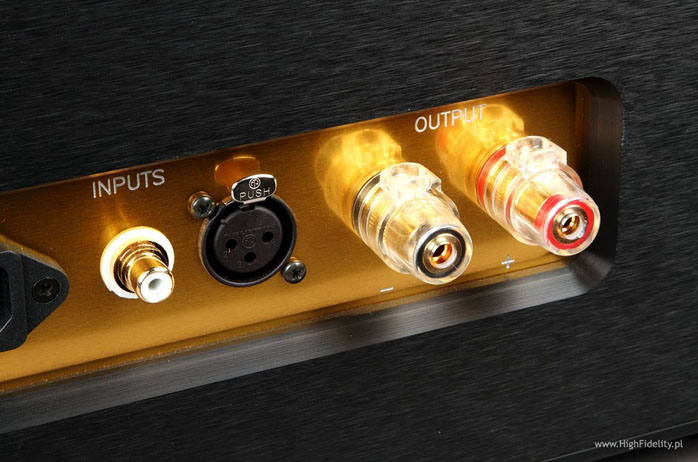
A final golden plate on the back also sits in its own recess and serves as mount for the i/o ports. The center holds the IEC power inlet flanked by gold-plated but otherwise ordinary RCAs, XLRs and speaker terminals. The latter are really bad because they sit deep within the recess to impair handling – and they do not accept spades. Fortunately my Omega Onyx speaker cables sported exchangeable connectors. At the Glory’s level, I think it worthwhile to fit the market’s top terminals like WBT’s NextGen. Lastly, the front panel sports a big ‘S’ apparently milled into the panel. But when we touch it, it turns out to be the power mains – really tasty.
|
|
|
|
|
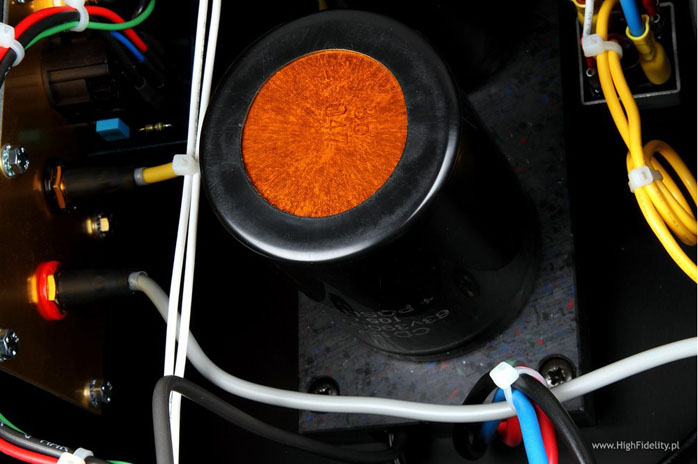
After removing the cover, we see solid and quite conventional construction executed in the very best tradition. As with any quality amplifier, most the space is occupied by the power supply. This is a dual mono affair with one toroidal transformer per channel mounted in a damped sub enclosure. In front of these trafos sits a thick vibration-damping spacer made from a polypropylene type material with four big capacitors to filter the supply voltages for the power transistors.
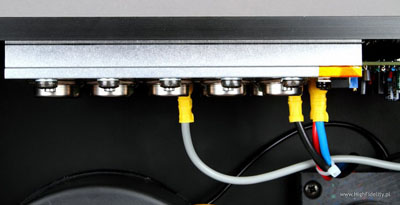
The output stages bolt directly to the side panels on either cheek and are split into two sections. The input and control circuits occupy a small PCB with many transistors and metalized resistors. The output transistors couple to a thick aluminum slab which mounts to the side panel. There are no traditional heat sinks yet the unit does not really get hot. One presumes a floating class A bias or similar solution. Each power stage runs 10 transistors in five complimentary push-pull pairs.
|
|
|
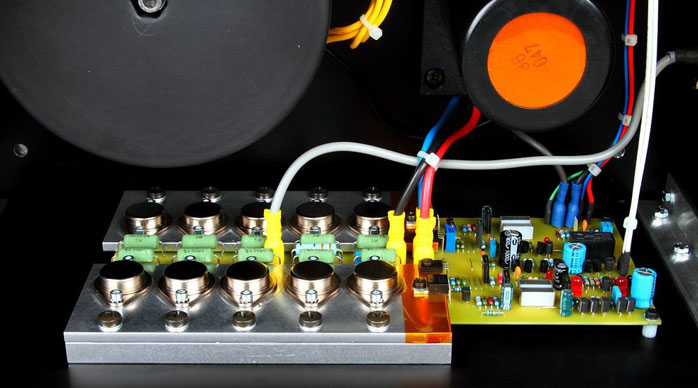 |
Interestingly, the transistors use old type TO-3 enclosures whose markings were erased. Those are controlled by bipolar Motorola MJE15030G transistors. A PCB for the standby and protection circuitry occupies the very front. Execution is very neat and tidy.
|
|
|
Technical data (according to the manufacturer):
Output power: 240W/8Ω | 420W/4Ω | 750W/2Ω
Minimum load: 1Ω
Frequency response: 5Hz - 120.000Hz
THD (10Hz - 20kHz): 0.09%
S/N: 94dB A-weighted
Channel separation: 93dB
Output damping: >1500 (DC - 10kHz)
Gain: 45dB
Maximum power consumption: 1500W
Clipping protection: Yes
Dimensions (WxHxD): 480 x 220 x 420mm
Weight: 35kg
|
|
|
 |

opinia @ highfidelity.pl
|
|
 |
 |