This review page is supported in part by the sponsors whose ad banners are displayed below |
 |
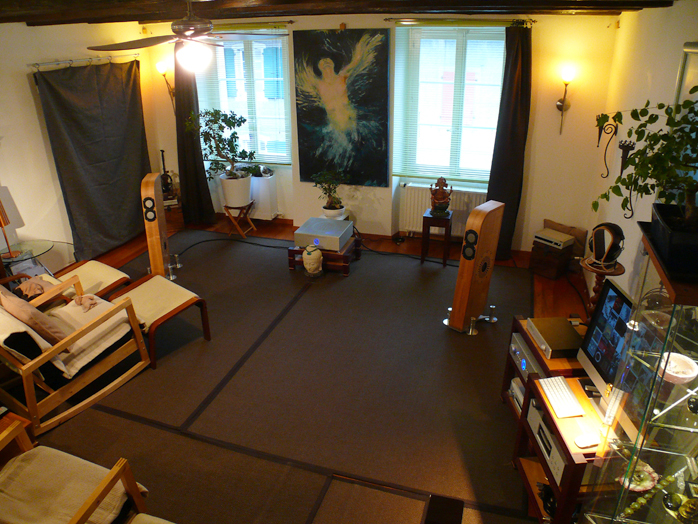
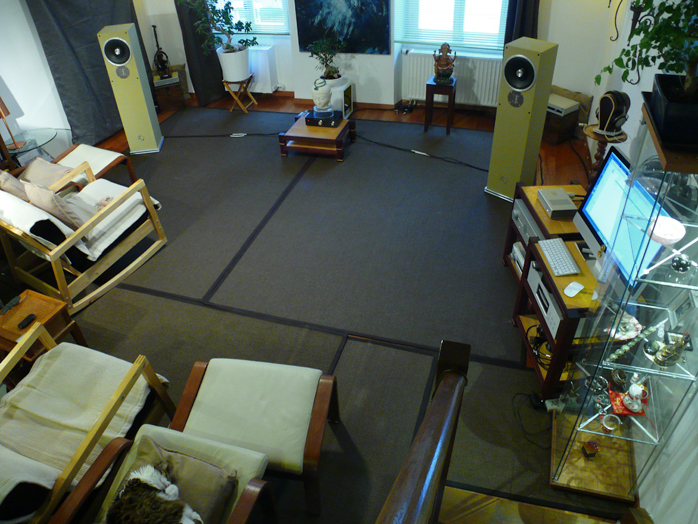
Provisos. First there's power or the relative lack thereof. A lot more studly than the SIT-2 whose 10-watt 8Ω power diminishes to a mere fistful of 8wpc into 4Ω, the Signature doubles to 30 watts into that. Even so my 87dB Boenickes with their series-connected zero-filter sidefiring and sealed 10-inch woofers clearly thrive on the far higher power of my ModWright KWA-100SE [below]. The RWA got plenty loud. It simply didn't exert complete control over the bass and generally had a looser than ideal grip. Heroic high tenor at full throttle for example didn't crest and unhinge as it should have. Not enough oomph. Don't expect 15 watts to perform miracles.
|
 |
|
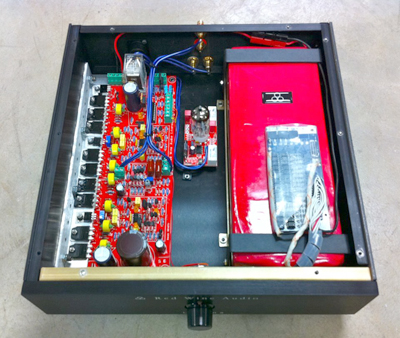
Battery power for amps reaps obvious dividends with low-impedance current drive. This translates particularly into the LF wherever raw power is sufficient. But even generally there's a high degree of grippiness. To me the core similarities with the class D Signature 30 suggested that the deep 2nd-order type sound which shares basic qualities with a core valve aesthetic ties directly to this choice of power supply. Just as I believe that Zu will be forever limited by their 10.3-inch widebander on achievable midband resolution, so do I suspect that Vinnie's dedication to battery power for high-level circuits encounters a similar built-in limiter. That's speaking in ultimate terms. His sound is supremely satisfying and highly caloric in the best sense. It's simply that particularly my various FirstWatt transistor amps demonstrate how traditional power supplies combined with very clever circuit minimalism can score rather higher on resolution, air, speed and separation power.
|
|
 Liliana prototype Liliana prototype |
|
|
 |
|
 |
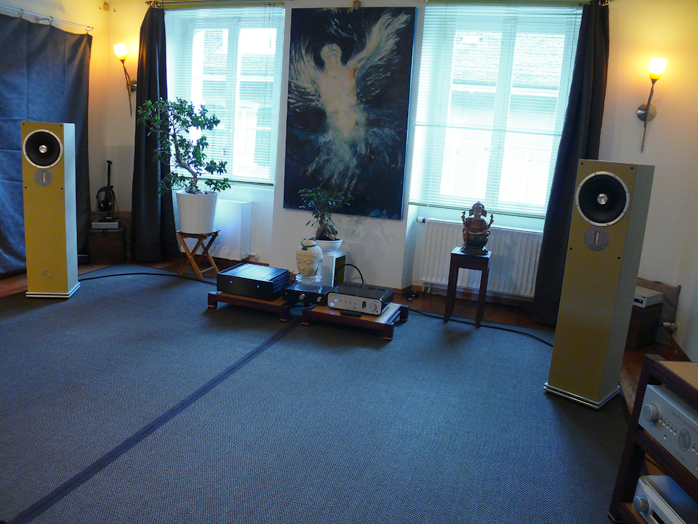
Complete retrieval of recorded ambiance thus steps back. If your musical diet includes many audiophile productions à la m.a., you could feel slightly shortchanged on their spectacular acoustic settings. What moves into the foreground instead is a very physical wall of sound. Its tight weave limits insight into the rear but compensates with very high they're here factor. This locks more on tone presence than outline sharpness or sculptural relief.
Colder sharper slightly vivisectionist more nervous speakers will thus get quite a lipo injection with the Signature 15 to fill out and calm down. Applied strategically (and hifi is all about that) a potential proviso turns real asset.
|
|
|
|
|
|
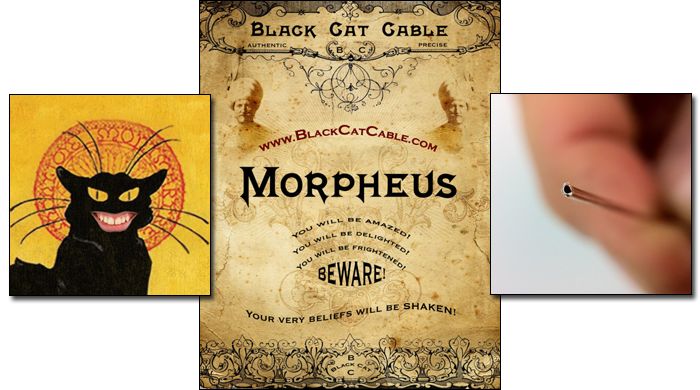
At this stage I replaced the $2.995 Eximus DAC with Schiit's $449 Bifrost with USB option. Then Zu's top Event interconnects and speaker cables left the room and Chris Sommovigo's new Morpheus! equivalents moved in. The latter change was very fortuitous. These hollow copper tubes with a wall thickness of 0.008" turned out to be very lit up and dimensionally sculpted. |
 |
Less weighty in the bass and thus also generally less robust or 'anchored',
these cables already in my ModWright/Boenicke system appeared deliberately dialled for articulation and upper harmonics. As two attributes on which the RWA/Zu combo could stand to be pushed more, this cable swap bled out some cream and sugar in favor of another espresso shot. Like a blood thinner's quickening action, the sound grew leaner, more energetic and illuminated.
|
 |
I preferred this new blend of traits. This segues neatly into the Signature 15's key attraction. In my experience the search for hifi bliss occurs over two stages - resolution and body. If you start with transistors as most do, resolution is handled first. If you're drawn to tubes, you begin with body. In either case you'll eventually want to address the other half. Ideally this wouldn't give up anything, just add. In reality compromises of gaining more than one loses are the ticket.
|
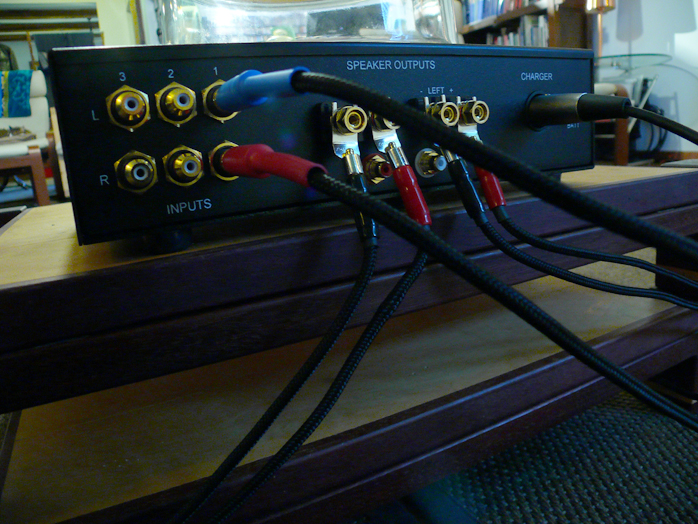 |
Virtues. As a transitionally priced integrated, Red Wine Audio's Signature 15 is unusual by securing such a high degree of body—the trio of tone, texture and density—from the start. In this class one traditionally gets the easier detail fix first. Then one sets out to have just the right amount of body work done to flesh out this pixilated resolution. Perhaps that's by way of a valved preamp. With the Signature 15's hybrid circuit as grafted atop a battery supply, any newcomer to the hobby instantly gains a quite advanced degree of basic tube virtues with a few uncommon very non-tube wrinkles. Those are a very low noise floor, stout current delivery and from that an excellent power/torque ratio which simply means raw speaker drive across the band and brilliant bass control in particular. As Black Cat Cables' super affordable Morpheus! cable loom proved, strategic ancillaries can easily shift the relative balance from the signature earthiness toward greater illumination and speed while tube rolling—of a single tube to be affordable—should provide its own quite effective voicing tool.
In my book starting the Sig 15 way handles the more difficult part of this equation first. If you share my belief that it is the far more important part to long-term musical enjoyment, that's vital. To get there for $1.500 rather than an ASR Emitter II-type $10.000 sticker is a really big deal. It's why the latest Red Wine Audio model joins the original Signature 30 in garnering our Blue Moon Award. It's an even better amp with more features for essentially the same price as it was six years ago. Take that to the bank! |
 |
|
|
Quality of packing: Insanely overbuilt as though designed for a parachute drop.
Reusability of packing: Many times.
Ease of unpacking/repacking: A cinch.
Condition of component received: Flawless.
Completeness of delivery: Perfect.
Human interactions: Always good. This is an owner/operator-type business that understands customer service in the information age.
Pricing: Very good value.
Final comments & suggestions: None. |
 |
|
 |