This review page is supported in part by the sponsors whose ad banners are displayed below |
 |
 |
To extrapolate, Octave's brilliant specs rely on a chip-based output buffer and 22-35dB of NFB depending on gain. Valve purists might scoff at the hybrid transistor outputs and the liberal use of negative feedback. They should recall that Octave's amplifiers are specifically designed to deal with low-impedance reactive speakers to be exclusively push-pull pentode and thus feedback by design. Octave demonstrates with big Dynaudio, Triangle Magellan and other burly boxes beyond the ken of most valve amps and a virtual death knell to nearly all zero-NFB SETs. That makes for an altogether different design ethic and— one shouldn't be surprised to learn—also a different type of sound.
|
In my review of Audio Technology Switzerland's Nagra Jazz, I'd juxtaposed it against the HP300SE and
described the sonic core difference as having less to do with audiophile sound items on the usual checklist and all with gestalt. Obviously speakers only deal in the acoustic transmission of electrical signals. They care nothing about abstract human concepts. Listener response is thus due to what's in that signal. It simply appears that some very important responses to hifi playback aren't confirmed yet by collaborative measurements. I'll thus talk of the audible effect, then briefly theorize what caused it. The Jazz was fluid, elastic, outgoing, effervescent and aerated. It had swing. Breath. It was generous and vibrant. Gushing. The HP300SE embodied a Victorian woman. In her fishbone corset she moves with very conscious poise whilst taking very shallow breaths. Musically things were rigid, stiff, drawn inward and dry. There was very clear and audible exertion of control. Its byproduct was simply a squelching of the Nagra's elasticity.
|
|
|
Yet nothing was wrong or objectionable about the sound per se! In fact listeners majoring on high-output wall-of-sound type power music would probably not at all relate to my description. But take for example Miguel Poveda's last track from Coplas del Querer. Here the singer is backed by massive string orchestra and solo violin. That oceanic soaring of expertly recorded strings had a very different singing quality which I imagine even lovers of amplified music would key into. And that bel canto gestalt was the vital differentiator. What caused Nagra's buoyancy and freedom of expression? Valve outputs without a transistor buffer? Much lower feedback? Here designers who have strategically isolated effects of specific circuit choices must chime in. Asking me what audible attributes created or contributed to the effect, I'd point at more elongated decays and their connective tissue and as such perhaps results of lesser damping.
|
 |
When I experimented with foam-filled acoustic corner traps and first-reflection sidewall absorbers, the effect was quite similar. Reduction of HF reflections killed off vital energies. Textures dried up. The sense of free breathing restricted. Once I removed these treatments, musical freedom returned and suffocation lifted. I understood that at least in my setup these treatments did something very different than damp unwanted bass energies. Hence my theorizing that this change of musical gestalt was directly related to an electronic facsimile of my long since abandoned acoustic damping attempts. The Nagra sounded like a reverberant room, the Octave like an overdamped one. Or think resonant tonewood soundkaos speaker versus an inert aluminum Magico. The latter's popularity reminds us. None of this is absolute. It merely reflects different design approaches and their associated sonic ideals. |
|
|
|
|
|
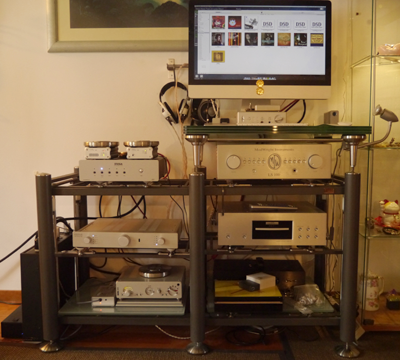
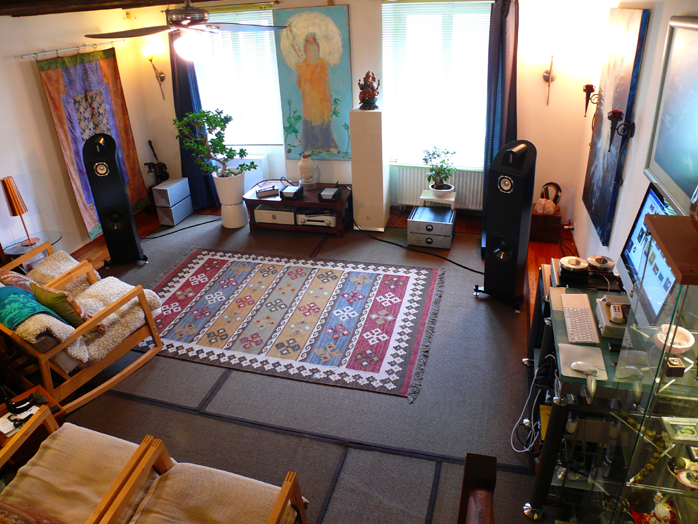
| Having pegged the HP300SE's gestalt in said comparison, a responsible reviewer next creates ancillary context which plays to it. Rather than high-efficiency widebander with 10-watt SET like the soundkaos Wave 40 and FirstWatt SIT1 combo on hand, appropriate to my mind meant more challenging speakers and high-power amps to create my version of a Soulution/Magico-type gestalt dominated by NFB, material damping and extreme control. For speakers I had the €12.000/pr Aries Cerat Stentor, a sealed three-way in a super-inert stacked Ply enclosure with trap-shaped inner walls and 30-part complex filter network. For amplifiers the 100-watt Thrax Audio Heros hybrid Fet monos did have appropriate muscle but their no-feedback concept with output transformers pursues a different sonic ideal. For my matchmaking task Wyred4Sound's mAMP monos seemed better suited. The Octave pre would drive them through its balanced output transformers. |
|
|
|
 |
|
 |
The combination of warmish slightly soft but ballsy and dense 200-watt ICEpower amps with the drier incisive very resolved hybrid valve preamp proved to be an ideal match. It had the Cypriot towers perk up at full attention. I'd previously tried the Nagra. Its texturally softer more fluidic approach with less transient cutting power had not gotten the best from these Californian amps. That sound lacked snap to restress the importance of conscious component matching. With the Octave I had true rhythmic fugue vision. If in a massively paralleled Baroque fugue you've ever tried to follow all the time- and pitch-shifted recurring motifs at once, you know the amount of attention that takes. With the HP300SE very complex rhythmically intertwined stuff enjoyed exceptionally sorted dead-easy clarity and the trampoline which all the beat makers bounced around on was very tautly stretched. |
|
|
| With the hybrid tube preamp's exploded bandwidth, superior Raal ribbon tweeters and small-diameter Fostex midranges, the class D amps had more lucid top-end response than usual. Whatever fiery content was encoded in leading edges peeled out clearly to emphasize rhythmic urgency, rollicking power and drive. Guitar arpeggios and close-to-bridge tremolos had high Platinum content to stress metallic over wood action. With a due nod at the class D monos, the sealed 10-inch carbon-fiber woofers deliberately tuned for accuracy exhibited truly outstanding control but also greater tension than the Nagra had conveyed. This showed how the Octave shared in the tightly sprung bass glory. This theme of taut timing and metronomic precision proved pervasive. |
|
|
On incision power, the Octave tracked the 6P6-powered fully transformer-coupled Thrax Dionysos though in tonal lighting terms the HP300SE was more blue and not as crystallized. Texturally it was nearly as dry as the 6H30-fitted TruLife Audio Athena but sidestepped the Greek's tendency for glassiness. Compared to the 6SN7-driven ModWright LS-100, it was less relaxed, more angular, cooler and tonally less generous. This confirmed my assessment that the Octave wears its hybrid heart openly on the sleeve. Transistor virtues are predominant. Whether that's fact or just a nod at popular perception—what do transistors really sound like per se?—is irrelevant if the intended meaning translates. HP300SE plus SIT1 amps pursued extreme lucid mode in search of warmth and relaxation. HP300SE and ModWright KWA100SE amp walked closer down the middle aisle if still on the slightly cool side. On the Wyred4Sound mAMPs (this would hold true also for the April Music Eximus S1 or a Peachtree Audio 220) the Octave tightened the reins and exorcized some warmth to increase power and control for wall-to-wall wallop. It thus struck me as a quite ideal mate for the current crop of 3rd-gen B&O-powered amps.
|
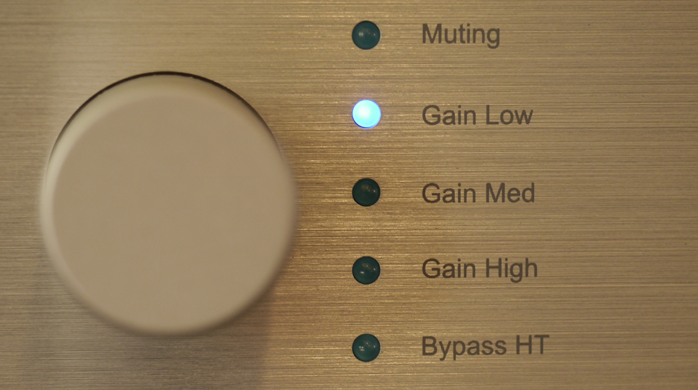 |
switching gain settings invokes ~10sec. mute so isn't instantaneous
|
If your notion of valve preamps is informed by traditional conrad johnson and the champagne gold of their anodizing, Octave is an animal of quite different stripes. Its focus isn't on tonal or textural tube qualities. It's squarely on the mythical 'triodes are the most linear amplification device ever created' claim. I simply prefaced that with 'mythical' because most zero-feedback SETs sound anything but linear. Here Andreas Hoffman flips the game to demonstrate precision, accuracy, control, bandwidth and raw resolution in action. That in this laudable pursuit he would strategically exploit transistors and high feedback will quite predictably eliminate purists from his audience. Those who care about results not means will only focus on whether in their system the Octave HP300SE moves the overall sound into the desired direction or not. The above descriptions should predict that.
|
|
|
At €5.500 and on raw micro-detail recovery, Octave's HP300SE refused to play second fiddle to Nagra's €10.700 Jazz or Thrax's €15.000 Dionysos. Its noise floor and bandwidth figures were similarly off the charts. Sonically the German deck was far closer to the Bulgarian than Swiss. At essentially 1/3rd the price of the Thrax, its continuos volume control even in high-gain mode also was far more practical than the very coarse transformer-coupled steps of the Dionysos. So was the far broader acceptance angle of its remote. What the Octave had functionally over both its costlier competitors was the ability to run its mixed outputs simultaneously, say XLR into dual-differential Mola-Mola NCore monos, RCA into a Zu Submission subwoofer.
|
| To my ears the decisive trait of this machine was its Naim-like rhythmic tension. Embedded in excellent separation and dry matter-of-fact attacks, what we might call beat fidelity—that taut gathered reaction to musical pulses—controlled every single session. Whether by this you envision the obvious feet tapping, heads bopping and fingers snapping or simply an underlying but communicative sense of springiness and vigor, you'll have pegged this essence. If your system needs more of it because it's presently a bit old fogy, chilled and indecisive—in other words sleepy—you could want the HP300SE to move into a higher octave of perkiness and energetic timing. |
|
|
Another way of expressing it is to misappropriate real estate's core mantra of location, location and location. Turn it into control, control, control. That's what the HP300SE's prime location is all about. If that goes against popular expectations for valve machines, it only shows that in the hands of the right engineer, gain or output devices can be harnessed in more ways than one. For cloud-less visibility as a confluence of sharp separation, extended frequency extremes and very low noise, this valve machine would seem the equal of any solid-state equivalent. Especially in the context of cuddlier slower valve or 3rd-gen ICEpower amps, the Octave becomes accelerator, energizer and spunk meister to take the baton from the currently sleepy conductor. That makes it a kind of wakeup call. So it's good morning to ya. Get ye cracking. The Octave HP300SE is here to address you... |
|
 |
 |
|
 |