This review page is supported in part by the sponsors whose ad banners are displayed below |
 |
 |
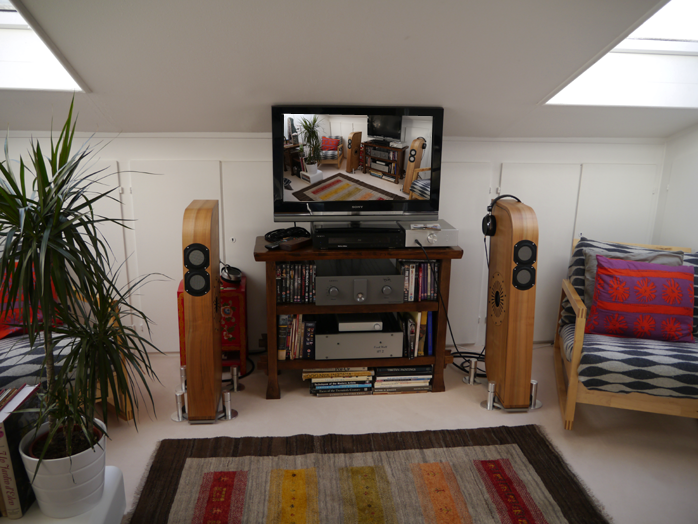
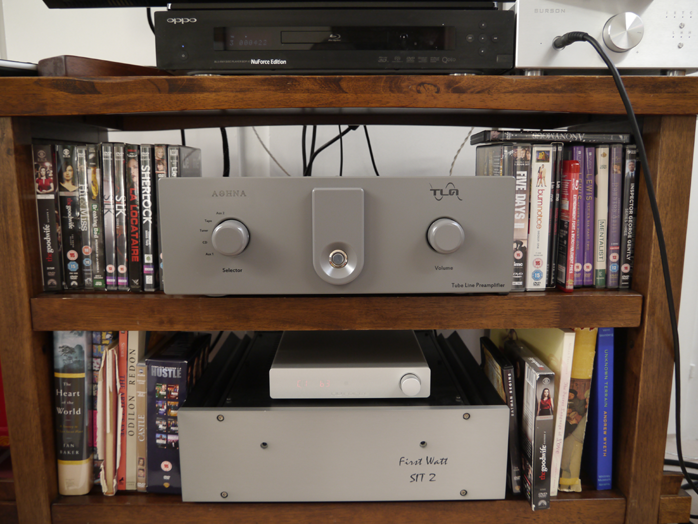
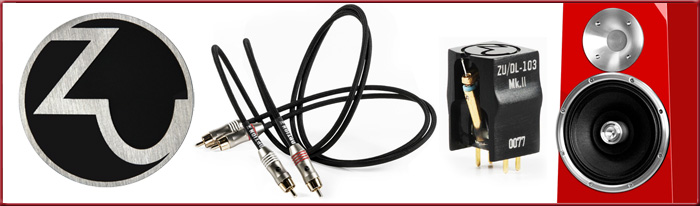
To grant myself the happiest possible second date, I booked a different restaurant by heading upstairs for our small A/V system. It's built around an Oppo NuForce Edition universal player, TruLife Audio Athena valve pre, FirstWatt SIT2 stereo amp and Boenicke Audio B10 speakers with Zu Event wiring. Think of the narrow wooden speakers as an Anthony Gallo Ref 3.5 from another mother. Instead of one sidefiring 10" woofer there are two - opposing, vertically offset and active far higher. Instead of the wide-dispersion MTM array there are two wide-dispersion flat-diaphragm tweeters. For minimalist electrical filtering there's a 1st-order tweeter high-pass with ultra premium parts. Plenty of differences but also much overlap in the semi-omni radiation pattern and minimalist approach. It makes for a similar performance with easier drive requirements and richer tone.
|
 |
Reseating the S/PDIF cable which otherwise feeds Burson's Conductor when I use HifiMan's HE-6 headphones on their 3-meter leash bypassed the separates and handed over directly to the DDA-100. As before, the sound arose squeaky clean against a jet-black quiet background. Unlike before however the third dimension had now been cracked open if arguably not fully conquered. This requires explanation. When one speaks of fullness, there can be a spatial meaning to imply 'not flat'. With these virtually omni speakers the soundstage per se had no real issues. It certainly wasn't on par with the far costlier separates but perfectly virtuous for the price. The stage was full as in filled up or peopled with performers in proper 3D relationships. Where things still were a bit flat was tonally. The B10 are highly gifted on tone because timbre—which in real life depends on a proper blend between direct/ambient attributes—is the core focus of their Swiss designer. It's why I get away with the very transistor-like highly incisive quick and dry-ish single-stage 6H30 preamp and the equally quick wide-bandwidth FirstWatt amp. Their contributions tidy up the speaker's otherwise somewhat amorphous gestalt and hone its cutting power. The thus invigorated sound requires no further harmonic assist.
|
 |
Yet tonally the DDA-100 was flatter. It still begged for an assist. To go caricature, it wanted valves. But obviously that was out of the picture. A purely digital input signal is mostly what it is. I thus reached for recordings of high quality to even the odds. Calling the sound two-dimensional would be misleading since most automatically associate a compromised soundstage which wasn't the case. Yet if such a thing as a somewhat 2D-ish domain of tone timbre and texture existed, we'd have a match. Measurement fans might invoke lower THD for the NuForce and probably be correct for 2nd and 3rd order. Just as likely they'd be incorrect for higher-order components. Despite running full-range speakers for proper tonal balance and weight (which you can never really say for desk-top setups), the sound had a clear MP3 quality to it: squeaky clean and tidily scrubbed but flat and lacking in color and emotional conviction. It was still 'digital'. That's of course criminal oversimplification but sets proper expectations like the judge who couldn't define pornography but knew it when he saw it. Remaining cognizant of price and the need to be realistic, I couldn't help but remember the cheap Dayens Ampino from Serbia. That had sounded rather more 'grown up'.
|
|
|
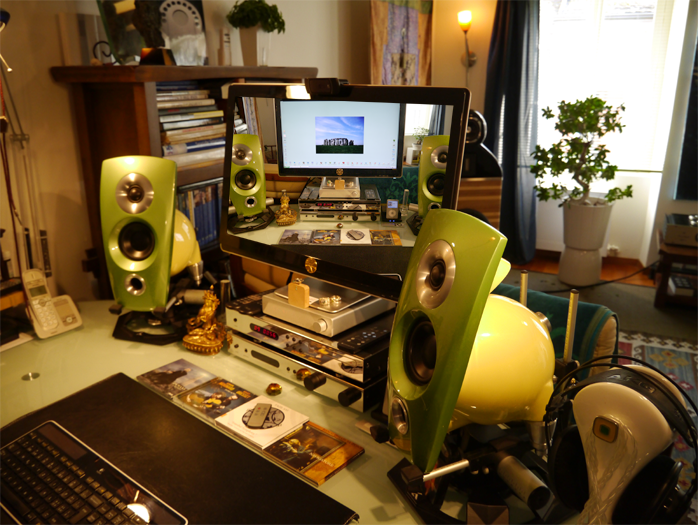
Time for more price-matched playmates on the desktop. Given the above I decided to head straight for my tonally most sophisticated monitor. The Bulgarian Terra III from Everything But The Box was properly elevated, isolated and vertically aligned on Ardán Audio's brilliant stands from Ireland. Sources were either a 160GB iPod Classic with AIFF files going through Cambridge Audio's iD100 digital-direct dock; or Aura's Vivid CD player. Same game but even lower. To get much of any sense of flesh 'n' blood required higher levels than usual. Those then partly ameliorated whitishness and textural flatness of lower volumes. The Hitachi Mosfets in Aura's Vita integrated—more than twice priced too—develop tonal fullness and body to a far more satisfying degree. They also don't need priming to open up.
|
 |
As I began to think on the latter—which admittedly took far longer than it should have—and added the fact that Amphion's usually sober boss had reported exciting results from a trade show where spaces and playback volumes tend to be bigger and higher than at home; and that the higher volume settings in the upstairs rig had sounded better which perhaps wasn't merely a function of costlier larger speakers... I began to suspect that the DDA-100's necessarily digital attenuation bit-stripped too much at the settings I'd run. Bracing myself for minor head banging to test the hypothesis, I turned up the wick to 75 on the desktop since my big speakers come on song sooner even in free space (which is counter-productive only in this type of upside-down context). Aloha. Pay dirt, finally! Rather than simply scale up in loudness as though working exclusively vertical, now the sound fleshed out as though expanding also horizontally. Cranking levels above a certain threshold added back all the vitamins, enzymes and 'active ingredients'
which the homogenization and pasteurisation of lower levels had bleached and stripped away. This felt like going to the health-food store for wheat germ to compensate for bread baked with bleached flour before discovering properly sprouted whole-grain Essene bread.
|
|
|
|
To exploit this fully wanted more inefficient speakers; lower recorded levels; larger listener distances; and higher playback levels all to strategically diminish digital attenuation and prevent it from exceeding a certain value below which things started to jump ship. Were I made of sterner stuff and/or had properly hard-of-hearing speakers... I'd condense all the above into one brief paragraph and come out swinging with the remainder. But to my mind an amp that must be played quite louder than I want before it sounds any good has real issues. That said, a younger audience of more fearless ears could really cotton to the DDA-100. This older mellower chap simply wasn't the right audience. My apologies to the good folks at NuForce who must have hoped for a better match. One purely practical concern should be that sans remote the amp won't come out of standby. Lose the wand or run down its battery and the DDA-100 gets stuck in terminal limbo unless it happened to be fully powered up when the remote went awol.
The upshot here is that contrary to expectations where small + cheap = desk top + easy loads, the DDA-100 wants to be run in the upper quadrant of its attenuator to fully blossom. This could mean big-rig settings with inefficient speakers and volume figures of 70 or higher. In the nearfield where 45 or less could be normal, the amp devolves into a paler and paler shadow of itself*. I wouldn't be surprised if user commentary on the DDA-100 ended up wildly contradictory. This amp was far more of a Jekyll 'n' Hyde type than I'd come across before. Users who can provide proper conditions for it should also know that USB-to-S/PDIF bridges such as the Stello U3, Audiophilleo 2, Resonessence Concero or KingRex UD384 make worthwhile improvements over running the DDA-100 USB direct.
_________________________________________________________
* I would have said 'true self' but this shadow side is just as real and true.
|
 |
  |
 |