This review page is supported in part by the sponsors whose ad banners are displayed below |
 |
Where proper loading proved extremely critical was for extension and dynamics. When run at 100 ohms, the resultant sound lacked weight and detail in the bass while proving a little dull on top. At the same time musical flow was at its very best, the notes moved freely and expanded without any asperity or rough edges but also without much dynamic capability as was very obvious on percussion impacts and pizzicatos that seemed to take forever to develop instead of exhibiting their usual explosive character.

Once proper loading was established, bass and treble extended and significantly gained in resolution and detail without overdoing things as was clearly the case when I had the cartridge loaded too high. Dynamics underwent a huge upward leap to return life to the music without sacrificing much of the flow and refinement I had originally admired - in other words, the best of both worlds.
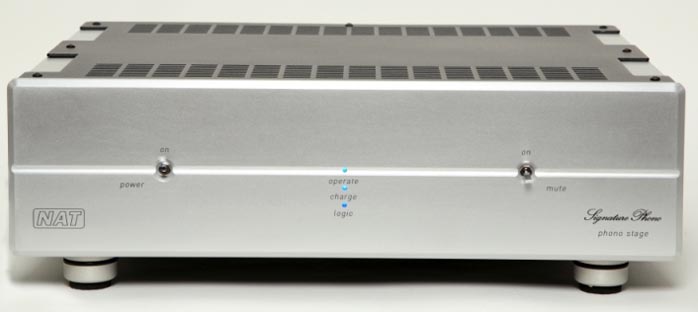
The E03 and Flight Phono both go further in dynamic micro ripples and macro waves (with the E03 the absolute champion on both) and they provide still greater extension (rounder and warmer for the Flight Phono, leaner and drier for the E03). Once I had NAT and cartridge properly matched, I did not feel anything was missing from the presentation though. The other two went farther with those specific traits but the NAT was no slacker by any means. Where it dominated the other two was on tonal accuracy and midrange elegance. No matter how good the two solid-state phono preamps were, they just did not match the NAT's triodes in that department. Voices took on dimensionality and palpability, strings gained in lushness, the wooden bodies of violins, cellos and pianos were fully revealed in their harmonic complexity.
|
|
|
Does this smack of a caricature between triodes and transistors? I'll accept the blame but it certainly summarizes the differences I heard, the key being that for my taste, the NAT brought a lot more to the table in added midrange insight and tonal colors than it sacrificed at either end of the spectrum. I originally thought the Signature Phono to have a tendency of pushing the soundstage to the back of the room. This was born from listening to Solti directing the London Symphony Orchestra in Mahler's First Symphony. All the instruments were easily identified and in their rightful place relative to each other but the whole orchestra was set back several feet behind the speakers, much farther back than with the Esoteric E03 for instance. With massive orchestral forces the NAT just did not resolve the same level of detail the E03 was able to reveal. The NAT gave a convincing holistic presentation of the orchestra but the Esoteric (and to a lesser extent the Flight Phono too) brought more of the symphonic mayhem into the room without compression or confusion.
|
 |
Yet switching to Tarentelle, Tarentule the impression of a compacted stage relegated to the back instantly disappeared. Some of the instruments were now in front of the speakers, some behind them and others pushed yet deeper into the sonic landscape. I later cued up La Folia and here again instruments spread in front of me from a couple of feet to far away. The NAT does not push back performers behind the speakers, it just places them within the recorded perspective at greater honesty than the other preamplifiers tested. On smaller instrumental formations this was revealing while on large orchestras, the E03's ability to provide additional insight and better instrumental separation became invaluable.
What those two discs of medieval music confirmed was how the NAT does not extend as low in the bass as the two transistorized units yet the bass I did hear had a truly acoustic quality. I don't know how to better put it but live acoustic bass has a very unique set of qualities. It is neither completely controlled nor loose, rarely felt in the gut but somehow physical. The NAT gave the closest rendition of those qualities I experienced in this series of reviews.
|
|
|
Switching to the Gorillaz' electronic bass and generously enhanced infrasonics demonstrated the limits of the NAT vs the E03. The Japanese was absolutely unfazed by the cavernous bass beats of Demon Days and although the Serbian was not very far behind, it did cry uncle on the most profound subharmonics (I could hear them but they were significantly muted compared to the E03 and lacked any kind of punch).
|
 |
One of the most striking and revealing comparisons was on Balalaika Favorites. If you ever want to hone in on what the NAT is all about, bring this disc along. I don't have another one that better demonstrates the qualities of the Signature Phono. The Esoteric E03 was all about snap and attack, offering sharp string pitches and amazing resolution of the metallic sounds. The NAT took a step back on the attacks but offered a deeper perspective into all the resonances and wooden harmonics of the instruments. The E03 was fireworks and amazement, the NAT a meditative contemplation into a roaring fire.
|
|
Another characteristic of the Signature Phono that probably contributes to the overall feeling of relaxation and contemplation is how it handles surface noises, clicks and pops – as discreetly and quietly as can be. Unlike the Esoteric E03 that will let you hear every piece of dust in the groove, the NAT does a particularly good job at minimizing those artifacts and preventing them from intruding into the music. On that front, it is similar to the Flight Phono, getting out of the way even more I believe.

When cueing up Ella and Louis, I was given another perspective into the NAT's strengths. Triodes just seem to have a magical effect on voices and brass instruments by infusing them with a life that you don't get with transistors. When you combine one of the finest jazz voices of all times with Armstrong's enticing trumpet, the NAT shines and offers its very best. The only way I can describe the effect is by speaking of dimensionality. Both Ella's voice and Louis' horn seemed to move forward in the music (not as in "aggressive" but forward as in "closer") and instead of being mostly two-dimensional, they occupied a 3-D space between the speakers. I've never heard this effect with anything but triodes and the Signature Phono offered it in spades. The E03 was flatter and two-dimensional by comparison and somewhat drier. You could hear a phenomenal level of detail and insight into the performance but with the NAT, you could hear a singer. |
  |
 |
|