|
This review page is supported in part by the sponsors whose ad banners are displayed below
|
|||||||||||||||
 |
|||||||||||||||
Akin to the Zu Essence speaker in gestalt but not extent, the ModWright has innate tone density and weightiness. The small but dazzling Dayens Ampino from Serbia for example is more lit up on top and lighter overall (as well as much lighter in power and price). Its speed sounds obvious. Whether the KWA-150 is marginally slower by comparison or whether that's a bit of psycho-acoustic deception due to its lower tonal center and minor warmth is impossible to determine. It's fair simply to say that its speed isn't as obvious because it is clothed in more body. |
|||||||||||||||
|
| |||||||||||||||
Compared to the Pass Labs INT-150, the ModWright is definitely warmer. In the two-pole Pass universe, the former is a 3rd-order, the latter a 2nd-order design. This refers to the remaining THD product that is predominant to the ear. From this is evident why many would describe the KWA-150 as tube-like. SETs are 2nd-order machines. Clear differences remain of course. The previous page was all about those. Another very obvious one is the amount of secondish flavor. The ModWright plainly has significantly less than any of my 45, 2A3, 300B or 6C33C machines. But in a modest fashion, it is of the same general school. Single-ended valve lovers would be far more apt to recognize in it a kindred spirit than with any third-order amp. (Lest this imply clubbish superiority, Pass shows a nearly 50|50 split in their model sales covering both sectors to grant equal numbers and thus legitimacy to either camp.) |
|||||||||||||||
 |
|||||||||||||||
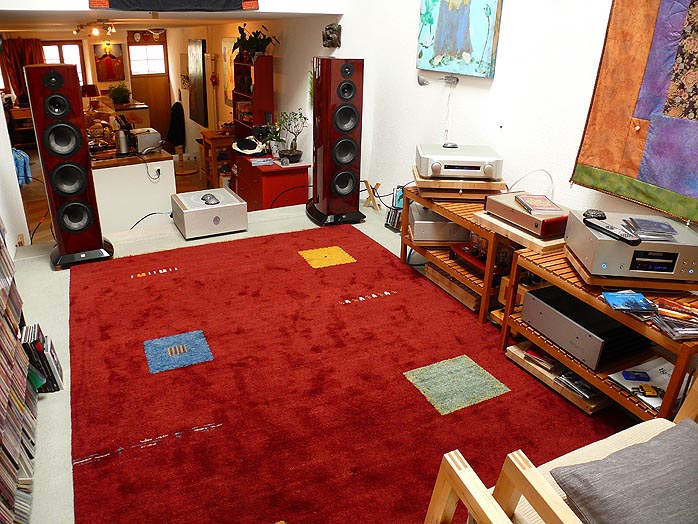
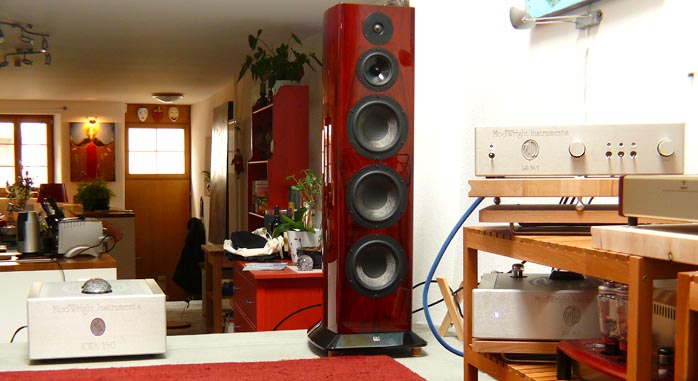
With my ASI Tango Rs, the differentiator most apparent to my biases is treble quality. As a very benign load driven well by low-power tube amps, the 40-some watts of the F5 into the Tango's 6-ohm impedance approach overkill. The ModWright's far greater reserves thus remain a frozen account. One does not tap it. From a drive perspective into this speaker and room, both amps are equals. By virtue of a very good Esotar clone tweeter coupled to a minimum-phase high pass and 'harmonic liberation' by three inbuilt acoustic resonators including Platinum per speaker, this transducer is terrifically endowed when it comes to overtone fidelity. Tone modulations are king. |
|||||||||||||||
 |
|||||||||||||||
Tone modulations are based on shifts in the harmonic envelope. An instrumentalist or singer uses various techniques to vary tonal expression. The best -- Lila Downs and Jan Garbarek are two easy examples -- can sound like multiple personalities altogether. But tone modulations extend also into rather more subtle strata. Those require extreme visibility to appreciate and, among other things, time-coherent speakers. Now think double and triple entendres in a language which escape even perfectly fluent foreigners. There's the word and its precise meaning. Then there is a hidden implied meaning that quite shifts the tenor or tone of the dictionary definition. Ditto for hifi modulating fitness. On one level, the tone is the tone as defined by its fundamental frequency. On another, its general harmonic content (that which differentiates it from a sine wave) is given a specific hue or weighting that tends to vary from amplifier to amplifier. On yet another level, there are the subtle alterations within the tone itself which the artist put there by inflection. It's here where lesser systems lose the thread. To my ears, a low-distortion wide-bandwidth 3rd-order amp like the FirstWatt F5 penetrates into this gossamer stuff of fluctuating tonal hues even deeper than the ModWright. In percentiles of obviousness, this is way down on the totem pole. For speakers that don't honor the time domain, it matters nada. But once timing is accounted for as well as analog crossovers and cables and circuits with their phase-shift limitations can, there is some room left in which to shine and resolve more. Within the hardware arsenal I keep on hand, here the F5 continues to be the undisputed champ. |
|||||||||||||||
|
| |||||||||||||||
The ModWright is a tad sweeter and heavier but close. This sweetness can be thinned out a bit with the lower bias setting but other aspects tone down as well. High bias really is the preferred serious listening mode. In terms of soundstaging, the KWA-150 casts great depth and resolves deeply into the recorded ambiance. Very small details are laid bare. On Ivo Papasov's Flight of the Falcon for example, you can tell which side of the clarinetist's embouchure leaks the occasional air. Due to the slightly warmish upper textures, image focus isn't as holographically locked as more lit-up amplifiers can render. The performer is unwaveringly localized and connected to its environment but not cast in high relief. Here certain class D amps like NuForce go further but arguably cross over into hyper realism. NuForce also applies more overt damping in the lower registers. By comparison, it dries out bass elasticity. |
|||||||||||||||
 |
|||||||||||||||
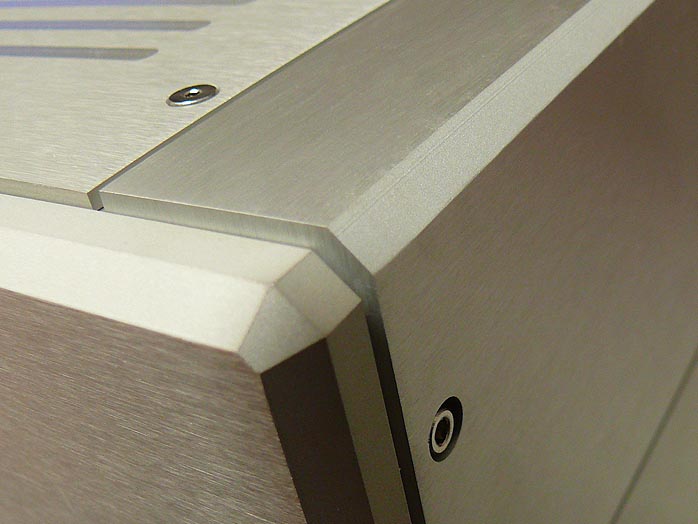
With the DM 36.5 linestage The 6H30 output stage of ModWright's tube rectified, tube regulated preamp meshes with the all-transistor amp by obvious design. The combination majors on dynamics both micro and macro, very robust bass and the kind of highly resolved deep space we admire SETs for. The combo offers minor valve textures with far more pronounced valve staging aka discrete layering - plus the control, linearity and low noise floor of the beefy amplifier. The Esoteric C-03 + Yamamoto A-09S counter proposition (transistor pre + valve power amp) demonstrates more overt tube virtues by way of greater holography particularly in the mid band, bloomier (less controlled) bass, greater 'wetness' or textural glow, still more pronounced layering albeit not as expanded in the depth domain, a greater focus in the center of the soundstage with less even coverage of the sides, a more 'pregnant' treble elucidation but inferior ultra-low (playback SPL) resolution. Quality During the review period, two manufacturers or their representatives laid eyes on the KWA-150 while delivering their goods. And they invariably commented on the extravagant enclosure and its intricately carved out top. Unfamiliar with the brand, they also over-guessed the price by a factor of at least two. When I explained that this included being built in America and dealer distribution, the ensuing silence said all. In fact, one such visitor already contacted ModWright to inquire about a presence in his country. I know because Dan thanked me for the referral by e-mail quite unnecessarily since I didn't do a thing. His pieces literally sold themselves and I simply had them. Yet their quality was self-authenticating and infectious even with jaded seen-it-alls. That's surely as high a compliment as can be paid. |
|||||||||||||||
 |
|||||||||||||||
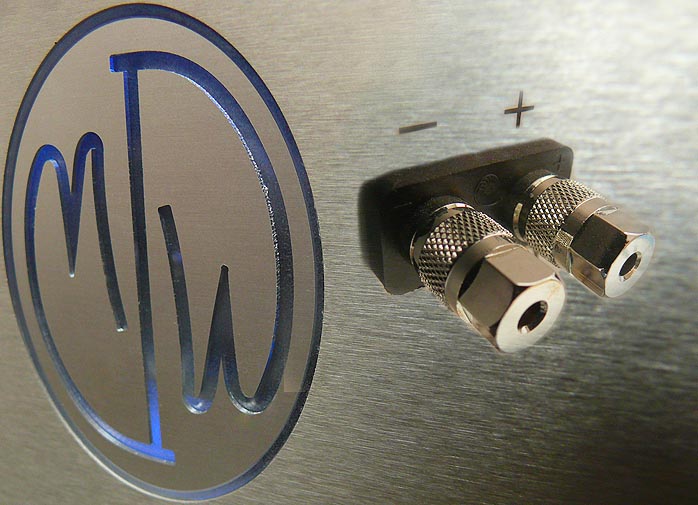
The Return of American iron With talks of GM and Chrysler bankruptcies dominating the news and the death of muscle-car brand Pontiac confirmed already, it's lovely to see ModWright's counter trend in the hifi biz. Just like Rogue Audio's Mark O'Brien, Dan Wright proves that outsourcing to the Pacific Rim is not inevitable to stay competitive. A superior high-value amplifier can still be built in the country that invented high-end audio. Without cutting corners. Witness top-quality Cardas posts and included premium cone footers with adjustable tips for just the first two examples of many. Equally admirable and refreshing is Dan's perfect candor about Alan Kimmel's circuit contributions which counters NDH aversions elsewhere (not designed here). It's honest and resourceful. What else to say about the sound that hasn't been said already? This is a pure, direct, slightly warm sound with very good body, first-class bass and a highly informative if not illuminated treble. The balance between image density and transparency is perfectly centered which is to say, you can find amps that do more of one but invariably diminish the other. Subjective separation is high but not extreme. Dynamics both micro and macro and ultra low-level fitness arguably score highest in what is a brilliant score card to begin with. I personally find macrodynamics to be less important since they apply mostly to symphonic music and anyone intent on recreating 'the real thing' on that score is hopelessly deluded. It's the microdynamics in the cramped 10dB of dynamic range that most music is recorded in today where the real differences occur between posthumous and alive, boring and compelling. Without being zippy, threadbare, nervous or hyped in the least, the ModWright KWA-150 despite its muscle beach allure is ideal for quiet yet fully satisfying sessions. Forget testosterone, that's what most music lovers do most of the time. They listen at from civilized to very subdued levels cognizant of neighbors and cohabitants, all the while longing for fulfillment from spirited sessions. That's where the KWA-150 delivers big time. |
|||||||||||||||
 |
|||||||||||||||
In short, ModWright's KWA-150 is a practical antidote to disappointment in the real world. While I'm no expert on high-power transistor amps having instead pursued the byways of valves, Dan Wright's first-ever amplifier strikes me as a very fine achievement. With the matching DM 36.5, it really does have the makings of a best-of-both world where tone and grip, finesse and power, textures and transients coexist and noise, drive and power tube issues don't factor in at all. Should the competition be worried? I should think so! |
|||||||||||||||
 |
|||||||||||||||
| Quality of packing: Very stout. Reusability of packing: Multiple times. Ease of unpacking/repacking: Easy. Condition of component received: Perfect. Completeness of delivery: Power cord, cone footers with adjustable spikes, excellent owner's manual. Website comments: KWA-150 info limited to PDF at present. Human interactions: Always courteous and prompt. Pricing: High value for a superior package of cosmetics, build quality and performance. Final comments & suggestions: None, team ModWright has crossed all the 't's. |
|||||||||||||||
 |
|||||||||||||||
|
ModWright website
|
|||||||||||||||
 |
|||||||||||||||