This review page is supported in part by the sponsors whose ad banners are displayed below |
 |
 |
AES/EBU'd iPod: Via Van den Hul's purple 110Ω AES/EBU Pro a Cambridge Audio iD100 talked to the Hex to have me flummoxed over how good streaming 16/44 AIFF files from a 160GB iPod Classic was. My fully optioned-out quad-core iMac with 2TB/256GB HDD/SSD requires the intervention of PureMusic 1.88a or Audirvana+ 1.41 to bypass a number of computing activities and optimize the sound via memory play. The music-only battery-powered iPod with its barely-there OS sounded terrific getting hex'd as is. Now my exposure to the digital AES/EBU standard is exactly 1 as this was my first foray. All I'll say is that the same dock's S/PDIF route via an equivalently priced Veloce link was clearly inferior to perhaps suggest higher transfer jitter; and that if you own an iPod and iD100, using the latter's XLR output will be educational with a DAC like the Hex that's got the equivalent input socket.
Upsampling an NOS DAC: Like Frederic I loved how PureMusic's 64-bit software-based NOS-type upsampling to 176.4kHz worked with the Hex. Sonically PureMusic 1.86 had been bested by Audirvana+ somewhere into the latter's 1.3.9 beta. With 1.88a Channel D had caught up again. Whilst I'm technically too dim to explain why upsampling the NOS Hex should work so well—and what it might imply about our collective attempts to explain why NOS DACs in general can sound so good—I'll merely suggest that should your music player of choice afford you the option of integer upsampling, give it a whirl on the Hex. It might just suck you in. If it plain sucks, 'twas a free lesson.
|
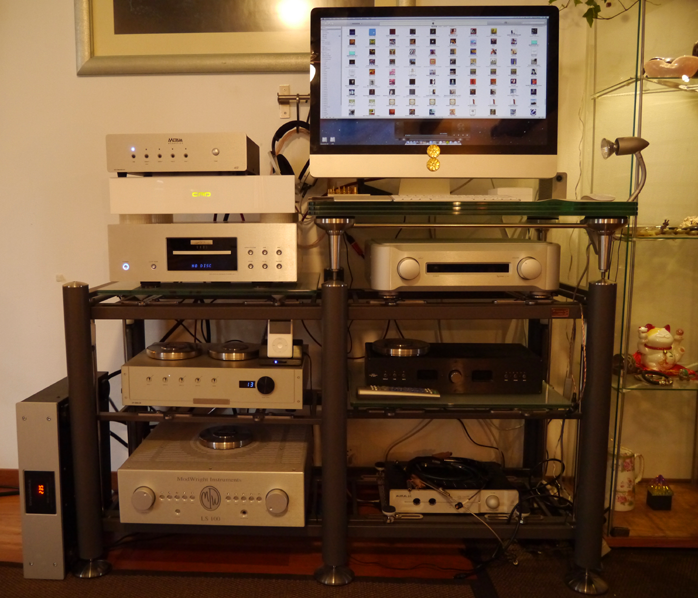 |
Metrum Hex, CAD 1543 DAC, NWO-M, Concert Fidelity CF-080XLS preamp w. Psvane tubes, GigaWatt PC3 EVO SE conditioner
|
XLR vs. RCA: With many so-called fully balanced preamps running single-ended volume controls to involve conversion of balanced inputs, ultimate statements on the Hex's two outputs seem impossible. So much depends on how the following preamp or integrated amp treats their balanced inputs. Extrapolating my results from running the AURALiC Taurus Pre, the Esoteric C-03 and the ModWright LS-100 preamps with equivalent Zu Event RCA and XLR cables, my final hunch is that the balanced outputs of the Hex might have a minor edge on jump factor. That said, I decidedly encountered no RCA warmth of the sort John described when using the 1527XL transformer option. The 1588 upgrade seems delightfully free of the softening/fattening effects one can incur with coupling transformers.
|
|
|
16 x 1543 vs. 16 x mystery chips or £6.990 vs. €2.521: CAD's 1543 DAC sounded as though the Hex were preceded by a Concero USB:S/PDIF converter to represent more 2nd-order tone bloom over less 3rd-order attack separation in general, on quantity about two Conceros worth. In addition the transformer-coupled Philips chips also shaded the treble to be less lit up. This was particularly obvious on struck triangle's diminished fire and dynamic cresting as well as lightly tinkled upper piano keys. It conveyed less ambient air and spiderwebby stuff. In short, the thrice-priced USB-only British machine felt deliberately groomed for traditional NOS virtues. It sounded generally softer/smoother and in particular slightly hooded in the upper treble to suggest a denser slightly midrange-y mellower take dialed for flow over adrenaline.
The Hex exhibited none of the breed's trademark treble softening. It was more impulsive on attacks and more elongated on harmonic decays. I had earlier referenced that simultaneity as zing and song, 2nd/3rd-order simulclass or a crafty triode/pentode mix. John had dubbed it tinkle beef. Frederic described it as more energetic initial dynamics without missing sonic body. Regardless of system or personal preferences, the Hex had behaved identical for three reviewers to reveal its signature or core sonics as the guaranteed traits that'll survive translation no matter your system.
|
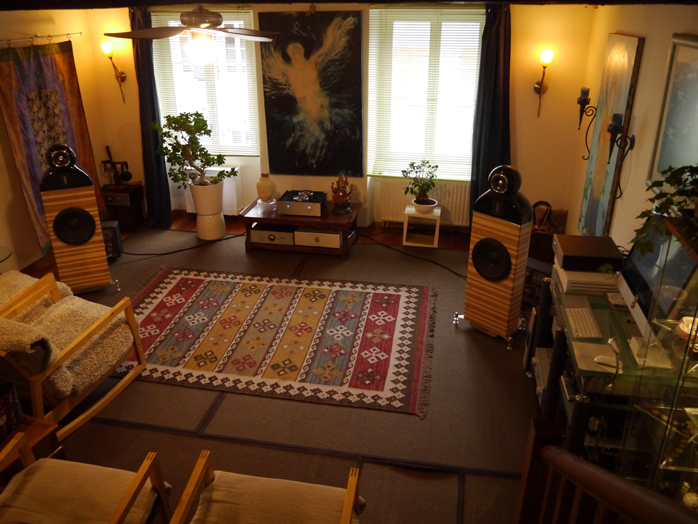 |
FirstWatt SIT2, Aries Cerat Gladius
|
16 x mystery chips vs. 40 x AKM AK4399 + tubes. Alex Peychev's completely rebuilt Esoteric UX-1 called APL Hifi NWO-M run as just DAC with my Audiophilleo 2 USB:S/PDIF converter and Bakoon's BPS-02 battery supply split the difference between Metrum and CAD. It mirrored the Hex's elongated decays and ambient illumination but didn't equal its leading-edge incisiveness or speed. Observed from our second angle, it inhibited the mellower gestalt of the 1543 'smoothie' DAC with its creamier tone but still managed the added more modern treble brilliance for enhanced sparkle. On price the older NWO-3.0GO rebuild demanded $19.000 on top of providing Alex with an Esoteric deck. It's fair to say that Cees Ruijtenberg's pricing of the Hex exemplifies Dutch thriftiness at an Olympian gold medal level. To pull John Darko's get-out-of-jail-free card, the Hex competes with converters well north of thrice its sticker represented here by the CAD and APL machines.
In a system celebrating typical ceramic driver sound, the Metrum DAC's frontal acceleration on transient microdynamics could conceivably cause a bit of a cold shower. It might overemphasize musical staccato/pizzicato elements over their legato counterparts to sound too prickly. In a vintage paper-cone system the Hex should be a much-needed shot of adrenaline and caffeine. In a well-balanced system of the sort most seasoned audiophiles likely aspire to after having explored the various byways of the main audiophile highway, the Hex loads up the scales of blister and tone equally to do both non-choppy flow and non-smoothed directness. All this operates on a very high level to be fully compadre in mature systems where each component costs $10K.
|
|
|
|
|
Conclusion. If the NOS Hex DAC were a 300B, it'd be no Western Electric or Full Music SE but a Synergy Hifi. It's most relevant to stress that the digital NOS tag in this instant requires the prefix of modern. Not only is the silicon of choice not the usual sort exploited for this approach, the resultant sound isn't the same. What it shares is temporal fluidity as the opposite to choppiness. Where it differs is not sounding slightly muted or overly smooth. It does spatial illumination full of air and light to champion very high resolution, then puts rhythmic alacrity on a very tall pedestal. It's not just about tone and languorous fades but also the visceral excitement of percussive exactitude. It's a bit of a bridge then between the classic NOS and modern Delta-Sigma sound.
|
 |
The perfect music track to envision this would be a well-recorded Claude Challe Buddha-Bar studio production with artificial but expertly layered-up ambiance including anti-phase effects. Think deft club groove distributed across multiple percussionists panned wide left, right and center. They energize not only various synths but a large array of bona fide Tibetan singing bowls, gongs, glockenspiels, triangles and cymbals stroked, brushed, tapped and twirled. There's a bassist handling a walking line with regular popped and slapped accents and a breathy songstress. It all makes for a unique mix of loaded harmonic sprays, endlessly dying fades, snappy instantaneous beats and exceptionally well-sorted deep space. |
|
|
 |
Full-featured as a DAC though lacking volume control, the 24/192 asynchronous USB implementation not only competes on the level of an Audiophilleo 2 or Resonessence Labs Concero, it being dissociated from PC power means that effective though added-cost battery power tweaks become redundant.
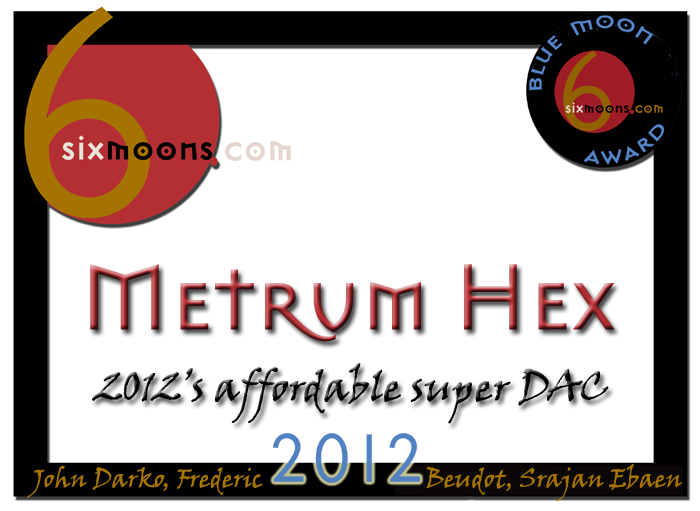
As Gene Hackmann has often been called the consummate actor's actor, the Metrum Hex is the archetypal engineer's DAC. It's very well engineered yet completely unpretentious on finish or price. It's a simple ¾-width box with standard rather than bling-thickness fascia yet the underside of the cover is lined with a bituminous plate to prevent ringing. To prevent redundancy of a different ringing, the AES/EBU and USB input modules are à-la-carte options and very fairly priced should you want them. In all the many ways which I'd consider relevant to cost-conscious shoppers pursuing maximum performance, Metrum's Hex is a true statement DAC. Going Dutch has never sounded this posh. It's also the first time one of our awards was shared between three writers who saw perfectly ear to ear... |
|
 |
Metrum Acoustics comments:
First a big thank you for this award! It was quite unique that in three different places around the globe the Hex was tested simultaneously and I'd already mentioned to John and Frederic that it makes us proud and also a bit shy that we received so much attention for a second time. Also thanks to Samuel Furon in Canada who introduced the Hex to Frederic which was a surprise for me. One and a half years ago I told you that it was probably time to create a second production facility and that's exactly what we now did in Maarsbergen. Hopefully we can manage production of the Hex without needing to create a third production facility :-)
Anyhow, all this attention to our products gave us an nice place on the hifi map and opportunity to create more products which hopefully will have the same success as the Octave and Hex. For both analog and digital we have some exiting ideas for the future but like good wine those need time to fully mature. Again many thanks to your entire whole crew!
Cees Ruijtenberg
|
 |
 |
|
 |