This review page is supported in part by the sponsors whose ad banners are displayed below |
 |
 |
|
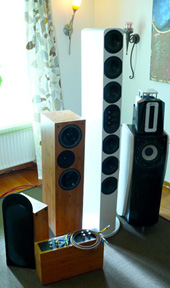 |
Aurelia Graphica vs. Mark+Daniel Fantasia S: The Graphica from Finland is a 2-way with six 5.25-inch underhung mid/woofers and three wave-guide 1-inch tweeters per side. It's also ex-Amphion designer Antti Louhivaara's current €7.500/pr flagship model. Though priced well below the Fantasia even considering the currency exchange, it's not merely a speaker I conveniently had on hand. It's another sane two-way statement effort from a very experienced speaker designer with a proven track record.
What the Finn shares with the others is deliberate décor friendliness. There's a small foot print and clean lines. Of the three the one from Shanghai actually sports the most unconventional 'modernist sculptural' cosmetics. Those could strike particularly women as a bit cubist or minorly robotic. (That was Ivette's first reaction but after hearing them all such objections vanished and she instead suggested making the pair our own. The performance really speaks for itself.)
Where the Aurelia beats its own path is championing cylindrical line-source propagation across its range. This explains the thrice-paralleled tweeters. Louhivaara prefers them over an equivalent tall ribbon for their greater dynamics and for enabling use of a shallow 1st-order filter.
|
| |
|
|
Where Aurelia and M+D overlap conceptually is exploiting surface. The Graphica does it across the board with conventional units (three tweeters, six mid/woofers), the Fantasia S with its tall folded AMT which only stretched out would reveal how much air-moving surface it hides.
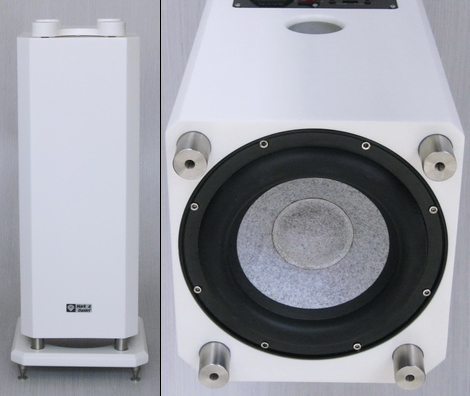
To compensate in the bassment the M+D woofer gets extreme linear stroke (in fact a slightly simplified version of it called the SX-8.0q-1.4 appears in Daniel Lee's columnar active Muse subwoofer to the right).
Would Aurelia's scaled-up cone/dome surface match or even beat Daniel Lee's dynamic reflexes?
|
|
|
|
|
|
Not. The Fantasia retained its drivers' unfair speed and response advantages. This flatly outgunned the Aurelia on articulation and micro-level magnification. The Graphica played it fluffier, looser and more distanced with all that implies. On low-down grunt the Fantasia was wirier and more striated. Its Q seems close to 0.5. The Finn moved more bass air but seemed less damped. A rough sighted estimate of its mid/woofer array would peg it at about twice the compound area of M+D's lone eight-incher. (My math in such matters has unfortunately walked off together with certain youthful aspects). On raw LF extension both speakers were equal but the M+D had more guttural impact.
|
 |
Upstairs the Fantasia with its OmniHarmonizer enjoyed its second unfair advantage. More pronounced elements of wisp, gossamer, faint decays, ghostly traces and an extra degree of overall illumination were its hallmarks. In short, against two well-known designers' best efforts—here I deliberately overlooked Kevin Scott's massive Vox Olympian/Elysian project—the Mark+Daniel played in a higher league. This wasn't of the different-but-not-better type. Nor was it a very marginal affair as one encounters with quality contemporary digital. This was significant.
Prior brand exposure perhaps should have prepared me. With the DM-5a at twice-plus the height of previous Dreams driver auditions I apparently just anticipated the same (just more of it). Absolute certainty is evasive given multiple new rooms, matured electronics and a completely different front end which separate my various encounters over the years. But growing experience and exposure suggest that this design leapfrogs the precursors and transcends them. It's more integrated. It's more natural, assured, seamless. These consequences reach deeper than small incremental upclicks of previous values. Regular readers know that I don't play at stratospherically priced hifi. I find it irrelevant and mostly obscene. This forbids absolutist statements. Who knows. Perhaps the grass really is a lot greener at oxygen-starved altitudes. In the up-to $20K speaker class I've paid attention to the Fantasia S does exceed what one tends to get from conventional cones and domes. Flashing back on Burmester show demos which struck me as unbearably hard and mechanical, I never expected I'd single out any expensive AMT speaker as resetting markers I care about. Learn and live a bit longer.
|
|
|
Fantasia Synergy:
"A friend recently asked me what the S in Fantasia stands for. It's for synergy - how we put everything together to be completely coherent. The Fantasia S is the most compact element of a series I'm still thinking about and for which I might one day develop larger building block arrays."
|
 |
If driver/enclosure/crossover synergy means working as one, the Fantasia is clearly deserving of its S-class suffix. Though it's brash and willful in this context, I'd unhesitatingly point at the tall AMT widebander if I had to pick out the core attraction of its recipe. The fact that one really cannot is testament to successful integration with a cone driver whose appearance suggests anything but nimbleness. While I expected dynamics galore, I did not expect this level of not-thereness and smoothness. Where previous M+D iterations had struck me as fresh and feisty, the Fantasia became their elder with nothing left to prove. It simply stepped aside. The greatest asset was magnificently dynamic contrast resolution at already very low levels. The most pleasant quality was its built-in tonefulness. This seriously diminishes what one usually has to expect—pray and dearly pay for—ancillary electronics will contribute. Unlike its smaller power-gobbling siblings, the Fantasia really lit up with 50-watts max amplification to allow prospective owners to shop the entry-level models of their favorite electronics brands. Finally and again unlike previous M+D encounters with their nearly unnaturally potent—i.e. enhanced—bass, this speaker was unbelievably even yet approached subwoofer territory on extension and articulation. To my mind, this makes it a reference and flagship speaker in every facet of the meaning.
How sorry would I be? Minus the fortuitously assisted stairs-up schlep not one tinge. This encounter was both pleasure and real education. It was confirmation too. A two-way speaker properly put together is all 95% of all listeners will ever need without managing to hit upon any built-in limitations or stops. Kudos to Daniel Lee for realistically redefining what a flagship speaker should—and should not—be! |
|
|
Mark+Daniel respond:
I'm not certain where, when and exactly why people started forming the belief that higher-efficiency speakers automatically present better articulation, detail resolution and dynamics. This is not necessary true. As long as amplifiers are operated within their linearity window as they should be, there are no differences in musical details fed into the speaker in precise proportion, be the amplifier rated at five watts or one kilowatt. Different efficiency ratings only represent different power requirements to achieving matched SPL. The sound quality relies on the speaker design. It has nothing to do with efficiency. Speaker efficiency is totally irrelevant to sound quality!
Higher-efficiency speakers rely on higher magnetic field strength and more involved technology for the necessary light-weight cones which are directly proportionate to expense. Inexpensive speakers normally use cheaper parts with lesser technology which is probably where this wrong impression originated. Reputable speaker manufacture involves not only creating fundamental design concepts but many parameter trade-offs and production details beyond the audiophile’s ken including frequency response, harmonic distortion, crossover architecture, efficiency, manufacturability, expense and so forth.
Any speaker system involves a four-step transduction from the electronic realm (the drive current from the amplifier) to mechanical vibrations, from mechanical vibrations to pressure waves and from pressure waves to room coupling. Any qualified designer can easily make a speaker by acquiring the necessary drivers and parts from catalogues, then putting them all together to meet those general specifications. Yet it is not automatically considered a good speaker. Any minor change to any one parameter within the four-part transduction process would significantly alter the outcome. These infinite possibilities are what makes designing speakers so much fun! It’s why M+D decided to do speakers not amplifiers.
Now back to efficiency. There were two major reasons why we chose relatively low efficiency for our speakers. We wanted to balance the various trade-offs in favor of affordability. Three major factors apply to any ideal speaker system - efficiency, bass response and enclosure size. You can get any two in combination but never all three. We voted for small enclosures and deep bass response so efficiency was sacrificed.
We could of course elevate efficiency to a certain degree without much technical difficulties. You'd just have to spend a lot more money on more powerful magnets. I simply don't see the appeal to impact our primary concern for value and affordability when we want to share our products with the greatest number of music lovers around the globe. A good 100wpc into 8-ohm high-current amplifier is quite sufficient to drive any of our speakers; and higher power is of course always better which is why so many of such amplifiers exist in the first place.
Daniel Lee
|
Quality of packing: Four cardboard boxes with flight case innards for the bass bins and main AMT modules.
Reusability of packing: A few times.
Ease of unpacking/repacking: Easy but the sheer weight of the bass modules makes this a two-person job.
Condition of component received: Immaculate except that the name decals for the grills were mounted upside down.
Completeness of delivery: Jumper cables not included. User must provide 20 and 40cm jumper pairs plus biwire cable.
Website comments: Unusually comprehensive. It's hard to imagine any question not already answered there.
Human interactions: Courteous and prompt.
Pricing: For a true flagship speaker, the price is very affordable. In real-world terms this is an expensive speaker but the complicated synthetic marble enclosures and custom drivers designed and hand-built in house pay for real substance and engineering, not mystique and dressed-up MDF boxes with off-the-shelf transducers.
Final comments & suggestions: Contrary to the brand's reputation for tough loads this top model is beautifully driven by a 25/50wpc into 8/4-ohm transistor amp of FirstWatt F5 caliber. Tubes can apply but their higher output impedance and limited current delivery won't get the best from this speaker. The Fantasia S is an über performer at background and even lower levels where most other speakers give up intelligibility and interest. This makes it ideal for apartment and townhouse dwellers who want peak performance but do much of their listening against neighbors.
|
 |
 |
|
 |
|