This review page is supported in part by the sponsors whose ad banners are displayed below |
 |
 |
The upshot of that friendly 3-way was plain. At 83.5dB/50Ω, HifiMan's HE6 clearly needed more raw power to really open up and drop their prepubescent voice. Contingent on median recording level, on the u:c:a even my 105dB/62Ω AKG K-702 could sit at 3:00 on the dial. On certain material I could even bypass the u:c:a's attenuator altogether without clipping my ears. Naturally what's loud varies from person to person and with age. Because the Linnenberg runs on digital signal only, high-output analog sources can't increase overall system gain. Except for the HE6 and adolescents with immortal hearing however, I predict that prospective buyers would find the u:c:a perfectly adequate for all other statement 'phones currently available. (Incidentally, running any device in the last quarter of its volume range doesn't imply you're short on power if that's plenty loud. It simply means you're throwing away less gain as heat.)
Sonically the u:c:a trailed the Soloist just a bit. The Aussie's higher power created the greater drive, urgency and color saturation. For a drive-anything amp in this price range, the suave Soloist looks like the current contender to beat.
|
| DACit. But not if you want a DAC thrown into the box. Since one cannot access the u:c:a's headphone amp directly—that'd require an analog input—I had to draft another DAC/headfi amp to generate a value judgment. Enter Burson's €800 HA-160DS. Shaving off about €300 from their popular HA-160D, the DS saves on a thinner face panel, bent sheet-metal cover, an Alps pot rather than Burson's usual stepper and smaller transformers. The PCM1793-based DAC, 24/96 Tenor USB transceiver and amp section are all identical however to make the DS 95% D. Since the AKG K-702 is known to be a tougher customer, that's what swapped between the amps. Each got its digital signal directly from my usual 27" optioned-out iMac with PureMusic 1.87 in hybrid memory play with preallocation and a reseated Telos Audio USB cable. |
|
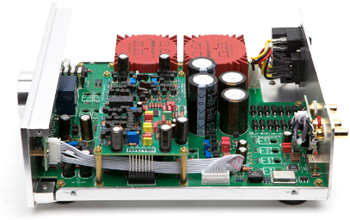 |
Burson HA-160DS |
|
|
|
|
|
| |
 |
Close call. Whilst the u:c:a was 4hrs ahead of the DS—with the AKG the latter's pot sat at 10:00, the u:c:a at 2:00 o'clock—sonics were close. It took a bit to tease out the various aspects of differentiation. Those came down to dynamic contrast, transient grip and bass power (greater with the Burson), textural wetness and fluidity (greater with the Linnenberg). Take Iz by Fahir Atakoğlu. On one track Göksun Çavdar solos on blackwood. Unlike most Turkish clarinos who play the longer G clarinet unfamiliar to Western concert music, Çavdar favors the classic B-flat. This gives him a lither more European than Middle-Eastern timbre. The DS teased out more breadth of his expansive loudness changes and with them the small tonal changes that accompany a reed vibrating maximally on a free-blowing crystal mouthpiece with monster tip opening to ease glisses and lip slurs. |
| |
|
|
| Meanwhile the u:c:a rendered piano with more song and generated greater individualized separation during the massed strings accompaniment. The u:c:a also portrayed audible space with higher reverb action for greater textural fluidity. This made the bassier Australian feel drier and more damped. None of these were significant offsets. They were nothing but small contributors one only bothers sorting out when tasked with explaining what caused the slightly different feels between these two equally compelling presentations. On wallet smiles the €400 cheaper Burson held the ace card and then clinched the capitalist advantage with noticeably higher power headroom to win the macho argument. Otherwise it's fair to say that the Linnenberg u:c:a and Burson HA-160DS would sit side by side on the very same retail shelf to compete for exactly the same customer. |
|
|
|
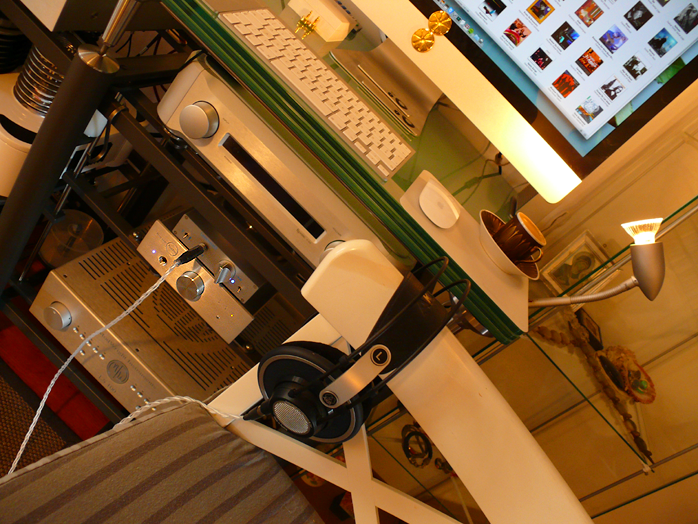 |
Big system. A recent upgrade to my Esoteric UX1/APL Hifi NWO-M universal player with HiFace 2 USB transceiver toppled my Eximus DP1 DAC from its top perch. But to take the u:c:a's pulse as DAC/preamp on speakers, I redrafted the Ex. While its €2.995 sticker doubled Linnenberg's, at least it wouldn't multiply it by beyond 20 like Alex Peychev's monster. At this juncture and having spent much prior time with Burson DACs, my gut instinct was that on digital the u:c:a had a small resolution advantage over the 'analog-voiced' Aussie. By this I didn't mean its capacity to process 24/176 and 192 files (Burson's older Tenor chip redlines at 24/96). I meant slightly greater magnification power. With my Eximus definitely being in a higher resolution league than Burson, how would the u:c:a keep up especially considering my unavoidable 6-meter cable to the SIT1 monos? Those cables would only factor in preamp mode. In DAC mode, I'd run through the on-loan Trafomatic SN101Dm single-stage valve preamp. There the u:c:a would only drive a 1-meter interconnect in case the long leash wasn't ideal for its output stage. Of course $10.000/pr amps, €20.000/pr speakers and a priceless (one-up) direct-heated triode preamp weren't exactly plausible mates. To isolate observations one simply changes one thing at a time.
|
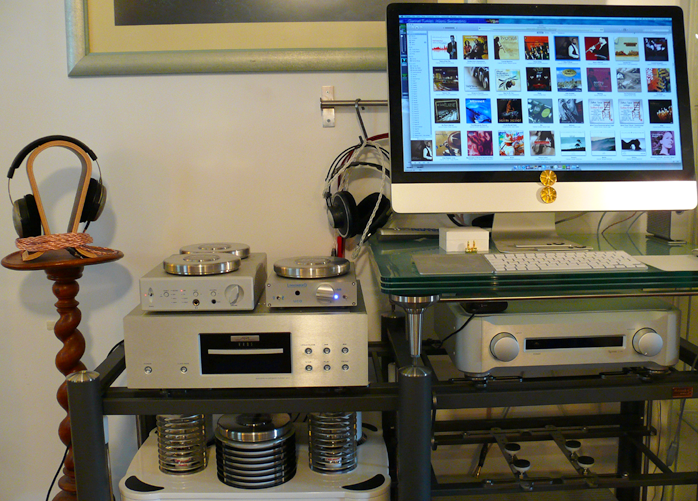 |
April Music Eximus DP1 and u:c:a as DAC/preamps
|
As DAC/preamp. In a 70m² room with 10-watt amplifiers (18dB of gain) driving 91dB speakers, standard recordings and room levels put the u:c:a's volume taper one hour ahead of the Eximus (11:00 vs. 10:00). Since volume bypass has it generate 4V whilst the Eximus maxes out at 3V, recordings with broad dynamic range and a thus lower median level meant that by around 1 o'clock on the dial, the Eximus' taper had crept about an hour ahead. Practically both machines had sufficient headroom for my space and purposes to not require an outboard preamplifier for gain. For more temporal fluidity in this all-transistor context —that 'greater reverb' quality direct-heated triode without feedback can inject—I would need to revert to Sasa Cokic's 101D line stage.
That said, the u:c:a on its own exhibited a 'pre echo' of this quality where the Korean machine's inner movement was a bit stiffer.
While the descriptive verbiage of 'temporal fluidity' reads esoteric stuffed into a two-word container, it's actually a very tangible quality (though not for test gear I imagine). The mood or feel of the tunes shifts. The poles of this are firm, taut, rhythmically driven, tensioned; and fluffy, elastic, breathy and relaxed. System tuning determines one's place on this axis. With the triode-output NWO-M and single-stage 101D preamp, my system usually sits deliberately off-center somewhat toward the right. Going all transitorized moves it across center to the left. Of these two variable-output converters, the u:c:a moved it back toward the right enough to notice. There were no indications that the 6-meter IC posed any issues.
|
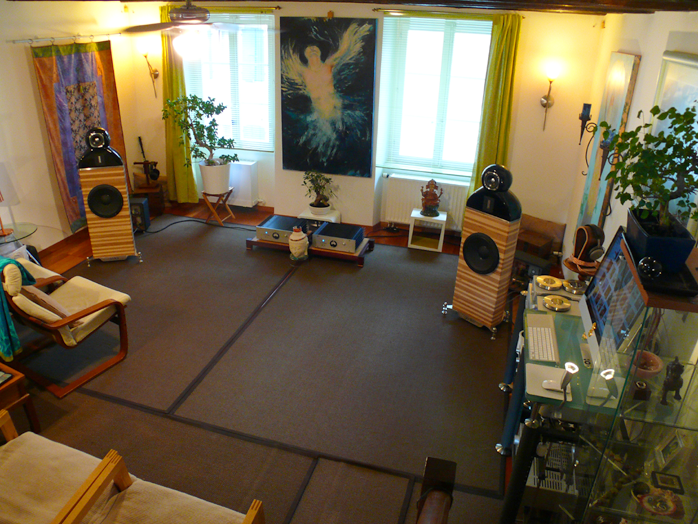 |
FirstWatt SIT1 amps, Aries Cerat Gladius loudspeaker with outboard crossovers
|
Extrapolating from this showing and returning to my attempt at assigning relative values to the u:c:a's digital and analog halves versus the Burson Audio HA-160DS, I would call the u:c:a the more advanced converter, the 160DS the more worked-out headphone amp. This gels with my prior assessment of Ivo Linnenberg's cdp3E. This engineer has a particular gift with digital. He manages to combine high resolution with elegance, two aspects not always on the best of terms. In the context of my system—iMac, 101D standing in for the eventual arrival of a 20A production version, SIT1, Gladius—I'd be perfectly content using the u:c:a as dedicated USB converter set to a standard 2V output. Given that financially this would render the Linnenberg a dwarf surrounded by giants, it's the very best compliment I could think of. And yes I did return to the NWO-M with its 20 x 32-bit AKM 4399 chips with bypassed digital filters for confirmation. And yes it did add tone color saturation, textural richness and dynamics. But at its well north of €20.000 sticker (I actually don't know the precise value since it was a gift from a friend) the percentages of cost vs. better become seriously skewed when the mid-priced level continues to push upward as it does.
|
|
|
Final words. In the intro I quoted the designer with "solid-state products using discrete parts for the amplifying stages are particularly rare. Burson, SPL and Harmony Design come to my mind but the vast majority tries to please the audience with cheap opamp constructions." As I had two Burson competitors on hand, I can confirm that the hot-running u:c:a also sonically belongs into that company. If it had more power, it could be recommended unconditionally for all headphones. As is the beastliest loads (AKG K-1000, HifiMan HE-6) should be excluded. The u:c:a competes squarely against the Burson HA-160DS, with the latter more powerful on the headphone front, the former the more advanced digital performer. Where the u:c:a steps out to act surprisingly ambitious is as fixed-output 24/192 USB or coaxial DAC. Here you could spend thrice to get significantly more socketry options and features like selectable upsampling but no better sonics. You could thus view the u:c:a as a €3.000 DAC with stripped-down features and a very good headphone amp thrown in free. At €1.190 that's ... well, a smoking deal! |
|
 |
|
|
 |
|