This review page is supported in part by the sponsors whose ad banners are displayed below
How the stage is shaped depends to some extent on how the loudspeakers are toed in. The distributor suggested to aim them straight forward as though to suggest that any toe-in would be in error. I’d concur with that with one modification – in my room I had equally good or even superior results when toe-in was very sharp with the main axes crossing in front of the ear. Either way the goal was identical – to avoid having the tweeters fire directly at our ears. In the second setting the stage narrowed (this could be corrected by placing the loudspeakers farther apart) but was more precise and coherent.
These are not everyman speakers suitable for all rooms and electronics. They have quite characteristic attributes which require that you listen to them carefully in your home. A session at the distributor will only convey a faint idea. How Isophon integrated the multiple drivers is incredible as is how they exploited ceramic virtues whilst shortchanging their usual liabilities. I personally could do with more openness and ‘freedom’ in the sound but then we’d probably lose some of the coherence and how everything is virtually glued together into one seamless picture. These are beautifully made high-end loudspeakers.
Description: The Isophon Berlina RC7 are large floorstanding speakers in a bass-reflex cabinet. Their dimensions— height of 1200mm and depth of 458mm—speak for themselves. Two large-diameter PVC ports fire downwards which mandates care with how we position the boxes on their spikes.
All drivers are from German supplier Thiele & Partners aka Accuton and here a 25mm tweeter, 173mm midrange and three 173mm woofers. The inverted dome tweeter (similar to JMlab) is made from ceramic sinter and suspended on a textile fold. From behind the tweeter is encased in a plastic cover which holds a large Neodymium magnet. Here the driver foregoes ferrofluid as a sticker on its back notes. A surcharge option is a 20mm diamond diaphragm tweeter. The midrange driver too employs a ceramic diaphragm suspended on a double-folded impregnated material similar in looks to the tweeter. On the diaphragm surface are two black rings for resonance control sealed to the ceramic with a material resembling rubber. The basket is a very solid cast affair. The motor too looks fantastic and includes milled steel elements. The tweeter/mid array works in a heavily damped sub chamber sealed with a full horizontal brace. There are five horizontal window-pane braces and one more solid sub division at the bottom of the cabinet below which sits the mechanically isolated mid/tweeter crossover. The bass filter lives insides the woofer cabinet. The 173mm bass units’ fragile membranes are protected by metal mesh and their suspension is rubber.
In the bass crossover we see five Intertechnika coils—four with a powder core and one with a solid core—two load resistors and five electrolytic capacitors also from Intertechnika. The company materials add that in the other crossover section we can find noble polypropylene capacitors, gold-silver Mundorfs and ribbon air coils. The drivers are connected with braided leads, copper and silver-plated copper for the treble and midrange respectively and thicker copper for the woofers. The latter hookup wiring bears a “Made by Alfatec”inscription and doesn’t look very expensive. Between the two crossover sections run far better braided Clearwater cables similar to Kimber. The filter frequencies are 170 and 3.400Hz. The midrange thus covers a broader than usual range and the most important part of the spectrum. Unusual is how the frequencies are cut with 50dB/octave slopes. This has sonic implications as mentioned earlier
Perhaps most important is how the cabinet is constructed in a very costly time-consuming process whereby six steel rods compression-fit 38mm MDF slices stacked vertically which are isolated from each other by 3mm elastomeric silicone-impregnated washers. Similar construction can be found in the Greek Mythos Ligeia or Italian Eventus Audio loudspeakers we previously reviewed. However it is the first loudspeaker of its kind for Isophon. The MDF baffle is covered with black varnish in a nice uneven texture. The loudspeakers are lute-shaped to have the side walls converge in the back which thus lacks a classic baffle. Hence part of the back features a cutaway at the bottom to house the single-wire WBT 9765 Midline series terminals and identification plaque.
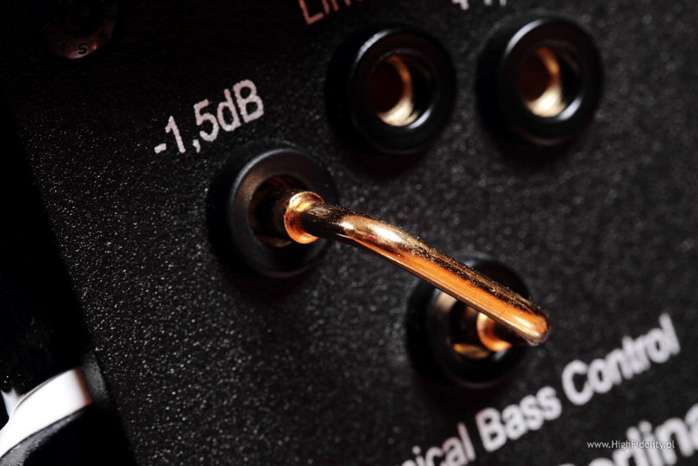
There are also gold-plated sockets and jumpers to set the amount of bass at -1.5, 0 or +1.5dB. This system is called Dynamical Bass Control. The loudspeakers are placed on four quality height-regulating spikes. Isophon is manufactured in Germany’s Rennigen where the company moved in 1997.
Technical data according to Isophon:
Drivers: 3 x 173mm woofers, 1 x 173mm midrange, 1 x 25mm tweeter
Type: three-way bass-reflex
Crossover frequencies: 170 and 3.400Hz
Filter slope: >50dB/oct.
Impedance: 4Ω
Maximum RMS power: 290W
Maximum peak power: 510W
Dimensions (HxDxW): 1220 x 230 x 460mm
Weight: 52kg