This review page is supported in part by the sponsors whose ad banners are displayed below |
 |
 |
What did it add up to? A terrific foundation, slightly milder than explicit highs and a by tendency fresher midband all dressed up in exceptionally lively dynamics. This made Gryphon’s Scorpio into a high-involvement machine that always played close to the action to remain fully engaged. Background listening wasn’t suited. Nor reading a book. Priming the pump just a tad was. This general character was supported by the subjective soundstage perspective. It moved a step closer as though by zoom.
I felt closer to the performers to intensify intimacy. Relative to dimensions, the soundstage remained unusually wide since only the virtual stage edge moved forward while my listening chair stayed put. Hence far left and far right sounded even farther left and right. Relative to depth, way back there became a bit closer than with machines whose ground line starts between the speakers.
|
 |
After its dynamic prowess, my second favorite Scorpio virtue was the plasticity and embodiment of individual sounds. Aside from pure sorting and localization of instruments and voices on the stage (very good), this machine was highly adept at turning these stage actors into physical beings, particularly so on vocals. That was fascinating.
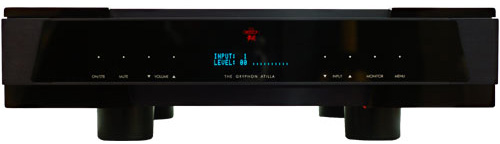
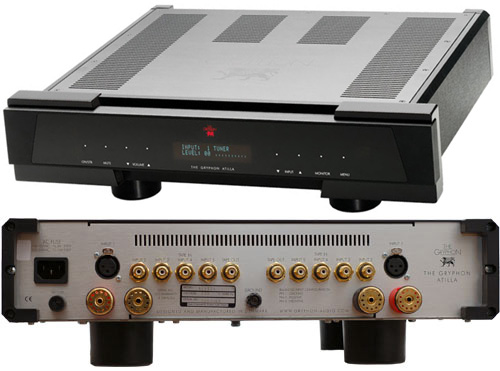
The Atilla didn’t just match on looks and price but also sound. Like the player, the amp drew the stage edge slightly in front of the speakers. While the player did this more—something I connected to a slightly different midband balance—the Atilla too was a clearly direct operator, at least more so than my resident combo of Octave HP300 preamp and Electrocompaniet AW180 monos. Those move the stage backwards some.
|
|
|
|
While still on the soundstage and my familiar reference, width was very similar and the Gryphon even managed the depth layering well though here more remained possible. Perhaps true mono amps are better than a dual-mono stereo affair for even higher channel separation but I expect that it really was the higher power. This paid dividends particularly in the bassment. There potency always affects subjective stage scale and hence depth. Here the Norwegian monos pulled ahead. Yet the Atilla’s broad staging was clearly impressive, never mind that the German/Norwegian combo wanted another €3.500.
The Atilla’s image definition was highly precise and like the Scorpio’s very adept at conveying three-dimensional embodiments. Once again song in particular could be shocking in just how tacit the vocalists ‘beamed down’. I had to admit begrudgingly that my reference team which I regard as unusually endowed here came in second. Hats off to the king of the barbarian hordes. At the frequency extremes the Atilla offered good quality without inducing me to fall to my knees. In the treble and bass the Octave/Electrocompaniet team had more structure and a more developed focus. The Gryphon also drew individual sounds somewhat larger than I’m used to which wasn’t merely a function of sitting closer. Performer dimensions were somewhat more opulent. While the space between them was sufficient, it was a tad diminished.
|
Like the Scorpio, the Atilla’s upper octaves veered into the mildly soft to not add any sheen or air. Conversely there were no negatives of harshness, brittleness or glassiness. The bass meanwhile was massive.
|
|
|
Purely on quantity, the mid and upper bass were fuller and juicer than my reference combo and arguably slightly north of neutral.
Yet low-down dynamics made for great punch, attack and fun, filled with intelligibility and articulation yet neither ultra dry nor overdamped. Extreme control and sex appeal don’t make for good bed fellas seemed the applicable wisdom. Those who’ve dieted on dry bass fruit for years will burp but thankfully that’s not my problem.
|
|
|
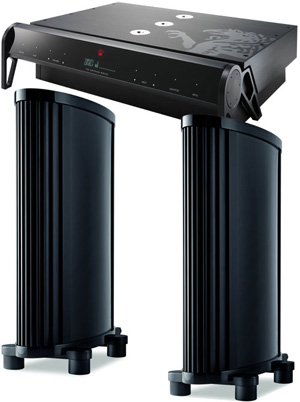
While listening at room volumes, Gryphon’s amp nearly invariably and unexpectedly had a tad more bass power than the Octave/Electrocompaniet duo. As I scaled up output, this shifted by degrees to have the pre/power combo gain in stability, mass and pressure. In the infrasonic realm, the separates moved ahead of the Danish integrated. Because psychoacoustics would remind us that for clear differentiation at low frequencies, human hearing requires certain sound pressures, this did require some fun on the volume control to even notice. The Atilla thus proved perfectly stable in the lowest octave. It simply wasn’t the end of the road – which is why Gryphon offers their own separates at just shy of €100.000 [right].
Why I ultimately regarded the Atilla’s tonal balance as a tad warm was due to the above – somewhat mild in the treble, nicely substantial down low. But the midrange contributed too. Where I found the player to be somewhat fresher and more present, the amp painted in deeper earthier but very agreeable colors. Simply don’t equate this minor warmth with boredom as suggested by the "warm baths make tired" theory. Gryphon’s Atilla has mastered the small trick to avoid a presence region lift whilst sounding unusually energetic, dynamic and spatially slightly more forward than laid back. This ended up with musical presence in the room despite the integral warmth.
|
|
|
 |
  |
 |
|