|
This review page is supported in part by the sponsors whose ad banners are displayed below
|
|||||||||||||||
 |
|||||||||||||||
| Since we have not spoken in a while, I need to bring something to your attention for your Pico Executive review. Effective 9/07, retail for the new Pico Executive HD model is $8,900/pr. This was introduced at the end of last summer and is what Wolfgang, our German distributor has for you. There no longer is a regular Pico Executive. Part of the price increase was from the tremendous rise in costs for almost all our parts and materials experienced from 2005 through 2007. Some of that was from the price of petroleum affecting everything right down to the foam packing (up 70%!). Some was from the falling value of the US dollar for the European parts we use. However, much of the price increase was from switching to the new Marigo Labs-designed Copper-Matrix wire inside the speakers (for which we are exclusive) and for the substantial additional labor required to install it. All our speakers bearing the HD designation use this wire. |
|||||||||||||||
|
| |||||||||||||||
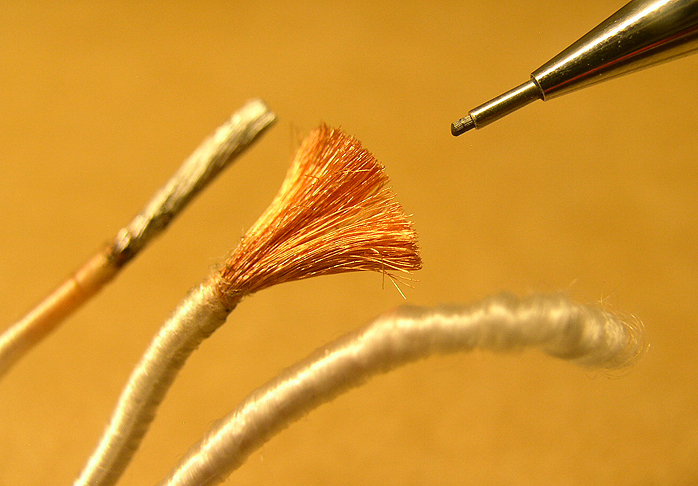
A few words about the wire if I may, as I find it to have produced an increase in clarity and emotional impact fully equivalent to hearing your first good tube amp after a diet of conventional solid-state amps. Absolutely breathtaking. I can tell you that Marigo's new wire is a 500+ strand Litz wire (copper) with a cellulose-based thread insulation (looks/feels like silk) around the outside, 18 gauge. It takes quite a while to strip even one end, followed by several steps to connect and then strain relieve it for a long service life. Litz wires this fine (~0.001 inch/0.04mm each) can break at the solder connection if not properly supported. I have attached an image, in which a 0.7mm mechanical pencil lead is seen for comparison. |
|||||||||||||||
 |
|||||||||||||||
As a physicist, I had great interest in Ron Hedrich's approach to serious issues in wire design that I had never seen solved nor even addressed, some especially applicable to wires used inside speakers. Ron is Marigo's designer, also a physicist and one who knows that any reduction of vibration of and imperfection inside a wire leads to a more perfect transmission of the electromagnetic (E-M) field around the wire. After all, it is the field around the wire that transmits the signal. Anything else is 'dirt' so to speak. So, one important outcome of using a very small diameter for each strand is how its production removes (squeezes out) many more voids inside the copper (truly microscopic ones). This permits smoother electron motion (electrons move back and forth on average only a few dozen atoms anyway), which transmits the E-M fields more cleanly. The copper is oxygen-free, of highest purity and double-cryo treated. Also, each strand's very small diameter removes the variation in 'mobile electron density' that usually occurs from center to edge of a conductor. Normally, electrons nearest the surface of a wire are the ones most easily disturbed at higher frequencies, simply because on one side, they have no neighboring electrons with which to 'collide.' The ones down in the center don't get to move as much at higher frequencies because of their many collisions. This variation in electron mobility from center to edge produces what is mistakenly called the 'skin effect' (which actually describes the penetration depth of an external E-M field coming into the wire as for an antenna). When the strand is small enough, there is no variation in electron mobility from center to edge because there just is not very much distance between the center and edge. This uniformity makes each strand more conductive/more responsive at higher frequencies than using one larger conductor, for what sounds like less phase shift to my ears along with a more accurate rise time without overshoot and a more graceful decay. |
|||||||||||||||
|
| |||||||||||||||
Many layers of this wire were wrapped together in a certain manner I cannot disclose, canceling the usual magnetic interaction between each strand, otherwise a source of energy loss into vibration and eventually heat. Each tiny strand is very thinly coated with a few microns of an insulating 'varnish' developed not only for minimum dielectric absorption but also to damp the inherent metallic resonances of the copper, including the axial mode, the one most difficult to damp. The external cellulose-derived insulating thread also provides damping and with the least amount of dielectric absorption I know of - very close to that of air itself. Plastic insulations do not damp wire vibrations as I know from direct experience. You should hear what a stethoscope reveals when placed at the far end of a wire coming from a tweeter's tab! You can easily make out the recording and the artist. Such vibration is not good for the signal and is only dissipated in the crossover parts. Because the end result has far less of what sounds and measures like phase shift (one sonic byproduct of resonances), we had to retune the original Pico Executive crossover circuit. The clarity of the wire then made audible the final benefits of adding certain bypass values of Sonicap capacitors on the few Sonicaps already in the circuit. At the higher price, we know the Pico Executive HD will more than compare to any much higher-priced speaker on the market and I welcome you to be as critical of it as possible, please. Thank you again for taking these speakers in for review. I hope you have a great time! I know they look small and they are. Most people think they are cute! Fortunately, they do not sound small, which I explain on our website. Roy Johnson |
|||||||||||||||
 |
|||||||||||||||