This review page is supported in part by the sponsors whose ad banners are displayed below |
 |
 |
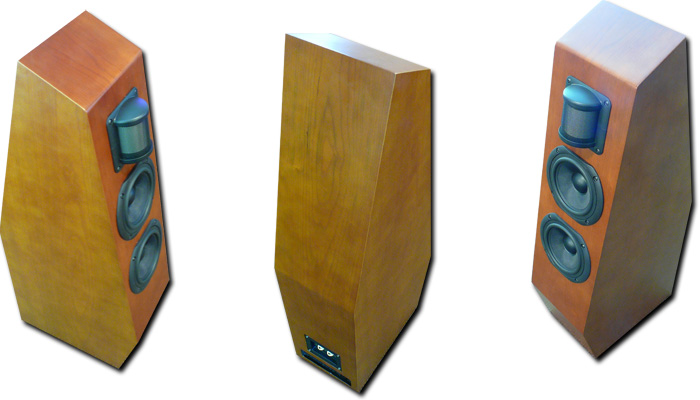
Strengths: Gallo's spherical speakers always soundstaged like demons. The Classico continues that tradition if perhaps trading a tad of hologram specificity for a definitely taller image. The enabler is the unique tweeter with a surface area far greater than traditional domes (good for dynamics), lower mass (good for micro resolution) and wider dispersion (good for spatiality). This tweeter's location on top rather than between the mid/woofers plus the upward angle from the slanted baffle have raised the subjective stage height. I doubt those who found the Reference 3.0/1 and 3.5 too low will find the Classico III lacking.
|
 |
The precise location of virtual images is fixed by their HF content. A superior tweeter like Gallo's pays obvious dividends. Transient precision and speed (how steeply and fast attacks rise) support localization too. They also creates PRaT, Brit speak for pace rhythm & timing. Those are interrelated aspects of taut rhythmic tension and beat fidelity. Transient speed also depends on the various harmonics of the event lining up synchronously rather than arriving staggered/delayed. Here the lack of a phase-shifty crossover is advantageous. Once more the Classico conforms to established prior RoundSound™ standards.
|
|
The best test for transient speed are noises. Our survival reflexes are hardwired to them. Slammed car doors, dropped cutlery, clanging pots, gravel steps, shattered glass, gun shots from a nearby shooting range, snapped branches and other everyday din imprint on us. Such noises jolt daydreamers back into the present. When recorded equivalents like rim shots, wooden creaks, metallic clacks, foot stomps, peppery audience applause, rattles and such have the same jolt power to make us momentarily confuse them for real... that's when speaker timing is accounted for.
|
|
|
With speed/timing and high tweeter dynamics in the pocket, the Classico III has good startle factor. The mechanically matched mid/woofers don't displace massive air but neither do they load down superior reflexes. Listeners into a few ticks greater warmth, bass weight and LF transient welly should probably eye the Classic IV. Two added mid/woofers and greater air volume ought to address these areas. I'd also expect a minor trade-off against subjective transparency (a leaner sound often appears more accurate) but that's the providence of having choices and preferences.
|
|
|
Weaknesses: Reinvoking my memories of the Ref 3.5 and disregarding the Classico's 80 - 200Hz band, I suspect that the revised mid/woofers have 'filled in' the transition zone to the CDTIII to give vocals a bit more body. This gets us to the only relative weakness worth mentioning. The sidefiring 10-inch woofer of the Reference models with barely any operative air volume behind it did not extend as low yet in the so-called power region of the upper bass had more pop, shove and snarl. This is the hara or vitality center of all music. It's here where the $6.000/pr stable mate had more moxy. That's why two paragraphs higher up I referenced the Classico III's startle factor as good rather than brilliant. Timing exactitude and speed are there but impact from raw displacement has its limits.
Besides the last few degrees of holographic lock or dimensional relief this is the only other performance aspect where the Classico III would seem to trail the Ref 3.5 if memory is trustworthy. In that regard I'd peg the III closer to a Strada + TR3 combo (more bass extension and LF amplitude than the Ref 3.5 but a leaner upper-bass balance).
Where that comparison fails in an absolute sense is that the C3 has otherwise fleshed out the Strada's electrostatic traits. Invoking the latter isn't applicable to image density or tonal fullness. There the C3 wins. It only relates to upper-bass violence vis-à-vis the Ref 3.5.
|
 |
Doing the math. At a probable street price of $1.995/pr—officially $2.195/pr—the Classico III caused head scratching as part of a conga line that included the likes of Living Voice's £10.000/pr Avatar OBX-RW and Aurelia's €7.500/pr Graphica. These speakers cleared the floor just prior. That made them coincidental comparators. In certain aspects they moved ahead of the Gallo. Given cost they should have. The Graphica's many drivers clearly moved more air. This gave the sound a massier weightier feel. It kicked in particularly at higher levels to generate not lower but bigger bass waves and greater overall density. The soundstage also was taller. On the flip side the C3 had more distinct separation. It offered more sharply honed transients, a more elucidated sophisticated top end and the virtual performers were cast in deeper relief. Here its proprietary tweeter and crossover-less simplicity had the upper hand.
The key is, this juxtaposition became an equivalent retaliation proposition. Tit for tat in slang. I fancied what the Gallo did more than what the Aurelia did (ideally I'd take the Finn's greater LF heft but the Classico IV ought to cover that). Another listener will lean the other way. Even so it's about equals. That's a reality check and wakeup call.
Ditto the Living Voice. It's unusually costly as a tweaked-to-the-hilt iteration of a proven core platform with outboard crossovers, exotic parts and cryo treatments. Over the ScanSpeak Revelator the CDT ruled again. Bass was on par, not surprising given similarity of weaponry. The custom 6.5" mid/woofers of the Brits ultimately had more tone color suavity. Their Hornslet-applied top-range veneers were clearly fancier as were WBT's most expensive posts. But at the end of the day deciding between these wouldn't have been foregone conclusion or clear cut. You'd carefully throw the quality of your ancillaries into the equation, the LV's special appreciation for costly Kondo wires and valve amps and such. Given my penchant for a faster energetically more lit-up sound, I'd favor the Gallos (and my wallet wouldn't protest either).
|
|
|
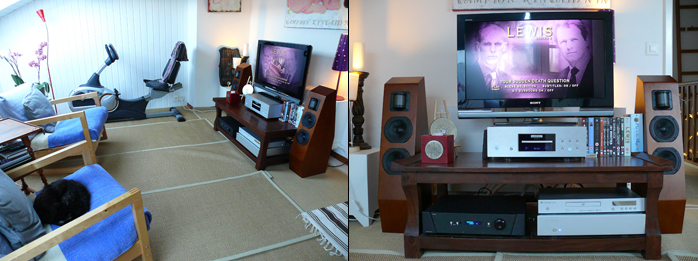
Also in-house was Mark+Daniel's $13.800/pr Fantasia S. Finally that was an unequivocally superior performer in every parameter of the audiophile shopping list. It had higher—actually spooky— low-level resolution. It had fiercer dynamics, lower extension, gnarlier shove and just as sparkly and airy and cloudless a treble. Here paying more added up fully to getting more. The point is, the Classico III's appearance pushes upward what's required to end up with unconditionally higher performance, not just move sideways. It's heavy on value. Its low-rider profile makes it unusually décor friendly. The closely spaced up-tilted drivers mean it works great in the nearfield as I verified with a 35-inch flat-panel screen in a small 2-channel video system sitting two meters removed. The wide-dispersion film tweeter makes listening a social rather than sociopath occasion. The middle of the soundstage is about two feet taller than the speakers (i.e. perfectly centered on the Sony screen below). Bass in a properly matched room won't require a subwoofer. A 50-watt amplifier or receiver will be sufficient to properly drive them. Those who feared Anthony Gallo sold out to commercial box pressures were hasty.
|
 |
Of course on more posh for less dosh competitors too are in rethink mode. Two stand-outs are the $2.500/pr Golden Ear Triton Two covered head to toe in an old-fashioned Vandersteen-type grill sock; and Aperion Audio's 5-driver Verus Grand Tower at $1.800/pr. Not having heard either I can't comment beyond their existence. At two grand the smart shopper clearly has sharp choices today. The Classico III belongs on that list. For Gallo fans it only seems to break with company credo. Listening now against prior experience suggests more than faintly that in a fair world where dealers set up disparately priced speakers to each perform on top of their game (and not deliberately hamstring the cheaper one to upsell the other) the Classico III would give the $6.000/pr Reference 3.5 a run for its money. What I didn't get which I seem to remember from the spherical midranges and 300° tweeter dispersion was that spooky ultra 3D holography. As I consider that a hifi artifice (albeit an impressive one), I didn't in the Classico's very good soundstaging miss that nth degree. I'd much rather pocket four Gs in savings. In short when an effuculated economy turns mother of invention there can be cause for celebration. For clever designer Anthony Gallo going square was the cool and courageous thing to do.
Given our prior award for the Reference 3.0, the Classico III stacks the deck without requiring an audition of the Classico IV. Alas by not having evaluated other über-value speakers which recently launched, the Lunar Eclipse Award of the Reference 3 can not migrate automatically. At its $3.000/pr launch price those many years back that speaker really upset a then still more gold-plated status quo. I doubt the Classico III duplicates that global splash with the same contrast ratio now that realsization is more widely practiced and expected. The Classico III simply does make a very big splash in the Gallo pond. A Blue Moon Award is in order for a stand-out value in the very short décor- and power-friendly high-performance speaker category.
|
 |
Quality of packing: The review pair arrived in a non-production flight case made for the CES show.
Reusability of packing: Unknown.
Ease of unpacking/repacking: A cinch due to the speaker's small size and weight.
Condition of component received: Good.
Human interactions: Anthony has always been unusually forthcoming about design details and technical solutions and often divulges things not for publication. He's not an entremaneur (someone selling bullshit to the masses).
Pricing: High value.
Final comments: Should overcome the cosmetic objections Gallo's Reference models created with more traditional shoppers. |
 |
|
 |