This review page is supported in part by the sponsors whose ad banners are displayed below |
 |
 |
Description: The Furutech DAC sold under the Alpha Design Labs brand is manufactured in a Chinese factory to explain why it can be much cheaper than it would have been as a Japan-built Furutech. The machine combines the functionality of linestage, headphone amp, MM/MC phonostage and DAC in one slim chassis. Taking into account the complexity of the device it is no surprise that Jerold O’Brien’s Tone Audio review entitled it Better Than a Swiss Army Knife!
|
 |
In the front we get a nicely milled steel knob with precisely silk-screened scale markers. The knob is used to regulate volume for both headphone and RCA outputs. In the middle sits a 6.3mm headphone jack. To the left are two translucent buttons – the blue one switches the unit on and off, the other is a selector that turns red for the analog input, green for USB. On the back we get fantastic Furutech FP-900 RCA sockets and a small switch that toggles between the line, MM or MC phono inputs. There is also a USB type B socket copasetic with signal up to 24/96. Next to that is a ground terminal for the turntable and a 9V AC power input for the supplied wall-wart transformer.
|
 |
While opening up the unit I admired its rigid enclosure made from aluminum extrusion and flat panels. The circuit splits up into one motherboard with a few smaller PCBs. The inputs solder into a small PCB with a switch and two 2068 stereo opamps as part of the phonostage built almost exclusively in SMD. From there we proceed to a small Soundwell potentiometer. Behind it we have two more 2068 chips. Near the gold-plated headphone socket we see a bigger chip, a small power NJM4556 JRC power opamp for the 'phones. Those are coupled with small Elna capacitors. Alternately the signal can run to the line outputs (blocked with a relay when the headphones are inserted socket) and at the end we see further 2068 opamps.
|
|
|
The USB transceiver is the Taiwanese full-speed USB 2.2 Tenor TE7022 as also used in Ayon Audio players or Stello’s DA100 converter for example. It works here in classic adaptive mode, not asynchronous. On the PCB we see two more Tenor chips, the TA1200 and TA1100. Those are 24/96 DACs with headphone amplifiers. Why two? I don't know. Perhaps one is for the headphone output, the other for the line output. On the PCB there are also traces for an S/PDIF input and transformer-buffered output but this section was left empty. The power supply circuit mounts on a separate PCB placed upside down. There is a single rectifying bridge and two different power supply lines with stabilizers.
Technical data (according to manufacturer):
- USB input: 24-bit/96kHz (also 16-bit/32kHz/44.1kHz/48kHz)
- Frequency response: 20Hz-20kHz (96kHz: 40Hz, +0.5dB; 32kHz: 15kHz, -0.5dB)
- S/N ratio: -90dB (A-weighted)
- Output voltage: 1Vrms
- Input sensitivity: MC 0.4mV/MM 5mV/line 1V
- Gain: 62.5dB/MC; 48.5dB/MM
- Input impedance MM/MC: 47kΩ
- Headphone output (max.): 80mW/32Ω
- Dimensions: 150 (W) x 111 (D) x 57mm (H)
- Weight: 785g
- Website
|
 |
|
|
|
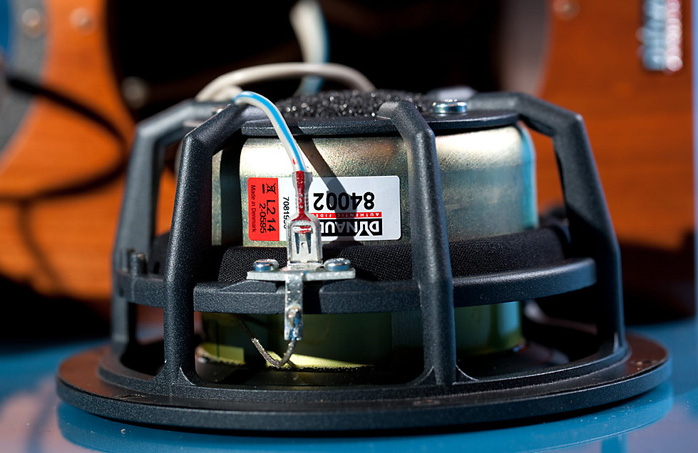
Dynaudio Focus 110A: The Focus 110A is the active version of the Focus 110. These are small loudspeakers in a solid enclosure made from 18mm MDF in natural veneer, with the sidewalls slanting inward to the back. This is a two-way bass-reflex loudspeaker with two 50-watt amplifiers for the tweeter and mid/woofer respectively. The treble is handled by a terrrific 28mm Esotec+ D280 soft dome, the rest by a 110mm Esotec+ with big aluminium voice coil and a single-piece diaphragm made from a magnesium silicate polymer. The crossover frequency is at 1.300Hz. The coil and concave center of the driver have a diameter of 7.5cm. Dynaudio has used this technology for years. It allows them to place the magnet inside the voice coil rather than outside. This solution they call Center Magnet System.
|
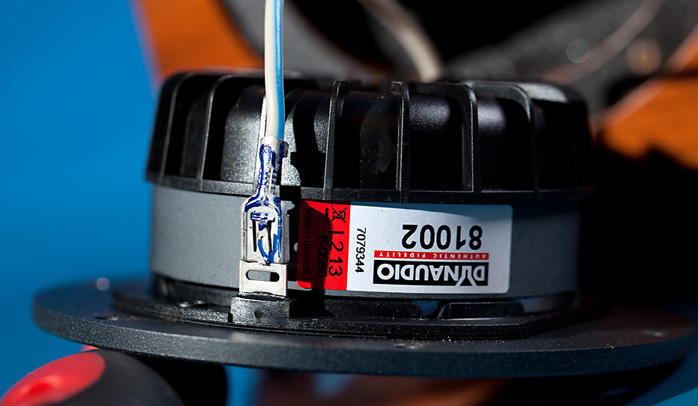 |
The amplifiers and active crossover mount to a ribbed metal plate bolted to the back. The outside has a large heat sink, an RCA input socket and switches for tonal balance depending on the placement of speaker versus walls. There is also a switch to set gain (+4/0/-10dB). The bisectioned insides are damped on the top with fill and in the lower part with bitumen liners. The transistor amplifiers are powered by a big toroidal transformer. The input section runs ICs.
|
 |
Technical data (according to manufacturer):
- Frequency response: 45Hz-21kHz (± 3dB)
- Input sensitivity: 120mVrms (85dB SPL/1m)
- Input impedance: 100kΩ
- Power consumption (max.): 90W
- Amplifier power: 2 x 50W
- Crossover frequency: 1.300Hz
- Cabinet volume: 7.5l
- Weight: 8.5kg
- Dimensions (W x H x D): 173 x 305 x 322mm
- Website
|

opinia @ highfidelity.pl
|
|
 |
