This review page is supported in part by the sponsors whose ad banners are displayed below
Next to weight distribution your precise placement of any footer in fact tunes that component. By putting pressure on a different spot of the casing, said casing will sound different. Compare it to moving a finger over the skin of a drum whilst hitting the drum. Moving the finger from center to rim will alter the drum's pitch decisively. Now go figure what it will do to the core resonant frequency of an amplifier, CD player or other active component. This phenomenon is often mistaken for vibration cancellation which a footer is alleged to perform when it really only shifts resonances into different frequency bands.
There’s nothing wrong with tuning your system to your liking. That’s part of the audiophile’s artistic freedom. But it is recommended to only start tuning when all basic parameters have been locked down first. Make sure all electronics are connected to the grid in proper power polarity and that the speakers are placed in the best possible spot down to the millimeter. Only after that it's time to fight vibrations and finally tune the sound to your personal liking if still required.
Many footers on the market are based on what was probably the first after-market footer ever, the humble aluminium cone or spike. One of the theories behind its workings was that it acts like a mechanical diode through which vibrations pass only one way but not the other (i.e. out, not back in). In our opinion any cone-shaped footer acts as a tuning device first and as a vibration control item only in a secondary add-on fashion. The same applies to footers where a single ball forms the sole contact area with the supported equipment. The small contact patch of the ball is under very high pressure and thus creates an area of high tension in the equipment’s casing which definitely alters its mechanical behavior.
Pawel chose a much cleverer approach. Yes there is a ball with a high-pressure small contact patch involved but that happens inside his footer. The contact area of the footer with the equipment itself is large and viscous. These properties mean that the footer is not tuning the casing to a different resonant frequency. Instead the Franc footers help damp casing resonances via absorption. In total his footers help isolate the equipment from external vibrations emerging from the shelf which the device sits on plus aid in damping the casing’s own resonance introduced either by the equipment’s transformers or the surrounding oscillating air pressure (sound).
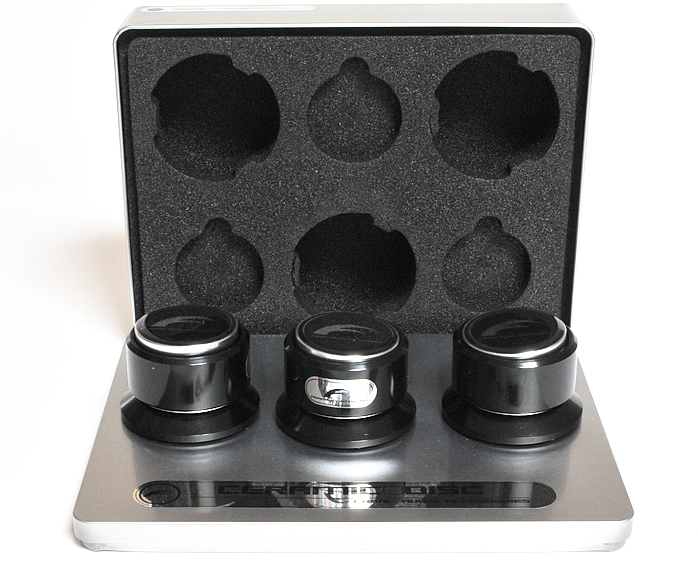
When we used the footers under various electronics, our unanimous verdict was that they added to the stability of the image and lowered the system's noise floor. Compared to solid footers like cones and plate-ball-plate or ball-on-plate footers which change the overall sound, the Franc Audio Accessories footers left the tonality of the sound unchanged. We thus didn't get 'more bass' or 'sparklier highs' which can suddenly appear after putting a device on new footers. With only one set of three Franc Audio Accessories footers on hand, the most beneficial outcome for us was when they were deployed under our Phasure NOS1 DAC source component. In conclusion we can say that the clever way of constructing this multi-tiered multi-stage vibration control device is highly effective. Besides isolating the device from its support surface, the footer also neutralizes casing vibrations without altering the sound’s core tonality. Lower noise not changed timbres could be the product's slogan...
Condition of component received: Excellent. Reusability of packing: Many times. Website comments: Could be more informative on products (new web site with better pictures and descriptions is already announced). Completeness of delivery: Complete. Pricing: For a versatile well constructed very effective footer the asking price is more than reasonable. Human interactions: Pleasant. Remark: The Ceramic Disc Classic is most effective under metal-clad devices.