This review page is supported in part by the sponsors whose ad banners are displayed below |
 |
 |
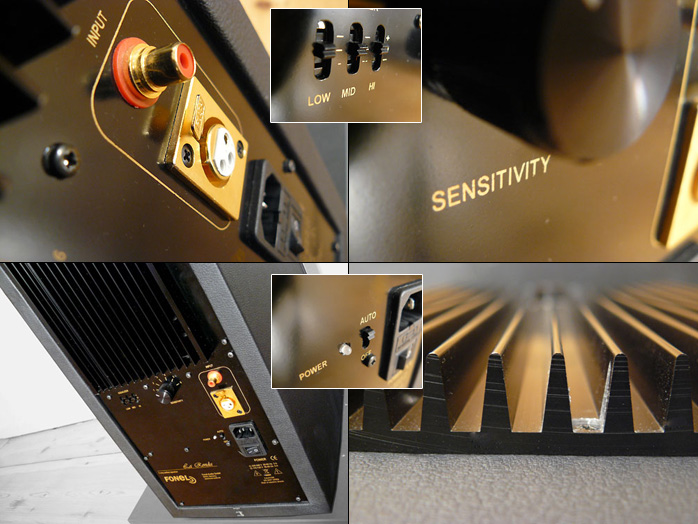
Given my particularly positive prior experiences with Fonel electronics (Simplicité & Emotion), I was necessarily curious how these two active black monoliths would behave. I’ll say early that unlike Dynaudio’s Special Twenty Five monitor which colleague Ralph dubbed "maximally neutral", La Ronda clearly had a personality. But let’s start at the beginning.
|
 |
 |
Skipping leisurely through my music collection from the variable outputs of the Fonel Simplicité digital deck, I first noticed how well La Ronda handled voices. Even an utterly non-hifi IT expert who was busy on his laptop while happening to be in the living room suddenly looked up with a "that sounds weird as though we had a real singer here." For background purposes, the Simplicité was spinning 1994 French Avantgarde Rock by Claire Obscure. Their varied lineup—up to 30 musicians participate—makes for an excellent test record. Christophe Demarthes’ voice on "Mercedi" accompanied only by bass, drums and guitar was pleasantly warm and sonorous without getting thick.
|
|
|
|
Lower midrange warmth was clearly a special trait. While arguably not 100% hardcore-monitor neutral, I nearly preferred the Fonel to my seriously more expensive combo of Audionet AMP monos and Thiel CS3.7. That team is blessed with a textbook-perfect midrange and focuses vocals with more spatial acuteness and detail. But it also sounds somewhat more sober and tonally ‘lighter’. So yes, La Ronda incorporates something that’s fundamentally pleasing and long-term friendly. After some sampling, Ralph called it fetching. Far from least this also involves the treble. Unlike the Audionet/Thiel team which on "Mercedi" has you peel out each fine hi-hat hit, decay and metallic timbre shift in dense succession, La Ronda subtracts a few percentage points of transient and microdynamic HF resolution.
|
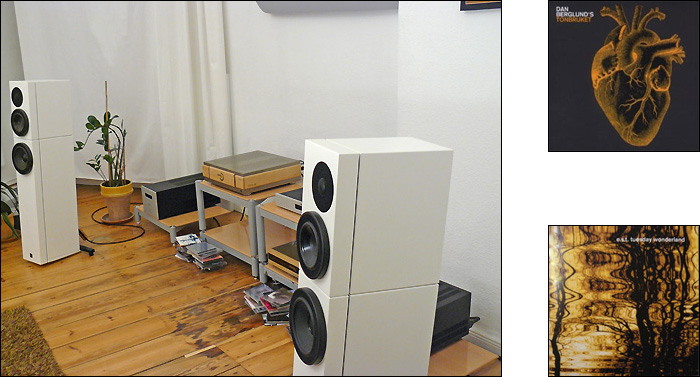 |
Songs like "Monstrous Collossus" meanwhile (from this year’s Tonbruket by ex-e.s.t. Swedish bassist Dan Berglund who here transitioned from Jazz to Art Rock) became perfection. That’s because this rhythmically keen number propelled by potent bass runs is accompanied by quite tizzy scratchy cymbal and hi-hat work. Depending on hifi hardware, this can spontaneously conjure up 120-grit sand paper to have me brusquely skip to the next track. Not with La Ronda. This was not exclusively so because she softened the bronze aspects of percussive attacks and presence. As did the entire spectrum, the treble seemed particularly pure, clean and distortion-free. While subtleties like the rustling/swishing noise of a brush on e.s.t.’s "The Goldhearted Miner" from 2006’s Tuesday Wonderland weren’t resolved to the very ends, the sound color and texture of an actual drum brush was tacitly apparent. It wasn't a mostly subconscious thing barely suggestive of something like scratching.
|
|
|
Resolution per se is a welcome virtue but many hifi components of apparently very high resolution on first encounter quickly cause quite the opposite. Despite a plethora of micro information the puzzle doesn’t involuntarily/automatically add up to an identifiable whole. It remains artifice despite the mega pixels. Such lack of acoustic synthesis often becomes tiresome even though a brief audition and first listen could well find it fascinating.
On unconditional comfort and approachability—unhurried realism perhaps—Fonel’s La Ronda reminded me of the formidable combo of their Emotion integrated amp driving Sehring’s S703SE speakers with the latest upgrades. While that team is the more open and airy on top, ultimate hi-hat counting based on analytically heightened attacks still doesn’t come off perfectly. La Ronda isn’t dull or damped but small items like a percussive noise sounding initially mostly like blowing on Dan Berglund’s "Gi Hop" were darker and weightier than with the Emotion/Sehring rig.
|
 |
  |
 |