This review page is supported in part by the sponsors whose ad banners are displayed below |
 |
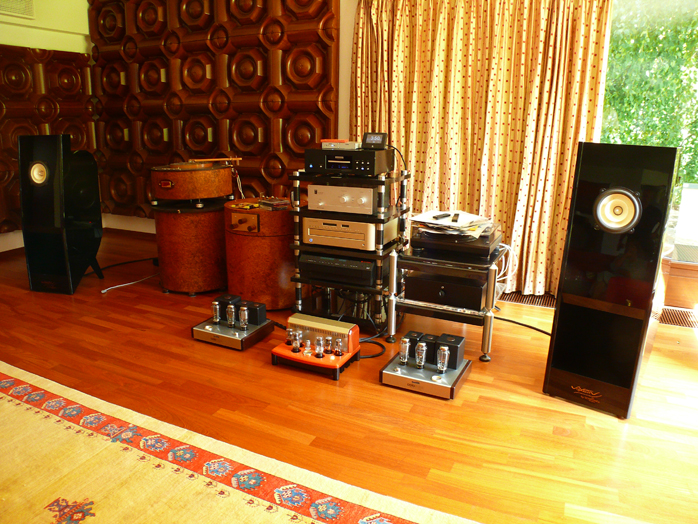
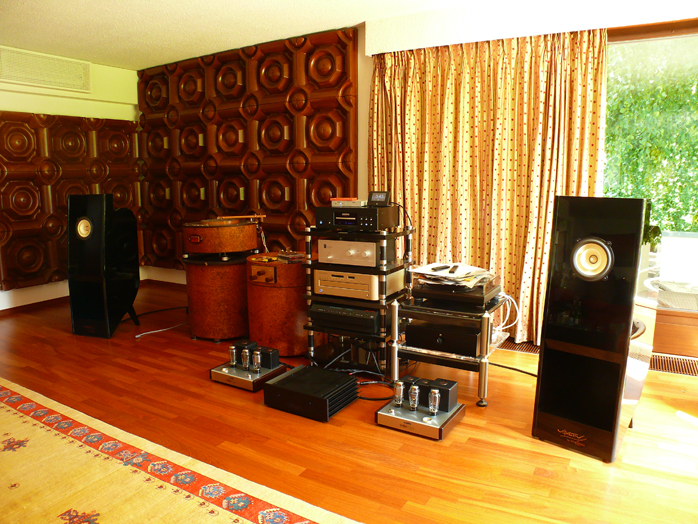
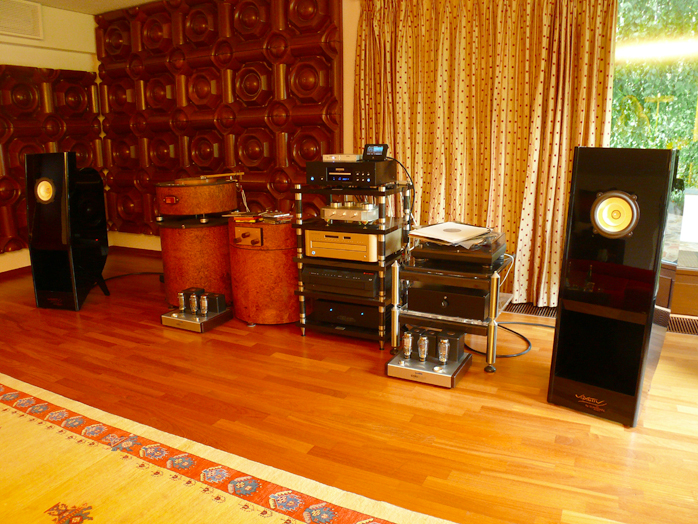
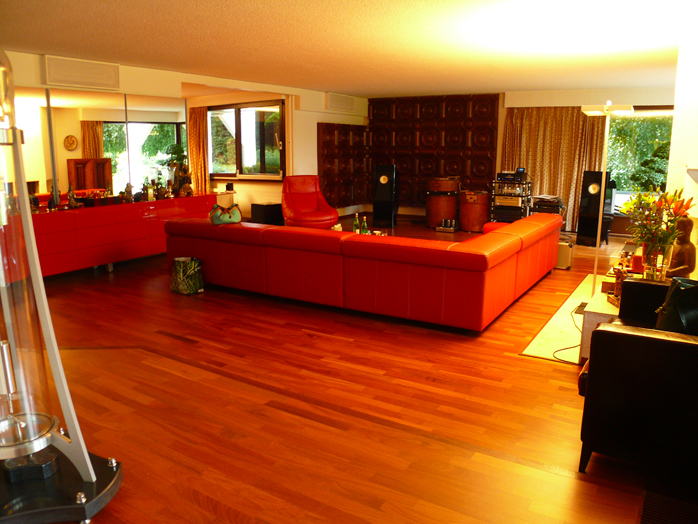
Broader context: My friend Dan's system during my visit in late August consisted of his Esoteric/APL Hifi UX1/NWO-M universal player spinning regular CDs or 24/96 files burnt to DVD. There also was a Metrum Acoustics NOS Mini DAC Octave, a freshly minted EPL laser turntable and Voxativ Ampeggio speakers. The variables were the preamps and amps. Preamp options included no preamp using the digital/analog hybrid volume control of the NWO-M; the StereoKnight fully balanced transformer attenuator; Red Wine Audio's Isabella tube preamp; or Kondo's KSL-M77 tube preamp. For amplifiers we rotated between Colotube 300B monos, Yamamoto A-010 stereo amp (VT-52 aka 'super 45') and S2 proto.
|
 |
Let's segue into this experiment with reader Charles: "The
APL NWO-M player is considered by many to be one of the very best digital sources, cost no object. What I find astonishing is the equal level of competition from the Metrum Octave mini DAC. The price ratio is an absurd—no make that staggering—43:1! How can that be? Have you ever come across another component that compares evenly performance-wise at such a tiny fraction of cost to the other component? How Cees was able to do this is a wonder."
This comparison of course relies on the Octave getting its signal from the Esoteric transport inside the NWO-M. The VRDS cost inside the rebuild shifts the 43:1 figure.
Alex Peychev hand-solders extremely tiny parts for the stacked boards that make up his 20 (or 24 in Dan's latest version) AKM 4399 DACs per channel. Cees Ruijtenberg uses robotic board assembly. There's a serious labor cost offset. That said the Dutch circuit is very simple. Its mystery parts place I/V conversion and output buffer on the converter chip to eliminate two circuit stages. Peychev's contains a tube output buffer with output transformer and analog/digital volume control.
|
 |
In amplifiers it's well known how massively paralleled transistors for high power can compromise sonics. Should we believe that 24 x delta-sigma DACs in a more complex multi-stage circuit would have to automatically be superior to 4 x R/2R chips in a simpler minimum-stage circuit? Then there's subjectivity. Writers can only write how they think. An audio designer can only pursue sound as he hears it. If you prefer my self-taught creative style to that of a properly trained writer who actually knows the rules & regs of formal English grammar, the latter's superior credentials won't matter. If you prefer Cees' ideas to Alex's on what's most important in playback sound, the NWO-M's far steeper price needn't factor. To get back to the beginning, in the hands of the right person simpler is better is no joke. This theme certainly resurfaced here.
|
|
|
The 100dB single-driver Ampeggio is an ideal demonstrator for low-power valve amps. Even so the S2 proto displaced two very good specimens of that breed. It had more bandwidth particularly in the treble and greater resolution. More important to Dan and my ears was the greater vitality, verve and communicativeness—raw and unplugged vs. spit-polished slick studio production—which we rationalized was probably a function of speed, superior timing and lower phase shift. Suggesting to Dan that a valve preamp had been my ultimate choice in Villeneuve, we started with the Isabella, then the Kondo. While the latter was superior to the RWA, the sound took on a kind of golden halo which transferred from track to track like a finger print.
Enter the passive. It created the greatest intensity without crossing the line from raw/naked to rough/obscene. Going simpler still—source direct—was worse. The sound emasculated, lost drive and tensional integrity. Since I'm a vinyl virgin Dan suggested a few spins with his latest-gen ELP laser turntable whose non-physical approach eliminates cartridge/arm nonlinearities but which becomes highly critical of groove dirt since there's no needle to push it out. The sound was very disappointing as well as centrally compressed in the soundstage. Then I remembered Nelson's email from that morning. I flipped the speaker cables at the amp. The resultant improvement and lateral expansion was shockingly unsubtle.
|
 |
We naturally had to try the same with digital next. Here the difference was less but the opposite polarity won. Eduardo de Lima of Audiopax many years ago explained how coupling distortion from amplifier and speaker THD can be minimized with flippant phase. This isn't a function of absolute phase—i.e. it won't work inverting polarity in the preamp or source—but of relative/arbitrary phase. One cable hookup between amplifier and speaker produces lower distortion because some THD components get cancelled being out of phase. I'd learnt how Anthony Gallo's Ref 3.5 and Strada speakers showed the difference off very keenly. The Voxativ and S2 combo was highly astute as well.
|
 |
"I'm gratified that the phase test was so entertaining. I find that it only
works
really well with speakers and other equipment that have good phase character
and with recorded material that's similarly in phase. Wrong/bad phase and the image
flattens out. I have several speakers which I otherwise like that don't
respond
particularly to that test and of course plenty of recorded material. Our
DAC
has a digital phase switch so it's fun checking out the digital.
"Mostly it points to a psychoacoustic phenomenon which is not well
understood
but I think goes back to some of Hiraga's observations. I think it relates
to
grouping mechanisms as described in a couple of chapters of Diana
Deutsche's
book "The Psychology of Music" (thanks, Steven Dear), in which there is a
description of the sorts of decisions made in the neural networks at the
bottom
of the cognition pyramid.
"Decisions like 'this tone is a multiple of that
tone
so they get grouped together'; 'these two tones arrived at the same time so they
go together' or 'these two tones have the same amplitude modulation' or 'these
two tones have the same frequency modulation'. You get the idea. As these
decisions rise in the pyramid, they become part of a picture of reality, a
picture
that the brain works hard to fill in to form a whole.
I suppose my job is to make that as easy as possible*." - np
|
|
____________________________________
* Relative to the load-line bias adjustment for the S1, this will involve just one variable resistor I learnt.
|
|
|
Dan's reactions to the S2 proto in a system tailor-made for and built around single-ended valve amps mirrored mine and also became a rerun of my Villeneuve sessions. While our preferences matched—that's personal and otherwise irrelevant—what we heard by how we talked about it was in sync too. This amp and transistor behave like a SET and sound like one in many though not all core attributes.
|
 |
We simply are of the outrageous opinion that it actually sounds better.
|
 |
Should one miss certain tubular actions, those can be injected via preamp and/or source. Such voicing clones even greater sonic overlap but still avoids areas where power tubes—i.e. valves asked to drive mechanical transducers with variable impedance and back EMF rather than the input impedance of an active component—exhibit limitations. With Dan who has been through more upscale valve amps than most civilians and reviewers, the reaction to the S2 and which ancillaries we picked (Metrum DAC, StereoKnight passive) showed that even finer thermionic injections may no longer be desirable. And that's a quite unexpected development for tube fanciers like us. |
|
 |
|
 |