This review page is supported in part by the sponsors whose ad banners are displayed below
Given the special attention Elac grants the handling of high frequencies with their Jet tweeter, I’d admittedly expected a speaker that would be defined by that band. I'd envisioned errors on the side of occasional harshness for crispness instead of relaxation. But what the Jet III delivered in my room never crossed that line. Instead it felt perfectly integrated for long-term satisfaction. Importantly the 14cm midrange kept up with its pleated speed-demon colleague. The transition into the vocal range occurred without detectable seams. Particularly voices or instruments with an expansive frequency span loose a good deal of innate charm when a speaker fails that integration. Here Stacey Kent exhibited her natural timbre and showed no recognizable losses in coherence or transparency.
The same held true for the 1901 Steinway D which Elisabeth Leonskaja picked for her reading of Beethoven’s Late Piano Sonatas on the classic label Dabringhaus und Grimm. This impressed with its brilliantly realistic piano sound. These sonatas 109 - 111 thrill me to no end. They demonstrate decisively how far ahead of his time the composer from Bonn really had to have been. During my audition I duly had troubles to remain objectively distanced from these masterworks which so cannily preview the expressivity of the later romantics. But enough gushing. Focused again on objective distance I had to admit that the second transition—between midrange and paralleled woofers—wasn’t as invisible as the one higher up. A minor shift in the Steinway’s timbre betrayed where the bass drivers took over.
Call it cruel bean counting to even mention such a minor incoherence on €5.000 speakers which became apparent only after intensive listening. I’d not disagree. I'd in fact say that save for this tiny faux pas the interplay between these drivers was really hard to criticize. The Elac transcended any such academic concerns by slipping humbly behind the music to let me know just how well Mrs. Leonskaja had mastered her chosen art to tease out such a scope of expressions from the romantic and introspective to the challenging and dynamically energetic as well as descending lustily into the far left register.
With Elac's specs the latter extends to 28Hz. A quick check with a subwoofer CD proved sufficient output at 30Hz below which things fell off rapidly. That was a respectable showing for a speaker without exorbitant dimensions.
The second track of Michael Wollny’s new Wasted & Wanted quotes from the first movement of Mahler’s 5th Symphony to go by "Symphony N°.V, Mov.1, funeral march". Bass and drums underpin that number with a driving bass figure whose repetition conjures up the sad funeral march theme. This bass the Elac reproduced nicely fulsome and sufficiently low.
Even so it was clear that woofer definition and speed trailed those truly impressive treble and midrange units. Certain peak performers like Klein & Hummel’s O500D or Audiodata’s Sculpture go farther by adding more infrasonics and blackness without an iota of softening. But Elac’s chosen price point still necessitates compromise to make this minor nit eminently forgivable.
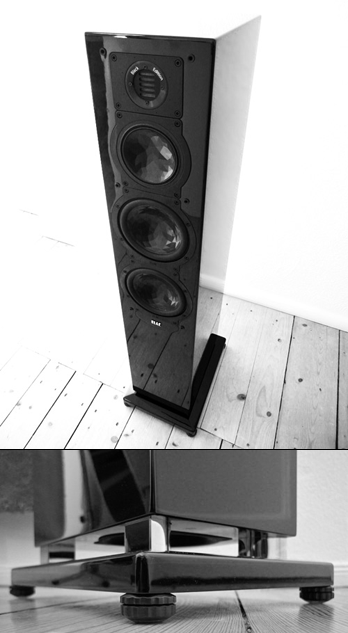
To inspect dynamic behavior Elac’s slim towers had to withstand comparison to my €12.000/pr Kharma CE 3.2 (includes SDSS stands and custom paint) which I find spectacular in this regard. If particularly in the microdynamic range the Kharmas evoke a race car, Elac’s 249 Black Edition was a classic sport car which tracked input signal with fleetness and no nervous twitches. This retained an overview not dissimilar to bigger speakers like Audiodata’s man-sized Sculpture. For achievable max levels enclosure volume and cone surface become the limiting factors of base Physics. Obviously slim-line speakers barely taller than a meter won’t set new records.
That said the FS 249 was good for impressive SPLs which should delight my colleague Jörg Dames who chalked up minor demerits on this very count for the smaller 2.5-way Elac FS 247 which he reviewed in 2008. With the Black Edition in standard-sized rooms you can launch the proverbial cow airborne without smoking any voice coils.
Such loudness stability becomes even more important with orchestral music where extreme voltage swings shouldn’t get compromised or cause the soundstage to collapse, say on Johan Johannsson’s monumental Miner’s Hymns. This multi-movement work for organ, wind orchestra and synthesizer originally was a soundtrack to a US film maker’s eponymous film but readily stands on its own as a Requiem-style composition. As does the film, Islander Johannsson manages with his music to paint a respectful picture of the halcyon days and subsequent decline of Britain’s coal mining and its protagonists during the last century. The production venue was the medieval cathedral in the former mining town of Durham in England’s NorthEast. It is well-known for its exceptional acoustics and even the omnipresent Sting has already recorded in it.
Black Edition replay allowed for relaxed exploits into the multi-layered sound structures of this atmospherically ominous work. Dramatic highlights accompanied by clearly pushed levels not only didn’t lose their effectiveness, the peaks which the Elacs scaled without breaking a sweat sadly remain elusive for my more than twice as costly smaller Dutchies. On this count the speakers from Kiel clearly scored. Kharma’s 3.2 retaliated a bit with its extreme holography and keen nose for actual venue depth where the Elac 249BE lost a few meters of reach. Whilst Durham’s cathedral didn’t shrink to a private prayer chapel, Elac’s ability to rebuild recorded venues in realistic scope and three dimensions was less acute than Kharma’s. This didn’t come as a surprise. Soundstaging is one of the masteries of the two-way Ceramique 3.2.
This made it notable that one specific requirement for image focus applied to both speakers equally. I refer to the ability to disappear as apparent sound sources. In my room's 24 square meters which occupy a golden-ratio type rectangle both speakers disappeared impressively. In the sweet spot they were no longer identifiable just as these things should be.