This review page is supported in part by the sponsors whose ad banners are displayed below |
 |
 |
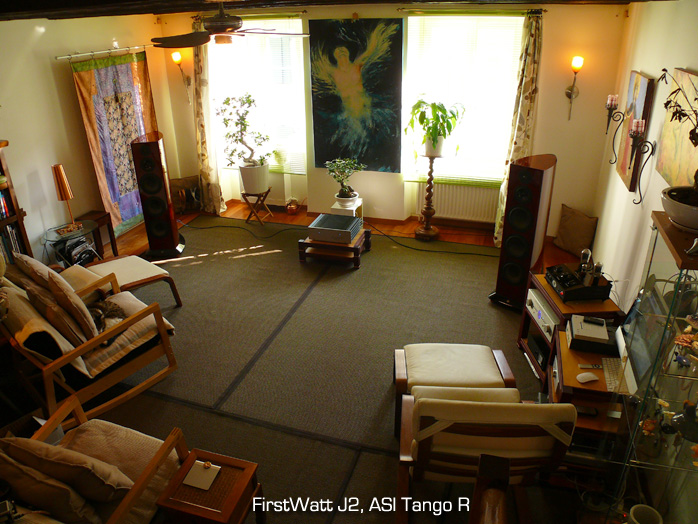
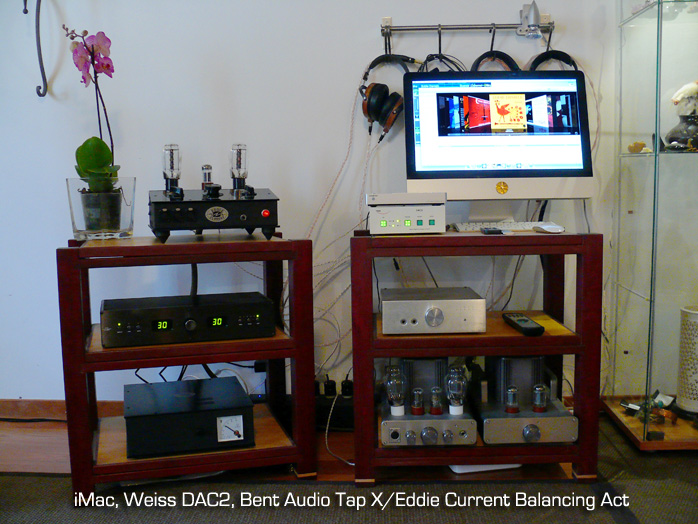
As preamp: To facilitate convenient comparisons I settled on my Weiss DAC2 with its paralleled XLR/RCA outputs. Its gain was set to max, upsampling to x 4 or 176.4kHz. That's where those options sound best to me. PureMusic 1.74 was copied on the same target rate. Files streamed in hybrid memory mode with pre-allocated RAM for purest data output over Entreq's Firewire lead. With otherwise identical cables, the Balancing Act connected to the Weiss balanced, the ModWright LS100 single-ended. Ditto for the amp connections. Here my two new runs of long silver/Teflon Zu Event cables came in very handy. To compare the two preamps I merely pulled out the hot speaker leads to mute the Tangos, swapped cables from XLR to RCA on my FirstWatt J2—this also required removal and reinsertion of its XLR jumpers—reconnected the hot speaker leads and presto. The ModWright ran Create/Synergy 6SN7s with the matching 5AR4. The BA had the PX4s from KR Audio plus another Create/Synergy 6SN7. This set up each machine with the best valves at my disposal.
|
 |
6SN7 vs. PX4: This juxtaposed two triodes, one indirectly heated, the other direct. One is a very common small-signal double bulb of which Dan Wright only runs one half; the other a quite exotic power triode. Hifi snobbery would probably peg the latter the winner by foregone conclusion. Luckily for entertainment and edification, things often aren't that simple and clear-cut. Take a simple girl + piano track as I had with "Miénteme Bien" of Concha Buika's Niño de Fuego album. The PX4 was more light, the 6SN7 more earth. I preferred the PX4 on voice, the 6SN7 on piano. The direct-heated triode was fluffier as though acoustic reverb was a tad higher. Greater airiness surrounding the Ibiza singer's potent pipes gave her more dimensional relief. The octal half bottle was texturally drier but weightier and denser. This benefited the slightly tinkly ivories particularly in the lower registers to invoke more of the resonating sound board over and above the vibrating strings. Both tubes tracked the high dynamic range of this track equally well. In fact Ivette who just then came up from her separate atelier two floors lower immediately walked over to the rack. She turned down the volume on the top-shelf BA. When nothing happened—she didn't realize two preamps were on duty—I enjoyed a few more sly seconds of forceful vocalizing before I shelved down the LS100 with the luxurious Tap X remote that runs the same IR codes for volume and mute. The more expensive BA's lack of remote volume would break my deal if I used it as preamp rather than dedicated headphone amp. Real men are made of sterner stuff of course.
|
 |
|
 |
To confirm the above tone/texture assessment on more exotic timbres, I next put the mouse cursor on Hector Zazou's In the House of Mirrors whose recorded strings I regard as some of the finest in my collection. Structurally uncomplicated to allow focus on minutiae, this album features in many of my reviews. Contemplative, beautifully played and mastered, I recommend this most highly as something that doesn't require acquired tastes and hits all the audiophile and music lover markers. Here the PX4 resolved more space. Contrast of performers against ambient context was higher and on-string action with its metallic overtone elements was keener. I was reminded of my Yamamoto 45 SET which Frederic on staff inherited. The 6SN7 meanwhile made better stronger more striated bass. On balance and for this spacey introspective material, I'd give the direct-heated big bottles the nod. |
|
|
| Irregularly drawn bow had more modulated rasp, the Indian slide guitar's undulating pitch more overtone energy. The 6SN7 focused more on the notes' bloom portion. This shifted attention on the material and less on the ephemeral. The prior light and earth polarity still held. Next up was Eddie Daniel's GRP Jazz energetic reading of Benny Goodman's "Sing Sing Sing" with Gary Burton on solo vibes [Benny Rides Again]. Here the harder-hitting drier bassier 6SN7 held the ace cards. The upright bass lines had more pizzazz, the rolling drum thunder more impact and that general foot-tapping sense of forward momentum called drive greater urgency. Here tautness and timing tension were the name of the game and the ModWright played with more élan. |
|
|
What surprised me was how on the level both machines performed. My allegiances would shift depending on what flavor best matched the given material—or mood, let's not discount psychology—but it was a clear case of not caring which machine would stay if a visiting audiophile were told to leave with the one he preferred. Letting things with this comparison settle to allow the ear/brain to filter down impressions, I concluded that for energetic modern music with plenty of pop, crackle and snazz I'd fancy the ModWright more. For seductive vocal magic and more down tempo fare with supreme recorded space à la Todd Garfinkle of m.a. recordings the Eddie Current had my vote. In the bigger scheme the ModWright's greater number of i/o ports, remote control and lower pricing should give it the competitive edge. Rolling or replacing two 6SN7s (first you'd swap them channel to channel to use the virgin other halves) is also clearly cheaper than dealing with designer power triodes. That said the BA's price positioning as a preamp is very competitive.
|
|
|
| |
|
 |
Multi-tapped autoformers vs. PX4: The next comparator became John Chapman's upsettingly discontinued €2.000 AVC with 61 x 1dB steps. While on the subject, how many makers do you know who kill off their own popular product just so it won't compete with their OEM clients? Popular lore on passive preamps would predict greater leanness, sharper transients, milder dynamics, less bass weight and perhaps some harmonic bleaching versus an active gain circuit like the BA. For my Trafomatic Kaivalya EL84 monos and Yamamoto A-09S 300B SET, the Tap X's clean-as-a-whistle lucidity is my favored volume controller. It counteracts the valve amps' mild thickening action from higher harmonic distortion. For a track with plenty of potential pit falls now—upright bass, piano, vocals, oud—I cued up "I Pass By Your Name" from Marcel Khalife's Caress album. |
|
|
 |
In fact passive bass was wirier, slightly more articulate and more potent. The operative term would be quicksilvery. Playing with lower volume settings where previous experiments had identified a definite forté for the Tap X, the autoformers held a resolution advantage at what I call midnight whisper levels. On general lucidity however—crystallization, separation, spatial relief, contrast—the PX4 was surprisingly close and just a skoch softer around the edges. This mandates a brief intermission. It's long since been my contention that to hear direct-heated low-power triodes at their very best requires headphones. Their single-driver high-impedance loads sidestep all the usual speaker-drive issues. Now I'll add line drive. With the FirstWatt power Jfets handling the grunt work, the PX4 was coasting. This idealized 'fixed load' condition had it perform far closer to invisibility than the clear personalities all such tubes exhibit loaded into loudspeakers directly.
|
With the BA, the usual power triode preconceptions plainly did not apply. Instead the oft-invoked purity and linearity of triodes played out for real, not just on the test bench with a steady-state 1kHz signal. I ran plenty of funky stuff with very bouncy bass. With the BA bass simply was no issue. There was a very slight softening effect but neither was it specific to a frequency band nor was it any coarse golden-glow patina. While one could question the greater circuit complexity when a superior passive is far more similar than not—particularly the absolutely essential low-noise filament power supply—the BA as proof of concept firmly rehabilitated such valves' reputation as expensive but unpredictable tone controls This wasn't about cloying colorations or cheap perfume. This was about very fine nuances over against the (theoretical) nothing of autoformer volume control. Vocals made it easiest to hone in on those nuances. The PX4 was texturally a bit more developed and richer. The autoformers felt energetically more lit up and sharply contrasted. The tubes were more honeyed. On competitiveness the Tap X once had that luxurious remote and lower sticker going for it. |
|
|
My Esoteric C03's variable gain (0dB, 12dB, 24dB) acts like an analog equalizer on bass mass, tone density and transient incision. No gain equals essentially passive performance though the Tap X is ultimately the more crystalline and sculptural. Top gain maximizes density and mass but reduces speed and articulation. The BA slotted itself right between zero and twelve dB, again far removed from deep triode myths. Instead the PX4 proved itself to be a very high-resolution essentially neutral output device whose beautifying treatment on the tunes—the very fine softening and texturizing—wasn't more than a faint but welcome whiff.
|
|
|
PX4 vs. 300B: Swapping in my top 300B from the Create/Synergy collaboration with Shuguang intensified this whiff. The musical flow slowed and thickened, the same tracks grew more stately and relaxed and the glass-like 45-type aspects of the PX4 turned more opaque. In terms of resolution this was a distinct step backwards but in keeping with what 300Bs sound like in speaker-level applications. The magnitude of this effect—it nearly felt like a type of buffering agent had been inserted—simply wasn't as pronounced as one usually encounters it there.
|
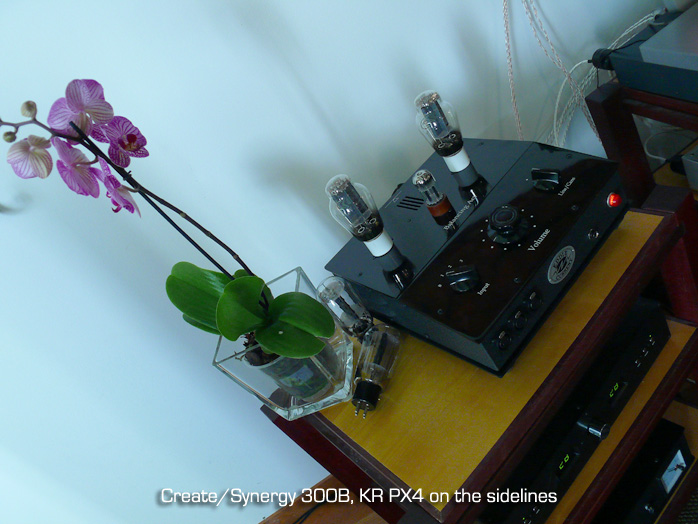 |
This being my first encounter with the PX4 trouble maker, I had no trouble admitting that in this application I considered it clearly superior to the 300B. For context I also prefer the 45 and VT52 to the so-called queen of triodes. That's nothing but personal bias of course but you can use it to gauge where you would fit in. In my stable of 300Bs this particular brand is the most linear, extended and resolute. In my estimation it has displaced the mighty Emission Labs 300B XLS and EAT. Even so here a salmon-like fattiness asserted itself wholesale. It made the PX4 the faster more transparent and resolved bottle. The 300B created emotional distance, dimmed down the lights and stirred in a mild gelatinizer. For a preamp my ears wouldn't consider those to be desirable accomplishments. I'd go with the PX4 and never look back.
|
 |
  |
 |