This review page is supported in part by the sponsors whose ad banners are displayed below |
 |
 |
Summary. Looking at hifi mag covers might foster the impression that almost every month there's some breakthrough in this industry which puts the ultimate perfect sound with reach. That's rubbish. Reproduced sound is and always will be a different universe than the live experience. And real breakthroughs appear only once in a blue moon. When they do emerge we need to acknowledge them. Only then something bigger and better will migrate down into mass availability. I don't think the D-Premier requires kissing but I would like to get in line to express my congratulations to its creators.
Make no mistake, this still isn't a perfect device. The soundstage could use some more depth and the differentiation of timbre is not as sophisticated as a good SET amp delivers. The lowest bass also isn't as well differentiated or defined as a high-quality transistor amp. Devialet's selectivity is fantastic but the same no matter what recording we play. It sounds beautiful but the problem is that it always does.
|
 |
These downsides should not diminish our recognition of just how innovative this amplifier really is. And whilst I wrote amplifier, its D/A converter also is very good. You might think its sound to be from a small SET with its incredibly palpable foreground which seems to be slightly warm. Instruments seem to be within reach. Resolution and selectivity are impressive not only considering the price but compared to other high-end devices. The ability of differentiation is amazing, like a tube amp inside a silicon chip!
Extensive functionality, firmware updates and a fantastic RF remote all shout 21st century. In connection with virtual early 20th-century tube technology it defines a sound that's different from anything else. This makes the D-Premier AIR a full-scale revolution and great aesthetic archetype.
|
|
|
Review methodology. The D-Premier AIR differs significantly from anything else on the market including other digital amplifiers [the recent launch of Wadia's Intuition 01 has added a direct competitor – Ed]. Its weight is not great but still requires a high-quality amp stand as our domestic distributor Jarek Orszański pointed out and which I can confirm. I used the Acoustic Revive RAF-48H stand. The power fed to this French deck matters too. I usually rely on the Acrolink Mexcel 7N-PC9430 as the best power cord I know. It tends to always work great in my system. Yet the distributor recommended the Synergistic Research Tesla SE Hologram A with active shielding powered from external power supply. Hence I decided to conduct my review in his recommended setup. A large IEC plug forced me to remove parts of it cover. Because the speaker terminals are placed quite close to each other I was somewhat afraid to use my reference Tara Labs Omega Onyx cable. Instead I used Acoustic Revive SPC-PA.
|
 |
With switching amplifiers it's often a challenge to choose the proper cables as the low-pass filters (LC) in the output combined with the cable's capacitance and inductance can influence response linearity. But there is no such filter in the D-Premier's output (another of Devialet's proprietary solutions). Thus I wasn't afraid of a mismatch.
Although the device sports analogue inputs including phono, it's in fact an amplifier with built-in D/A and D/A converters to become a power DAC. Of course you can use a turntable or other analog source as long as your primary source is digital. I thus used the Philips CD-Pro2 transport section of my Ancient Audio AIR V-edition CD player and as file player the Ayon NW-T via its buffered S/PDIF tube output. I ran A/B tests with both A and B known. I used 2-minute long music samples. My reference devices were my Ayon Polaris III + Soulution 710 pre/power combo and the Jadis I-35 tube amp.
|
 |
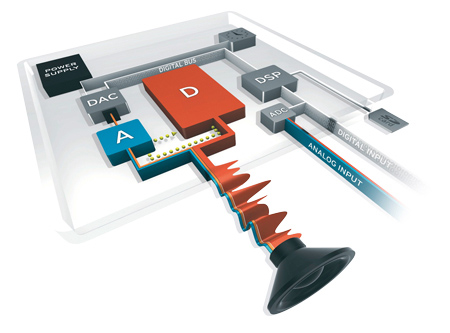
Description. During an interview with Stereophile's chief editor John Atkinson, Pierre-Emmanuel Calmel presented many details regarding the design of the Devialet which I'll cull from here. You can feed the D-Premier digital or analog signal. All analog signal is converted to digital with a Texas Instruments PCM4220 A/D converter running at 96 or 192kHz—the former is the default—before being applied to the digital-domain volume control implemented in a 32-bit floating-point DSP chip by Analogix along with a soft-clipping function and crossover filters when required. All signal is then converted back to analog with two Burr-Brown PCM1792 chips. Those are high-quality 24-bit two-channel current-output parts operating up to 192kHz. Just half of each DAC is used per channel. The current output of the DAC is converted to voltage with a resistor and fed directly to the class-A amplifier. The analog signal path from DAC output to speaker terminals is just 2 inches long.
In effect the DAC swings the high voltage required to drive the speaker output whilst the class A amplifier works at unity gain and voltage follower to linearize its performance at high frequencies. As Mr. Calmel stated there are only two resistors and two capacitors in the signal path. Classic amplifiers of the kind have issues as they generate high-frequency noise at the output which enforces low-pass filters yet there are none in the D-Premier. Instead the class D stage is fed by digital processors to receive a digital 300kHz PWM signal.
|
|
|
|
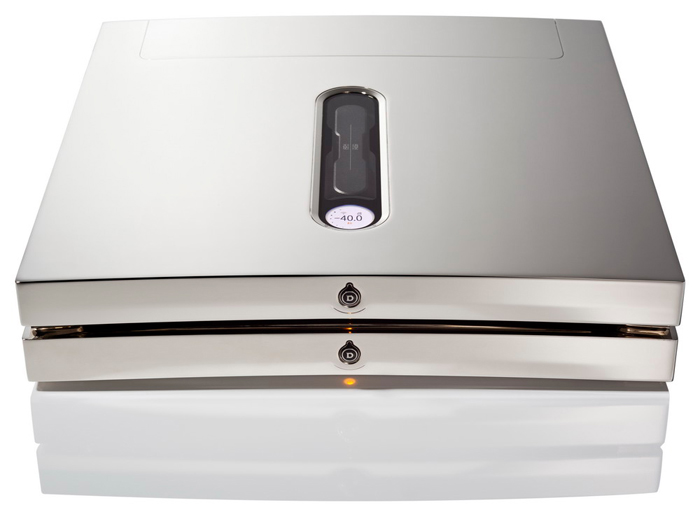
| The machine is equipped with an SMPS as known and widely used in military and health care devices and in audio's high end as popularized by Linn and Chord. This power supply delivers 600Wrms and 2KW peak power. The flat square shape of the D-Premier AIR is quite distinctive. On top there is a translucent window with a display beneath to show volume, chosen input and menu layers. Volume can be set between -97dB and +30dB in 0.5dB steps. Analog input signal above 0dB is compressed and at +30dB gently cut off. The elegant circular display orients itself if you wall-hang the D-Premier. When a digital signal is received the name of its input turns red for lock before reverting to black. Sadly world length isn't displayed. Since ongoing firmware upgrades already added sample-rate confirmation, it's likely this can be fixed in the near future. |
|
|
All sockets are placed on the back panel where impedance-matching transformers sit behind all digital inputs. Access is very simple as part of the cover is fixed by magnets to be easily taken off. The back panel of course is quite narrow to leave little room for plugs and necessitate close spacing. The distributor's favorite power cord IEC was too large hence parts of its cover had to be removed to make it fit.
|
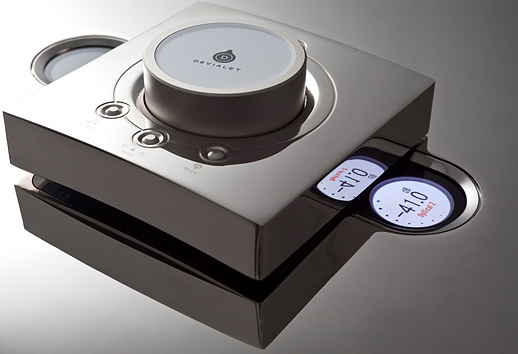 |
There are as many as 8 digital inputs: AES/EBU, 4 x coax, 2 x optical + HDMI. All accept up to 24/192 PCM. Before one sends a signal from a DVD or BD player it must be converted to PCM (check the player's menu). An HDMI output can send audio/video to a projector. There's an analog input which can become MM/MC phono. Two digital inputs can be configured as a second analog input including phono. Two more digital inputs can become a pre-out for a subwoofer. The D-Premier sports single binding posts. In toto, I've never seen anything like it before. Pure perfection! |
|
|
opinia @ highfidelity.pl
|
 |
 |
|
 |