This review page is supported in part by the sponsors whose ad banners are displayed below |
 |
 |
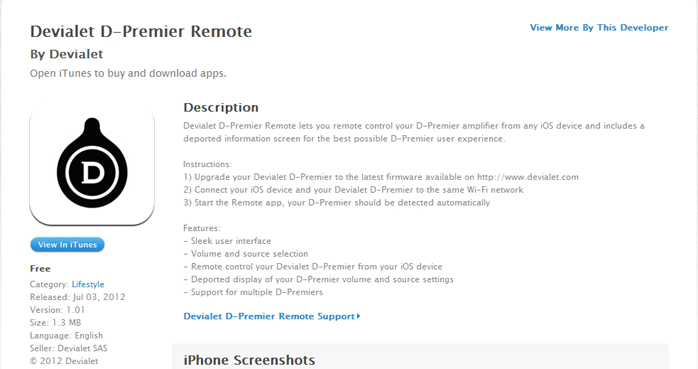
July 2012 marked the release of version 5.6 of the D-Premier firmware and version 1.4 for the AIR software. These two needed to be downloaded from Devialet's website and installed to enable the new features. These included lossless replay of high-resolution material up to 24bits 96kHz. Higher resolution material like 24bits at 176.4kHz or 192kHz gets downsampled to 88.2 or 96kHz respectively. Later versions will offer support for higher sample rate support without downsampling. Next to the new firm- and software, Devialet also introduced the first version of their remote control app. Only available for iPod/iPad/iPhone from the iTunes store, an android version is in the making.
|
 |
For our two D-Premier receivers—that's the name we will henceforth use for this all-in-one piece of gear—we downloaded the new firmware ZIP file, extracted that to a spare SD card and swapped that for the one in use in a D-Premier. Simply rebooting the receiver started the upgrade process which took less than a minute. Updating the second one took a bit longer because we forgot again to set the SD to read-only. The upgrade process deletes a few files when possible from the SD card rendering the remaining set of files invalid for a second upgrade. This meant we had to reload the files onto the SD card, then do the upgrade. That second attempt worked fine.
|
|
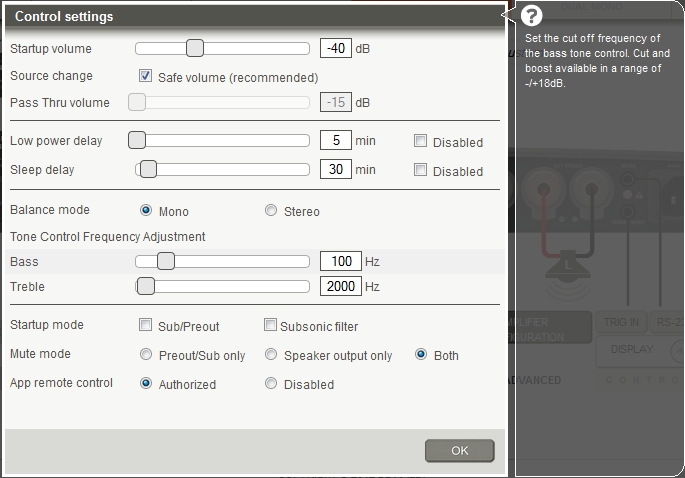
We use iTunes on PC and Mac platforms and downloaded AIR in EXE format for PC and DMG for Mac. Installation on either platform was simple and flawless. While at it we also picked up the Devialet remote app from the iTunes store. As with all things Apple, that was a breeze. Next was the new configurator. With this version on Devialet's website there is the option to include balance and tone controls to the receiver’s control software in DSP by clicking on the control box on the web page. We first uploaded our configuration from the SD card in use and added the control settings for balance and tone control. With the tone control, the pivot point can only be set via the online configurator. Default is 100Hz and 2000Hz but the actual ranges are 20-500Hz and 2000 to 20000Hz. From a set point, cut and boost operates from -18dB to +18dB. So it will depend on your speaker’s capabilities, needs and room interactions where to set that pivot point. After making the choice, the complete configuration set was downloaded back to the SD card and that card was inserted into the right D-Premier.
|
|
|
|
|
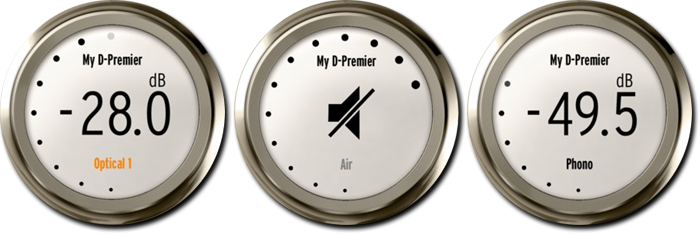
Before trying the new hi-res options we played with the balance and tone controls. One 4-second push on the RF remote's bass knob entered balance mode, two more short pushes tone control, bass first then treble. Once inside one of the selected modes, simply turning the big wheel sets the desired left/right balance or bass/treble boost/cut. Picking up the iPad with the new Devialet remote app installed had us notice that the app was still rudimentary with only input selection and volume control implemented. Secondary functions controlled via the RF remote’s small buttons are not yet available and for those the user still must walk up to the D-Premier to watch the display. Things like the new balance and tone controls, polarity inversion and RIAA selection will probably be available with an upcoming version. However what was already available worked fine and had stunning looks.
|
 |
Now onto hi-res. On a laptop we keep a selection of such files where we now created a test playlist in iTunes containing a mix of resolutions from 16/44.1 to 24/192. Sitting at the dining table we started the first track, in this case a 24/96 Paul Simon song. Oops, something was really wrong. Paul was stuttering and suffered severe dropouts. Was the cause hi-resiness? After a quick stop of the track we selected a normal 16/44.1 cut. Here we had no data loss and a fluent very nice playback. Back to a hi-res track with an opened AIR status window. Here we could see what the D-Premier was experiencing - not nice.
First the fill factor of the buffer was very low. Next the speed adjustment was going berserk moving the cursor from left to right and back. Music integrity was very low and down to 60% where the lost packets rate topped 200. The culprit was of course network strength. With low-res files there is much more time and space for re-transmits before any problems become audible. With hi-res content these margins are substantially smaller.
We had to figure out why we experienced such data loss. Our WiFi router sits downstairs but its function is limited. It provides the IP addresses to the D-Premier and laptop, in the current case in its DHCP capacity. Then the router’s role is virtually finished. The laptop will find the D-Premier(s) and the accompanying AIR software enables the selection of the desired unit. Once connection between PC and D-Premier is acknowledged, data exchange commences. That part of the streaming had been successful. Sustaining a reliable high-speed connection was problematic.
|
|
|
|
|
We and our laptop were sitting at the dining table about 10 meters from the D-Premier. Was that the cause? Moving to the standard listening position 3 meters from the D-Premier made everything work flawless. No signal loss, no clock adjustments, steady clean sound. With this achieved the playlist with various sample rates showed that the AIR software in combination with the new firmware had no problem locking on quick and secure whenever the format changed. Our Mac sits downstairs more or less straight underneath the D-Premier separated by just a wooden floor. After starting iTunes on the Mac, we took control with the iPad running Apple Remote and the new Devialet Remote app. Needless to say this combination worked brilliantly and due to the short distance between Mac and D-Premier without signal loss.
|
 |
|
 |
With more and more hi-res material becoming available for download from our favorite Qobuz Studio Masters site and others, physical music media are becoming rapidly obsolete. Playing many hi-res tracks we have come to the conclusion that true 24/96 material is a big step forward in definition and dynamics. Higher resolution beyond that does not add much more lucidity or—most important for music—tone definition. As long as the availability of true 24/96 material improves and providers stop upsampling 16/44.1 material to sell it as the real deal, we could live happily ever after with 24/96. Now that Devialet has added the processing of such files in their own unique way, only old-fashioned 'true' audiophiles with their insatiable urge to swap gear every three months will still feel left out. Owners of a D-Premier should upgrade their ASAP and non-owners should visit a Devialet dealer just as quickly. Yes we do love these music machines which redirect any user at what it is really all about: musical ecstasy in the home.
|
|
 |
 |
|
 |