This review page is supported in part by the sponsors whose ad banners are displayed below |
 |
 |
At the back we find from left to right an SD card slot with 2GB card. This is used to transfer software and firmware updates and with it a user can also load custom i/o settings. Two optical inputs sit above two HDMI ports. In the default configuration these connections are set up as input and output. Then there are three pairs of RCA connectors. In the default configuration they are set up as MM phono, line input and S/PDIF inputs. A ground connection is provided between the leftmost RCA pair. Ahead of the left and right WBT speaker terminals sits the AES/EBU balanced input. For future use there is an RS-232 connection present. There is no input voltage selector. The power supply uses auto detect and the D-Premier is universally employable. When looking at the IEC power inlet the red-blooded audiophile encounters the first hurdle. Most aftermarket cables employ fairly large IEC plugs from Furutech, Oyaide & Bros. Those connectors have a diameter of 3.8cm, too much to close the lid. A square-shaped connector like the Furutech Fi-15 with its 3.35cm height does not fit either. So we played with the lid off.
|
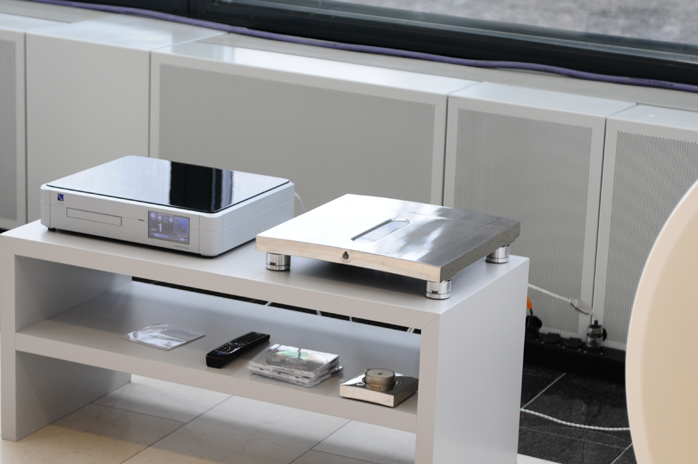 |
For our Dutch review we mainly spun CDs on our PS Audio PWT transport and occasionally used hi-res files from a laptop with XXHighEnd software. For the transport we used Devialet’s recommended XLR connection, the laptop after conversion to S/PDIF communicated with one of the coaxial inputs. Before the first CD started we slowly turned up the huge knob on the RF remote. Despite the 107dB sensitivity of our Avantgarde hornspeakers even the 0dB setting was spookily deathly unbelievably quiet. Whoa. Down to an ear-safe -30dB Romane & Stochelo Rosenberg’s Tribulations disc sounded far more immediate than we had ever encountered it before.
|
|
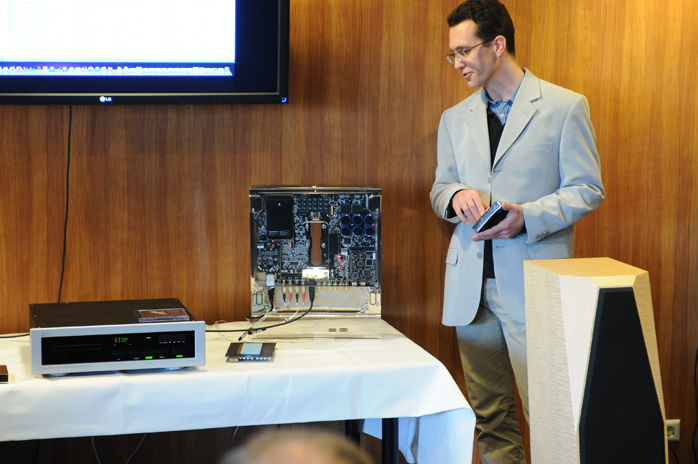
Still at the show, just class A playing
|
Transients emanating from the lightning-fast string duels of the guitar manouche maestros were processed at far more real-time speed than our trusty Audio Note SET. Where the latter can be accused of touching up and being forgiving, the D-Premier was honest and blazingly fast. More exotic timbres and electronically manipulated bass lines from a gum bass came from Hadouk Trio’s Air Hadouk. Here we missed the perhaps romantic addition of SET warmth. With the D-Premier the sound was somewhat thinner and slightly brighter. Lila Downs’ En Paris – Live at FIP, another wonderful job by Radio France, confirmed the slight shift towards the higher frequencies. This however did not give any impression of ‘digital’ or ‘jittery’ but was more a matter of voicing.
We even played some heavy stuff like Wagner’s Die Walküre and Antwerp’s loudest trio rock band, Triggerfinger’s All this dancing. Streaming hi-res downloads from the PC was a joy too. Once the handshake was established, listening was a pleasure. Again the D-Premier showed what airiness and lack of aggression mean to a performance at home and what a complete and utter lack of background noise does for a sense of realism
|
|
|
After we finished the overall positive Dutch write-up a few month passed and other projects came our way. One of these was the Arcadian Audio Pnoe. For this we had opportunity to combine the huge Greek single-driver horns with Audio Note Ongaku and Jinro amplifiers. While in the progress of reviewing the horns the organizer of the Doelen Lente Hifi Show in Rotterdam—that city keeps haunting us—paid a private visit. He wanted to listen to the horns. To make a long story short, he asked if it was possible to get them to his show. We contacted Arcadian Audio and after some negations with show management they agreed and were even willing to run the demo in person. Because we were in Holland and familiar with the event and its organizers, we were asked to help arrange for transportation and ancillary equipment.
Transportation was once again handled by our now familiar Janssen Value Added Transport company so the delivery was in secure hands. All we had to do was find suitable electronics. During the still ongoing review of the Pnoe we had noticed that the speakers were very revealing and with their 16Ω impedance not every amplifier’s idea of a good time. Because the horns would not be playing a normal room but an open foyer in the congress area of the Doelen Concert Hall complex, the amp had to be powerful enough to generate sufficient SPL.
|
 |
In the meantime we had received some DVDs with hi-res WAV tracks from Todd Garfinkle’s m.a. recordings. This and the Pnoes' innate quality made a PS Audio PerfectWave transport the ideal source since the latter plays 24/192 WAV files from DVDs without a sniffle and has the preferred AES/EBU output. All that was left was finding a suitable DAC and amp. Show organizer Tom was a very happy Devialet owner. Devialet’s distributor D&D was participating and had invited their Manuel de la Fuente to give a presentation. It became a nearly foregone decision to opt for a D-Premier when a unit was made available. Cables were also easy to arrange as D&D distributes Crystal Cable.
At show time it was merely a matter of positioning the Pnoe with a laser tape measure, install the PWT and D-Premier and connect the loudspeakers, AC cables and XLR digital interconnect. For sheer looks the silver PWT, shiny D-Premier and huge white Pnoes were stunning already. Tom arranged a kinky red sofa to complete the picture. Imagine this at least on paper lovely system set up in a corner of what for home hifi was an immense stone and glass foyer. Nightmare?
Just before the show opened, one of the Greek Pnoe team members reacted very badly when he realized that his babies were to be driven by a class D amp. "Please find a 300B amp" was his panicky request/demand. Here we remained stone faced and persistent by calming tempers and actually playing some tunes in the still empty foyer where hard stone floors without carpet met the speakers, a 5-meter tall glass wall sat behind them and in front was only a lone red sofa surrounded by cubits of empty space. Did our Greek visitor silently wish he’d remained in Athens and never trusted reviewers to organize a show demo on his behalf?
|
|
|
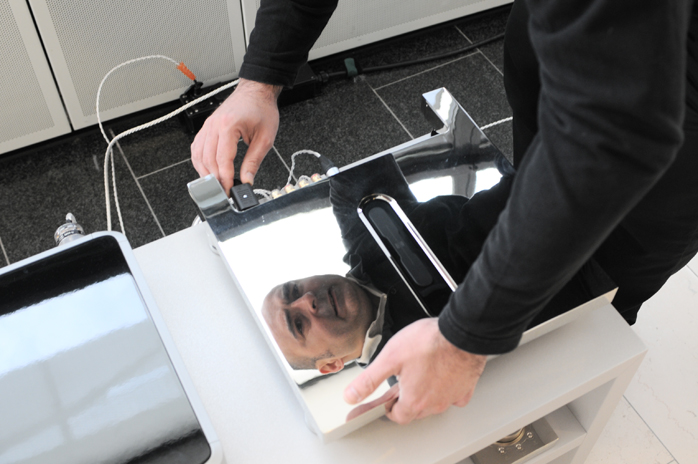
As to how the Pnoe behaved at the show, their feature review chronicles that. Today we focus on the D-Premier in this challenging environment. After an extended audition, the previously anxious Greek designer who so happens to build his own tube amplifiers began to appreciate the D-Premier more and more. The urge to replace it had clearly relinquished. At the end of the first show day things got better still. Devialet’s Manuel de la Fuente announced that he had the long awaited version 5.3 of the soft- and firmware available for their own demo and offered to upgrade our show loaner as well [below].
|
 |
|
 |
The process was child’ play. Get the software from Paris and unzip the file to SD card. Power off the D-Premier, insert the card, power back up. In the display Upgrading Software appears while a circle of dots slowly dissolves. When the last dot has vanished the display shows Upgrading Firmware. After 1.5 minutes the procedure was over. Just remember to delete the software from the SD card to prevent update conflicts.
After the upgrade the sonic difference was shocking. Actually earth-shattering was more like it. That's because in the huge foyer the Pnoe suddenly controlled and played the space will real verve. Bass extension was far better and the somewhat light tonal balance from before had completely vanished. A subtle shift toward the lower spectrum introduced a new level of emotional triggers. Where the D-Premier had been a fine omnipotent music transducer, it had transformed into a musical instrument now. This is from dyed-in-the-wool SET fanciers mind you (us and the Greeks). |
|
|
 |
  |
 |