This review page is supported in part by the sponsors whose ad banners are displayed below |
 |
 |
Accuracy are the stomping grounds of B.M.C.’s Amp C1. It orders, sorts with and establishes precision. It reads a bit flat but isn’t. It simply all depends on the quality of your software now. Boring dynamically compressed sauce targeted at MP3 players will sound terribly dull. Substantial musical calories meanwhile… well, back to the beginning.
|
 |
 |
I enjoy kicking off a session with Jazz. Here it was the Lisa Bassenge Trio with A Sigh A Song. The first thing to attract attention was exceptionally acute staging and placement precision. This kind of localization focus is rare. Though the outer dimensions of the virtual stage weren’t grander than I’m used to, there seemed to be more air between its actors. This created more clarity for the individual. Rather than segregating the action, it was the appreciation of how perfectly everyone played together which grew.
|
|
|
|
|
Since I couldn’t relinquish muscle-bound preconceptions quite yet, I cued up mightier fare next. For abysmal synth orgies Madonna can always be called upon. I was additionally curious how the diva’s preferred artificial acoustic constructs would hold up against the amp’s extra soundstage clarity. Ray of Light quickly confirmed that synth sounds and effects aren’t mutually exclusive to operating at a high professional plateau. What emerged from my speakers was fantastic. This presentation didn’t even pretend at realism. The effects popped with otherworldly insistence like Avatar in 3D. While that film’s visuals arose from computers the final integration was so fluid that it worked. Transpose this to music and voilà. As to bass, it was fast, bone dry and massive. At higher levels I actually got a bit concerned for my speakers’ welfare. But nothing boomed or grew out of proportion. Cineasts into resonant murky earthquake bass will be disappointed there.
|
|
|
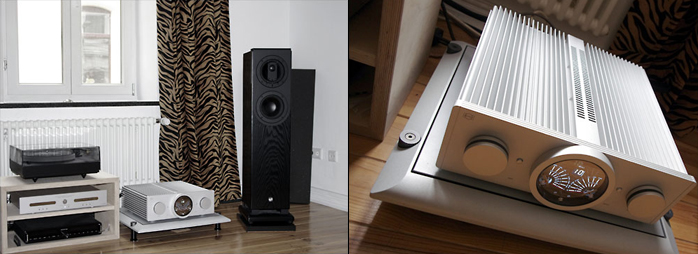 |
The C1’s enormous reserves thus aren’t used to embody the rogue Rambo agent. Pumped up is left for Venice Beach. Energy reserves appear solely harnessed for speaker control. My Geithain ME150 was in its grip and not allowed the briefest overhang. Even fat or fulsome bass impulses as they feature on "Damned if I Do" of Ursula Rucker’s Silver or Lead emerged with more dryness than any other amp through here has yet managed from that number. The effect was terrifically cool – endless power that worked naturally without steroid antics.
|
|
|
|
 |
Ursula Rucker also impressed upon me that the amp’s absolute control wasn’t limited to the lower octaves. This album is highly dynamic and peppered with noises and effects which over systems that inject additional color often approach becoming ‘too much’ for me. Over my Jadis Orchestra for example I can only handle this recording at moderate levels. With the B.M.C. these levels didn’t devolve into more boring but rather into increased interest. I felt aware of far more musically relevant detail since nothing was overlaid or masked.
|
|
|
 |
|
I now reverted to my favored musical genre to work through various Jazz records. For Jazz piano Abyss by the Japanese Cihirio Yamanaka is one of my favorites. But it’s also quite the drum set workout to have me pull out this album whenever microdynamics and resolution are under the microscope. Here too the amp’s control over the speakers became apparent. Detail magnification seemed unlimited as each tone and each noise was clearly outlined. Attack, sustain and release were clearly defined, nothing seemed to slip away. To remain with piano for a bit longer, Ahmad Jamal’s A Quite Time elucidated a further quality. The amp’s control didn’t telegraph as an iron death grip. It seemed softer than that but no less unassailable for it. After each hammer fall it was the damper felt which extinguished the sound if you appreciate the implication and difference.
|
|
|
|
 |
|
 |