This review page is supported in part by the sponsors whose ad banners are displayed below |
 |
The Bergmann turntable's build is of extreme quality, with a beautiful design and great overall concept. It sounds incredibly precise and revealing which is why not all of your albums will sound great. Of course you can try different cartridges but in my opinion the PC-1 showed all the most important attributes of the Sindre. I might also check out some top Koetsu models for a potentially good match. A few details remain which, if improved, would make this deck far more user-friendly. But it's already a wonderful turntable that can be topped only by something as good as the SME 30A. And that costs twice as much. This review is Bergmann's debut in Poland and in High Fidelity and what an absolutely fabulous debut it was. The PC-1 cartridge too is outstanding and I know that one day I must have it or the top model Supreme.
|
 |
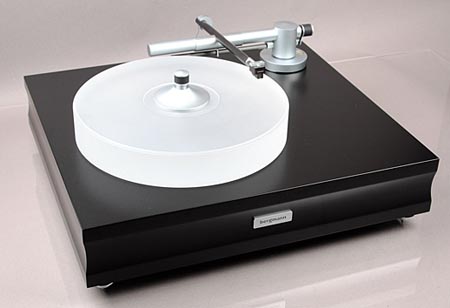
Description: Sindre. Bergmann Audio is a Danish company with presently one turntable and one arm, both subject of this review. A new reference called Sleipner should be available soon and their website already shows a few teaser pictures. This company believes in simple but well-executed solutions. That’s why the deck and arm were designed to use as few (top-quality) parts as possible. The TT is quite large and heavy. It is a belt-driven device with an air-suspended platter. The Sindre is built around an 88mm massive block of a 3-layer fiber board. From the top all you see is a thick acrylic platter and the linear tracking arm. This platter sits on an aluminum sub-platter which floats on a thin air film centered by a spindle. The only point of contact between sub-platter and turntable is the belt. To ensure the least interaction between plinth, platter and motor, this belt is quite narrow and not driven by excess torque.
|
|
|
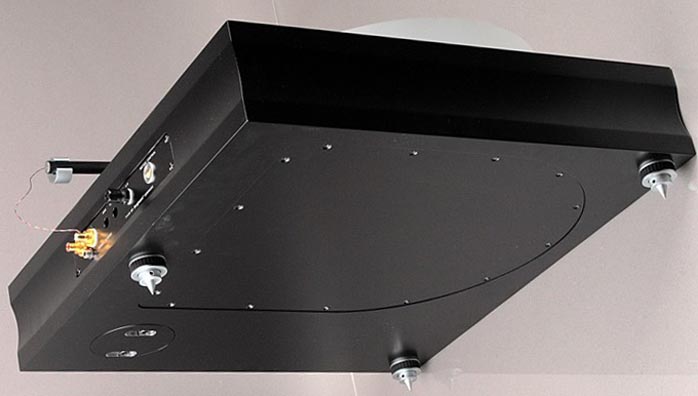
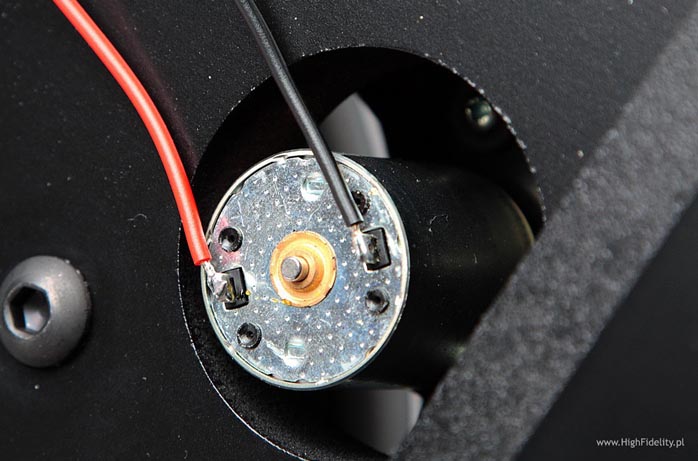
This is a key differentiator to many turntable designers. Some of them like Tim de Paravicini believe that you need very powerful motors for maximum platter control. Others say that it provokes a far greater transmission of vibrations into the platter. Obviously Johnnie Bergmann Rasmussen prefers to avoid vibration transmission. Motor torque transmits to the sub-platter via rubber belt inside the plinth to remain invisible. Bergmann chose a DC motor because he believes that it ensured the best speed stability. The platter air bearing consists of two aluminum discs between which the air supply creates a thin frictionless film. The 3.2kg sub-platter supports the 4kg acrylic top platter. The spindle is centered in a bearing housing made from long-wearing frictionless technical polymeric. The plinth is placed on three adjustable spikes. The back panel of the plinth contains the fantastic and most expensive WBT RCA connectors, the air supply socket and a very good Lemo power inlet.
|
 |
The Sindre can be upgraded to battery power. There are separate air flow adjustments for tonearm and platter. A record clamp screwing to the spindle threads is included. The turntable weighs 23 kg and its dimensions are 475 x 500 x 210mm D x W x H. The power supply is external and sports a selector for 33 1/3 and 45RPM on its front panel. On either side are two small trim pots for speed control. To be honest, the switch is quite ordinary and does not compare well with the sublime design of the total device. The low motor power is responsible for a quite slow platter start-up. You might want to help it a bit by pushing at the beginning. The air pump is separate and fortunately so quiet that you can place it in the listening room.
The Sindre tonearm is an air-bearing linear tracker made with the utmost precision and very easy to set up. Some form of protractor from Bergmann would be a nice addition and ease the setup even more. If you use the included aluminum template and set square, you also will get good results in a short time. The arm tube is mounted on a sliding pipe which is made from a very hard aluminum alloy to secure the highest stiffness. The arm tube itself is carbon fiber. You can't change azimuth but can change overhang. A cylindrical weight clamps to the arm with a tight rubber lining and can move on the arm in either direction. The tone arm wires are very thin so you need to exercise extreme caution when attaching the clips to the cartridge! These lead wires disappear inside the plinth somewhere between the RCA connectors and are soldered directly to them.
|
|
|
 |
PC-1: This moving coil cartridge is manufactured by Air Tight of Japan. Their line has only one higher model called the PC-1 Supreme. The output voltage is a quite high 0.6mV and the internal 2.5Ω impedance is very low, hence this cartridge should work very well with most phono stages. The magnet is a #50 Neodymium. This pickup offers very impressive frequency response of 10-50 000Hz. The cantilever is made of single-crystal boron. The stylus tip is a 3μm x 30μm semi-line contact. The recommended tracking force range is 2 to 2.2 g but I suggest the upper limit as the best option. The pins are made of Rhodium-plated polished copper. |
|

opinia @ highfidelity.pl
|
 |
|
 |