This review page is supported in part by the sponsors whose ad banners are displayed below |
 |
 |
|
Now let's return to the first page where Xuanqian made a particular statement.
I frankly lack the tech savvy to enter into any intelligent discussion on the relative merits and demerits of ICEpower versus UcD. Where I can and will weigh in is how April Music's Stello Ai700—and by extension the very similar Peachtree Audio Grand Integrated—differed in the listening seat. Having the Ai700 and a pair of Nc1200-based Acoustic Imagery Atsah monos on hand whilst the Meraks were in residence allowed for a sampling of latest-gen bridged ICEpower for 500wpc into 8Ω powered by B&O's SMPS; Ncore with its stock SMPS [right]; and today's modified UcD 400 with a linear supply.
|
|
|
|
 |
To cut to the chase, ICEpower in these implementations was slower, warmer, fuzzier and thicker. Particularly the upper bass seemed emphasized—it got positively elephantine on the Rhapsody speakers with their deliberately lower Qms—whilst the treble was just a bit hooded. If I had to nutshell the effect, I'd call it a legacy paper-driver sound. If I could borrow from the recent Rhapsody review, I'd call it vintage Sonus faber voicing with an American rather than European bass balance. Think attractively physical, organic, warm and generous yet not the last word in lucidity, speed, dynamic jump factor or dimensional sculpting. When I learnt that Simon Lee had introduced his Ai700 to US audiences at RMAF 2012 with ceramic-driver Mårten Design speakers, I thought 'perfect'. Such a combination really would seem ideal. By extension I'd not say the same about leashing his integrated to the AudioSolutions or Serblin-era Sonus fabers. Such an overtly warm + warm combo sacrifices too much haute-cuisine resolution at the altar of comfort food.
|
|
|
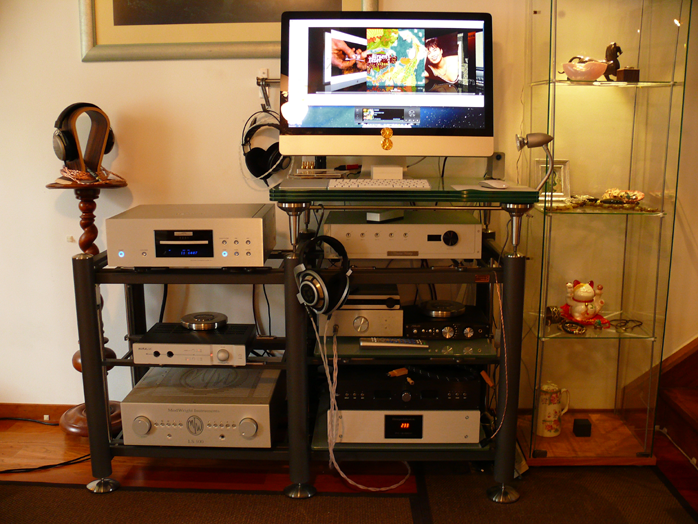 |
NWO-M (with Audiophilleo 2 off Bakoon battery), AURALiC Taurus
|
As two apples fallen off the Putzeys tree, the delta between Merak and Atsah predictably was a lot smaller. Both assumed a counterpoint position to the Korean integrated. They were quicker, more lit up all over, more incisive, in higher front-to-back-and-everywhere-between relief, more resolved and more energetically charged. Where they differed was by degree. The Ncore monos—stock Hypex tucked into very fancy casings—were the most illuminated, lit, unconcealed or shadow-less. They best matched the opposite polarity of the Lithuanian Rhapsody speakers. My customary Aries Cerat Gladius loads its 12-inch Fostex woofer into a far smaller sealed air volume. Then it's augmented on top by a Raal ribbon to be inherently tauter, faster and leaner than the generous slightly underdamped dual-woofer dual-port bass alignment of the AudioSolutions speaker. This shifted my priorities.
|
|
|
|
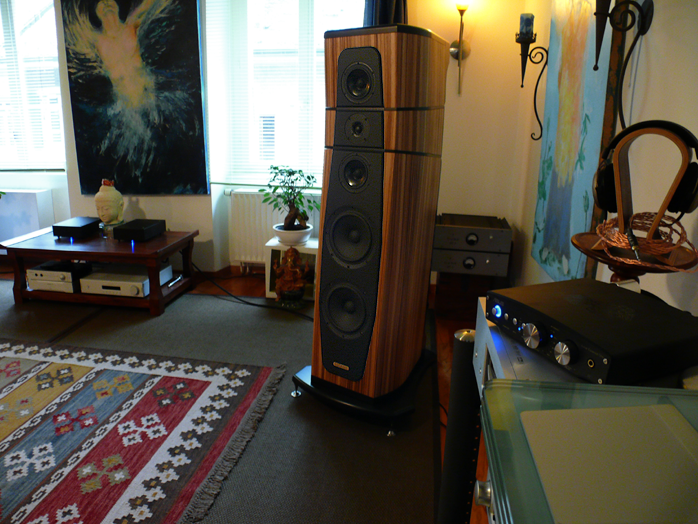 |
Rhapsody 200 driven by Atsah monos fronted by Asus DAC
|
 |
To build out a bit more textural density for the Gladius in fond remembrance of the just-departed Rhapsody meant that the Atsah monos now wanted my valve-buffered NWO-M DAC where the Lithuanians had had all the body I wanted with the $899 Asus Xonar Essence Muses Edition DAC in amp-direct mode. With the Merak monos splitting the difference though being far closer to the Atsah than Ai700, for the Gladius speakers I could revert to my usual Eximus DP-1 DAC. This again meant balanced DAC-direct drive to eliminate the costly NWO-M whose lack of volume control mandates a preamp.
|
|
|
|
|
|
Did this litany of gear have you lose track? Let's explicate. To some the prospect of 'digital' amps conjures up lack of tone to fret about what type of valve preamp counteractions might be required. Here the Merak is toneful all by itself. Unless your speakers need an extra boost—perhaps because they're teutonically bright—you needn't uncork any glass bottles. It's cheers going transistors all the way. With these amps there's dense detail and detail density. The soundstage is chock-a-block with musical detail. Unlike with earlier class D, this detail isn't edge-rimmed, bright or hyper focused however. It's undeniably there and is so en masse. But now it simply coexists with material gravitas. Call it the heaviness of substance. It's no longer a sharp-toothed piranha swarm in a feeding frenzy. It's a benign school of bigger fish passing by stately. This means edginess and subliminal agitation are gone.
|
|
|
|
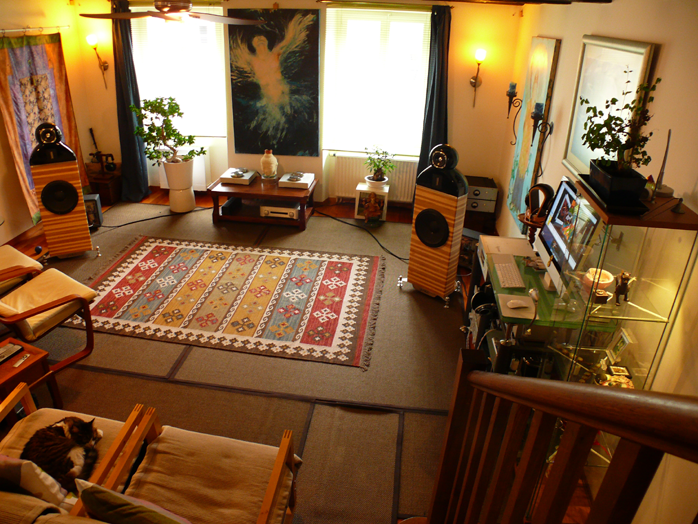 |
Aries Cerat Gladius driven either DAC-direct (Eximus) or NWO-M via Taurus preamp
|
As playback levels increase, this heaviness increases in lockstep. Because detail capture is immense, high volumes create a particular intensity. This can get nearly oppressive by how much virtual space it occupies. That's key with this amp as it was for its nearly twice-priced Atsah relative. It's what's different from my low-power class A FirstWatt amps or class AB Bakoon AMP-11R.
Those are still more illuminated from within, more aerated and thus translucent. They also have the more effervescent top end. In that sense they're lithe-ankled ballerinas, not stout farm girls. Their damping factors are lower too. Perhaps as we ascend in frequency, less damping means more elasticity and liberty to ring out?
|
|
|
| |
|
 |
Flexibility. AURALiC's clever input transformers meant no ground loops. Unlike with the Atsah monos I could fearlessly use my Nagra/Neutrik XLR/RCA adapters and run RCA cable with non-XLR'd preamps like the 12AU7-based Concert Fidelity and Bent Audio; or the RCA outputs of my ModWright and Esoteric without any noise. That said DAC-direct drive did have the edge in directness even over the €24.000 Japanese reader loaner. Finding a DAC with proper volume control (preferably analog to maintain resolution when playing very low levels) plus a legible readout to enable precise repetitions could thus be the next to-do item for a Merak shopper. Here AURALiC's own Vega would seem custom-made, its 32-bit 1.5MHz upsampling protocol a possible antidote to prior limitations of digital attenuation.
|
|
|
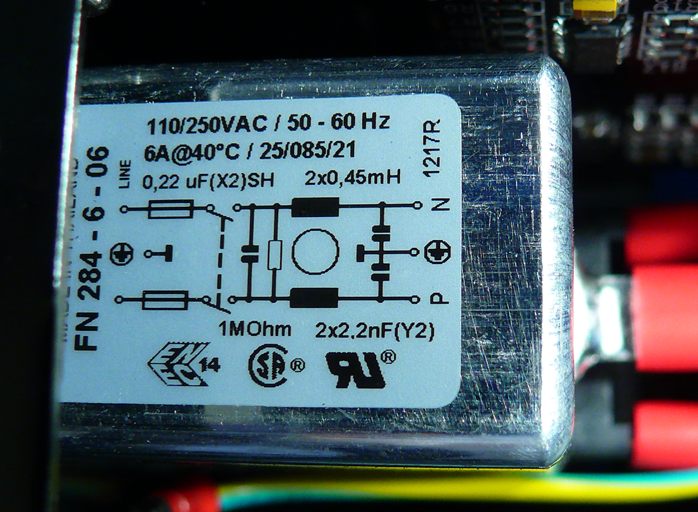 |
built-in PurePower AC filter
|
 |
In these mostly digital days—for many listeners analog sources are already passé —the elimination of a preamp has become very viable. Naturally this dumps whatever additive virtues a preamp previously handled onto one's amp and/or source. It thus relies on circuits like the Merak to be tonally complete. Now the search is on for an input signal of the highest quality. With a noise rating of <50uV, here these powerful Asian monos won't throw away resolution. That's king on ultra-complex rhythmic fare like a quartet of cracker-jack Turkish darbuka hand percussionists establishing densely interweaving tattoos of staccato salvos whilst instrumental and vocal contributors surround them like ornate Arab lettering tendrils. Doing the magic with the typical girl singer on the piano is child's play by comparison (and exactly why that type of fare dominates trade-show demos).
|
|
Rating. Whilst the Meraks gave up a sprinkling of lucidity to the Ncore amps, they countered with far superior value; immunity to ground loops for broader interfacing with non-balanced drivers; and a slightly more relaxed take. The Ncores had the more incisive bite which, all men on deck, can be bloody exhilarating. Equally it's higher maintenance when recording quality declines or ancillaries aren't up to it. Again, by splitting the difference between April Music's ICEpower and Acoustic Imagery's Ncore sound—in the middle of the half closer to the latter—the Merak monos exhibited a near ideal balance of minor warmth with stupendous detail density. Be it Ulrich Herkenhoff whistling his pan flute in the very top register to loosen dental fillings; the Balkan Messengers ripping through high-speed Bulgarian odd-metered rutchenitzas to pester your nerves; brightly recorded bubble-gum shaabi from Cairo for great vocals but bitchy sonics; equally forward Cuban brass screams; a massive steel-drum orchestra from Trinidad clanging away; Claude Chalhoub and his all-string orchestra doing massed spiccato mic'd closely; or other really challenging stuff... the Meraks had me neither flinch nor yawn.
|
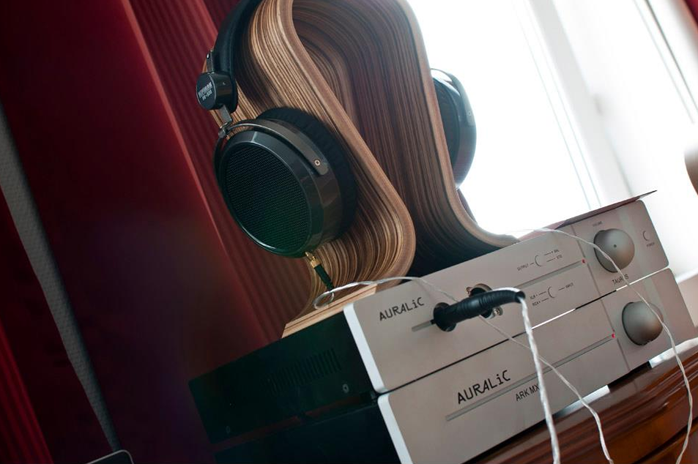 |
AURALiC's Taurus and ARK MX+ at the Horton Hifi Show in Norway
|
Once you think about it, that's the master trick. We all want maximum emotional excitement but not relentlessness. Ratcheting up adrenaline factor with hornspeaker dynamics can get trying. It's why their usual remedy is valves. We want tonal weightiness to escape being surrounded by spectral electrostatic ghosts. Yet we don't want a quagmire of stickiness that renders physicality into artery-clogging taffy. How to negotiate the path with equal attention on both halves is the audiophile conundrum. When it comes to low-power amps and the speakers suitable to them, class A's special handling of the top end—tintinnabulation—and harmonic richness still has the advantage in my SIT1 monos from Nelson Pass. Once we get to speakers that require more power and damping however (the latter would apply to nearly all ported designs), class A quickly escalates on cost, size and heat dissipation.
|
| Combo appeal. That's where class D done right comes to the rescue. It runs 24/7 cool yet with humdinger power. It has ultra-low output
impedance to 'get a grip' or 'come to terms' with the usual speakers. Then it adds utter freedom from noise whilst transcending the usual turbo lag of legacy muscle amps which didn't sound good at low levels. Finally there's compact physical size. It's a winning combination of virtues class A can't match. Yet AURALiC's Meraks are all that and priced competitively. Finally their linear power supplies won't have you worried about yet another in-house radiator of HF noise never mind whether it's audible. Health issues factor too. In my book less ultrasonic radiation is always preferable to more. |
|
|
|
|
|
|
I don't know what AURALiC have done to achieve their documented reduction of higher-order THD. Its presence in the first place (one assumes) is due to copious negative feedback inside the Hypex module. But this is an example for where measurements correlate directly with subjective perception. AURALiC's take on class D plainly achieves a more relaxed flow without sacrificing raw detail acuity. The striated wiriness I remember from earlier NuForce Reference amp is gone. I in fact doubt seriously that anyone would/could peg these as class D by just listening. This really is the next chapter similar to how Scott Berry's DAC 1543 under the CAD label combines no-oversampling no-filtering analogue virtues with 176.4kHz data processing, the very latest in power supplies and 16 paralleled chips to take USB DACs to the next level.
|
 |
By intellectual makeup I'm generally predisposed against high-power amps. I find their justification dubious when the speakers are selected smartly to render them redundant.
That said, the speaker market is dominated by designs which benefit from them. The ongoing appeal of small boxes with extended bass says it all. Since this appeal is very real—what average household wants monkey coffins—a high-fidelity amp solution for still sane coin is needed. That's AURALiC's Meraks. That they play it backwards too to enfold speakers fully coming on song with 5 watts is an extra bonus for contrarians like myself. There's absolutely nothing lumbering about these silvery low riders. A quick romp through Romane & Stochelo Rosenberg's Tribulations with some Grappelli-esque Jazz violin demonstrates that in a heartbeat. It's all très swingé in fact, light on its feet like a dancer. |
|
Conclusion. Street-legal muscle car with sedan comforts, brilliant handling, winning speed and zero noise emissions all for a Honda sticker. It's basic but fitting. In audiophile lingo it's modern high-resolution sound with just the right underpinnings of analog vintage virtues. Considering the two high-performance competitors covered above, my nod for ultimate value & performance falls on today's AURALiC Merak. Of higher fidelity than the ICEpower integrated, not quite as brilliant but uncomfortably close to the Ncore equivalents which sell for nearly twice the coin, the $5.000/pr Meraks have simply nailed that most attractive balance of them all... |
 |
 |
 |
|
 |