This review page is supported in part by the sponsors whose ad banners are displayed below |
 |
 |
|
 |
Reviewer: Srajan Ebaen
Financial Interests: click here
Source: 27" iMac (3.4GHz quad-core IntelCore i7, 16GB 1.333MHz RAM, 2TB hard disc, 256GB SSD drive, ADM Radeon HD 6970M with 2GB of GDDR5 memory); PureMusic 1.87; Amarra 2.3; Audirvana Plus 1.2.1; April Music Eximus DP1; Antelope Audio Zodiac Gold & Voltikus; Weiss DAC2; Esoteric/APL Hifi UX1/NWO-M; Audiophilleo 2
Preamp/Integrated: Esoteric C-03, ModWright LS100, Bent Audio Tap X
Amplifier: ModWright KWA 100-SE, FirstWatt SIT2, Trafomatic Audio Kaivalya
Speakers: Aries Cerat Gladius
Cables: Complete loom of Zu Audio Event, Entreq & Ocellia USB cables, Stereolab Tombo Trøn coax BNC/BNC
Stands: 2 x ASI HeartSong 3-tier, 2 x ASI HeartSong amp stand
Powerline conditioning: 1 x GigaWatt PF2, 1 x Furutech RTP-6
Sundry accessories: Extensive use of Acoustic System Resonators, noise filters and phase inverters
Room size: 5m x 11.5m W x D, 2.6m ceiling with exposed wooden cross beams every 60cm, plaster over brick walls, suspended wood floor with Tatami-type throw rugs. The listening space opens into the second storey via a staircase and the kitchen/dining room are behind the main listening chair. The latter is thus positioned in the middle of this open floor plan without the usual nearby back wall.
Review component: $19.000
|
 |
23 December 2011 00:45. "I’d like to introduce myself. My name is Adriano. I’m an audio designer and member of the AES Audio Engineering Society. I would like to share my story with you. It’s been almost 9 years now since I first listened to the Brazilian Audiopax Model 88 amplifier. I must confess to feeling choked by how close it was to live music. I thus decided to become an audio designer like Mr. Eduardo de Lima. He and I are close friends now.
After years of research and investigation I showed him my hand papers in 2008. Now it was his turn to be amazed. He acknowledged that it was the first time he'd met someone who had developed different mathematical expressions and models only to arrive at the same deeper understanding. After that discovery we grew closer than ever but by 2009 I radically modified my focus when analog class D amplification piqued my attention. I can now claim the world’s first fully hybrid analog class A/D topology. It would be a honor if I could get this Audrilabs Novachord reviewed. I believe we have something new and really good. While Audrilabs is a new audiophile company, we’re very serious. You can check our youtube promo video which I made for the upcoming CES show in Las Vegas." - Adriano Franco Vecino
|
 |
|
|
|
27 February 2012 17:08. "I read your last review on class D amplification two weeks ago. Thanks for mentioning us. I’ve read a lot about Devialet and can assure you that there is no conflict. When I say hybrid class A/D, I’m using the word 'hybrid' in a fashionable way. I’m talking about tubes! I’ll tell you more about this topology and my way of thinking about high-end circuits while I’m designing them.
I believe there is no obsolete technology, just the right technology in the right place. In my projects you will find tubes, bipolar junction transistors, field effect transistors, class A operation and analog class D operation. My Audrilabs Novachord is an integrated amplifier based on a hybrid preamp running in class A. This preamp drives an analog class D power stage. The classic 6H30Pi Russian twin triode is my tube of choice because you can work with very low resistor values in the signal path. This design is free of global negative feedback and there’s only very little local negative feedback. I put two mono preamplifiers and two power amplifiers into one chassis.
|
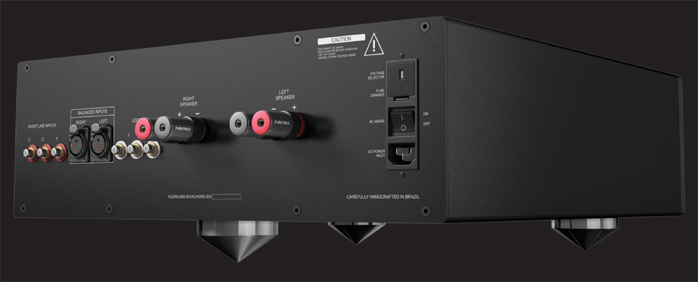 |
"It’s funny how our listening tests challenge certain engineering rules. When we think about class D operation, the first word to mind is efficiency - typically something around 90% to 95%. It means that I could use a switching power supply instead of a classic linear power supply with large bulk capacitors. Tests however showed us another reality. That’s why I only use linear regulated power supplies. Inside the Novachord there are four toroidal transformers. The power stage is fed by a huge 1.4KVA power toroid with a 88.000µF capacitor bank to generate 500 watts into 4Ω. Each preamplifier channel with its multi-layer circuit board has its own toroidal power transformer and separate power supply. The fourth transformer feeds the LCD, touch-screen management micro controller and tube heater supplies. The chassis structures were designed on software such as AutoCAD, Catia V5 and MasterCAM as used by the aircraft and automobile industries. I developed this amplifier to join that group of top integrated amplifiers which includes the Goldmund Telos 390.2, darTZeel CHT-8550, Vitus Audio SIA-25 and Devialet D-Premier.
"I tell you another detail about my preamp section. Volume attenuation is via a DACT 24-position stepper attenuator. I developed an optical encoder feedback circuit to turn its shaft when our infrared sensor receives instructions from the remote control. It’s still rare to find high-end equipment with DACT controls and I know why. Unfortunately Elma's rotary switches have a step angle that makes it impossible for standard motors.
7.5° and 3.75° stepper motors simply go off the charts. In my opinion only 1.8° and 0.9° stepper motors are fit for the job. I did have some problems with my current supplier but am now importing a new 0.9° motor that was originally designed for medical instruments and Telescope positioning systems."
|
|
|
|
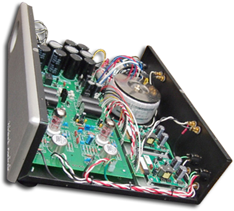 |
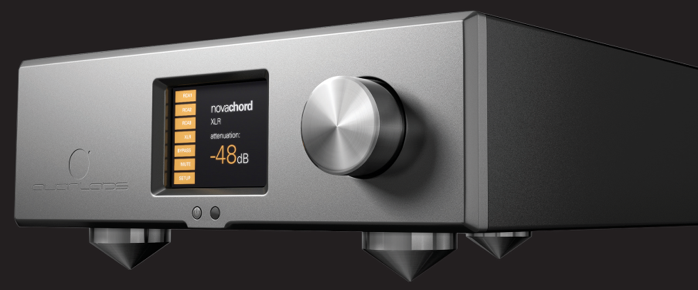
With its orange/black touch screen for input/bypass/setup selection and that lone multi-function master control, the Novachord presents an exceptionally tidy and modern face to the world. With 3+1 RCA+XLR inputs and one pair of top-quality Furutech speaker terminals, the business end is equally orderly. Power specs are a stout 220/500w into 8/4Ω. Peak output current is 46A. Claimed frequency response is 4Hz to 60kHz ±3dB. Damping factor is 1.500 @ 1kHz. Dimensions are 480 x 474 x 154 DxWxH.
At CES 2012 Mark O'Brien of Rogue Audio had announced the Hypex-based Medusa and Hydra hybrid tube/D-class amps [left]. With each chord needing at least three notes, the Audrilabs Novachord still managed to strike a new one* particularly given its ne plus ultra ambitions. |
|
|
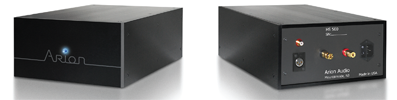
Further googling on the subject netted the $5.995/pr Arion Audio Harmony Series HS-500 monos. They combine a 6H30 voltage gain stage with a 500/1.000W into 8/4Ω switching power stage. Veloce Audio had a 400-watt amp on DC power announced. Still tube/class D hybrids are rare and pioneer Red Wine Audio recently vacated the sector in favor of class A/B outputs. |
|
|
________________________________________
* With tube component veterans Audio Research and Cary Audio promoting class D power for their now mixed catalogues, it's surprising that it took newcomer Audrilabs to propose a no-compromise switching output stage preceded by valves. While at least theoretically the idea holds a lot of appeal, commercial realizations are mostly absent. Should that suggest that the appeal is merely theoretical; or that successful implementation is unusually tricky?
Mike Kalellis of Arion had his own view on the subject: "Building an excellent sounding amplifier no matter what class or output device type requires a valid design, proper implementation and careful attention to details. Most designers who bad-mouth class D amplifiers have no idea how to design one and feel threatened. Many class D amps are simply a standard xxx board in a box. We use a proprietary design. Our switching power supply is designed specifically for our application and the 'tube front end' is powered by a completely independent power supply. We spent countless hours on isolation, parts placement and parts selection. We have been selling our hybrids for over two years and have replaced amps from Audio Research, Pass Labs, BAT, Joule Electra and some tube amps I never heard of."
|
|
 |
|
 |
|