This review page is supported in part by the sponsors whose ad banners are displayed below |
 |
 |
|
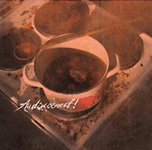 |
Now I imagine a gent with a greasy leather jacket in the back row shifting agitated in his seats. He wonders whether the Arpège can rock out. Yep, it can. I call the Dresden formation Audiocaeneat to the witness stand. I first met them as surprise opener for I Like Trains in Berlin’s Magnet Club. Adiocaeneat sounds like what happens when you lock up early Marillion, My bloody Valentine, Mogwai and a crack pipe in a studio room with the alert that the doors won’t open again until they have recorded six songs. "Calypso" is the second number on The Red Sessions albums which early on lives on nervous pickings, later pressurized percussion and finally brutally cleansing distorted guitar thunder and crash cymbals on eights. Here the Arpège’s depth mining surprised. The production is somewhat raw to leave plenty of space for the sub bass. The French valve amp exploited this without losing its composure, something the earlier songs didn’t indicate since they lacked this level of LF heaviness. With this crossed off too, wasn’t there anything to complain about? |
|
|
|
|
Little really. It needs saying that at idle the Arpège wasn’t 100% silent. The tweeter on my PSB Synchrony One floorstander with 90dB/W/m exhibited a faintly pulsating rush whose amplitude strangely lowered with the volume control toward 13:00. To hear this demanded close proximity and became inaudible at half a meter. There also was minor cross bleed between the four line-level inputs. Compared to price-matched sand amps the Arpège’s depth layering was not as stringently sorted and precise. Finally it didn’t cotton to disco by which I mean attack-heavy over-produced biting danceable sounds which today go by the misleading R&B label like Destiny’s Child & Co. Here one would want for more potent upper bass and an uglier faster super-angular demeanour. For that the Arpège’s upbringing must have been too genteel.
|
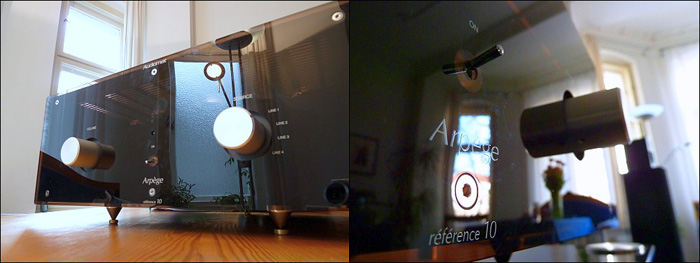 |
Were I asked for greater context relative to clichés on valves versus silicon I’d go for the middle. The negative excesses of airiness and bloom aren't the case and tonal balance is even. But I also noticed that control over the loudspeakers wasn't as dominant as it is with many a transistor amp. Clearly though the amp handled nearly all genres and its colorful way with the tunes invited me to rediscover the resident music collection.
|
|
|
Conclusion: Audiomat’s Arpège particularly delights with a wealth of detail and midrange sophistication, a gorgeous long-haul listenability, a lean but very extended bass, tactile material quality and immaculate execution. The money here buys a lot.
The Audiomat Arpège Reference 10 is characterized by:
- bass that’s lean, bouncy and fast rather than opulent but which cleanly extends to the bottom.
- a midrange that’s exceptionally colorful, detailed and articulated.
- a neutral top end that’s more lit up than silkily shaded.
- a good approximation of the oft-cited holographic playback.
- good but not spectacular depth layering. Horizontal separation meanwhile is very believable with a tendency for good spacing between performers.
- good macro dynamics for a valve amp but highly angular club fare incurs some demerits.
- microdynamics which are top of the class in this price range. Attacks and decays are realistically convincing and richly detailed.
Facts:
- Concept: Tube integrated
- Dimensions and weight: 44.5 x 18 x 38cm (WxHxD), 25kg
- Trim: Black
- I/o ports: 4 x RCA in, 3 x RCA fixed out, 4/8-ohm terminals
- Other: Remote control over volume
- Power consumption: Ca. 150 watts at idle, no standby
- Warranty: 2 years
|
|
|
 |
|
 |
